
Logo

American Heart Association

  121
  0


Final ID: WP255

Visual Tools for Informed Decision-Making in Large Core Thrombectomy for Acute Ischemic Stroke

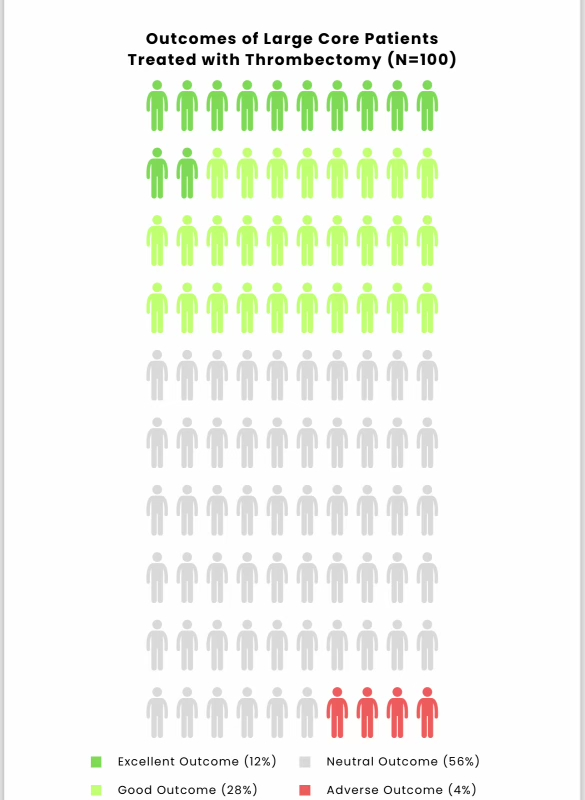
Abstract Body: Introduction: Several recent randomized clinical trials have demonstrated that EVT can improve functional outcomes and decrease mortality in patients with large ischemic cores. Despite these landmark findings, hyperacute decision-making in large core acute ischemic stroke (AIS) remains complex as these patients still experience high rates of disability and mortality. This study aimed to develop a visual decision aid to help patients and families understand the potential benefits and risks of EVT in large core AIS, facilitating more informed and timely decision-making.
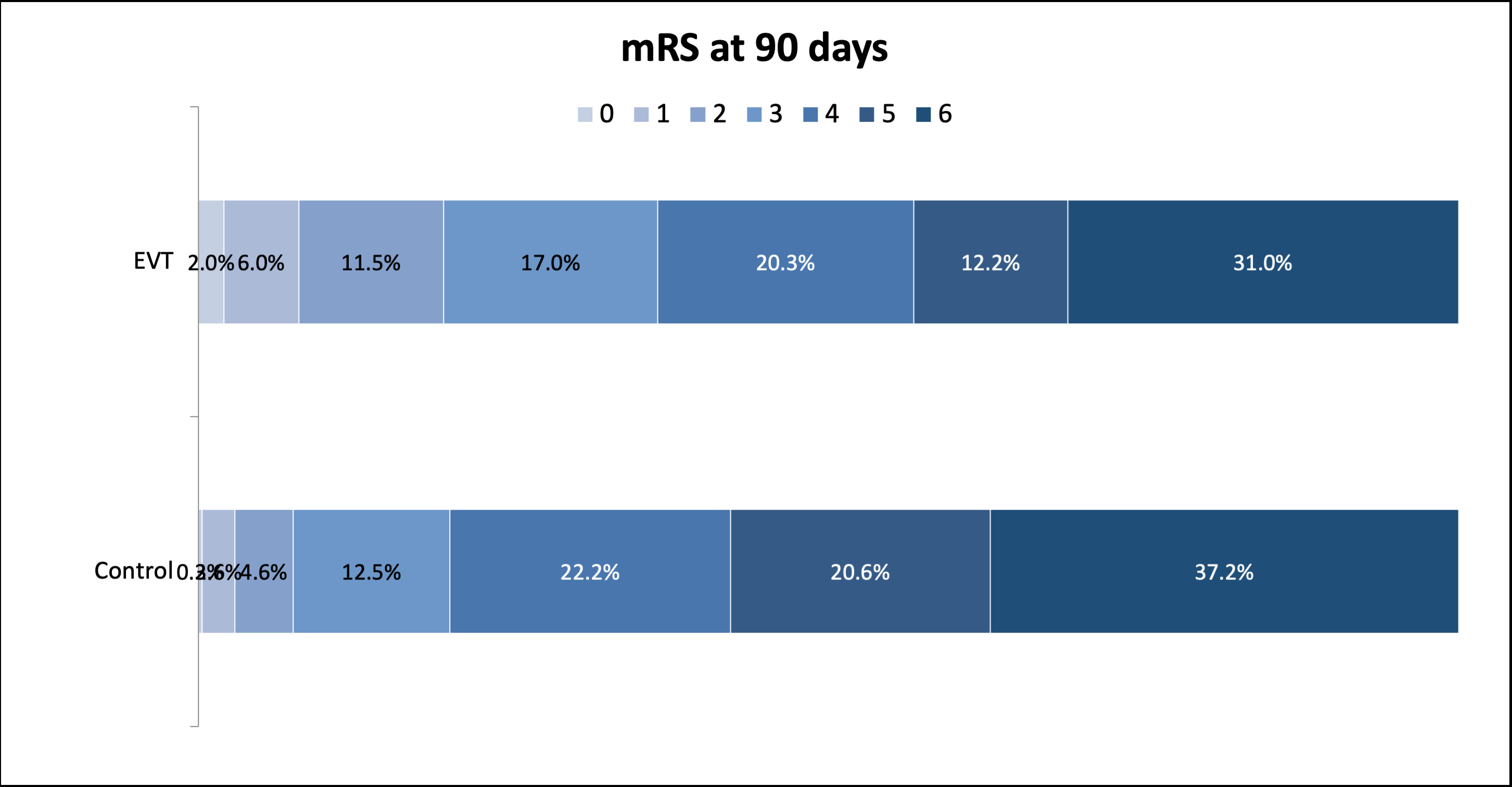
Methods: Data from six pivotal trials were pooled to evaluate the global disability outcome distributions based on the 90-day modified Rankin Scale (mRS) for patients undergoing EVT versus medical management. A visual decision tool was created using Kuiper-Marshall personographs to represent these outcomes as icon arrays. Calculations for benefit per hundred (BPH) and harm per hundred (HPH) were performed, factoring in rates of symptomatic intracranial hemorrhage (sICH) and decompressive hemicraniectomy. Net benefit was derived by subtracting HPH from BPH. The visual aid employs color-coded shifts in mRS scores to communicate risks and benefits clearly to patients and their families.
Results: Pooled analysis demonstrated that 2.0% of patients in the EVT group achieved an mRS of 0 compared to 0.3% in the control group. Similarly, higher rates of mRS 1 (6.0% vs. 2.6%), mRS 2 (11.5% vs. 4.6%), and mRS 3 (17.0% vs. 12.5%) were observed in the EVT group compared to the control. Patients in the EVT group also had lower rates of severe disability and death (mRS 4-6), with 31.0% achieving mRS 6 (death) compared to 37.2% in the control group. sICH occurred at a rate of 5.5% in the EVT group versus 3.2% in the control group. Excess treatment harm, combining sICH and hemicraniectomy, was calculated at 4%. Using these pooled data, the BPH for EVT was calculated at 36.1%.
Conclusions: This study highlights the therapeutic potential of EVT in reducing disability and improving functional outcomes for patients with large core AIS. The visual decision aid developed in this study aims to simplify communication of risks and benefits of EVT to patients and their families. By providing a clear, visual representation of potential outcomes, this tool enables better-informed, patient-centered decision-making in emergency settings, ultimately improving care and aligning expectations for all stakeholders.
  • Mehta, Amol  ( Mount Sinai Icahn School of Medicine , New York , New York , United States )
  • Goel, Nupur  ( Massachussets General Hospital , Boston , Massachusetts , United States )
  • Brown, Scott  ( BRIGHT Research Partners , Mooresville , North Carolina , United States )
  • Desai, Shashvat  ( HonorHealth , Phoenix , Arizona , United States )
  • Jadhav, Ashutosh  ( Barrow Neurological Institute , Phoenix , Arizona , United States )
  • Author Disclosures:
    Amol Mehta: DO NOT have relevant financial relationships | Nupur Goel: DO NOT have relevant financial relationships | Scott Brown: No Answer | Shashvat Desai: DO NOT have relevant financial relationships | Ashutosh Jadhav: No Answer
Meeting Info:
Session Info:

Neuroendovascular Posters I

Wednesday, 02/05/2025 , 07:00PM - 07:30PM

Poster Abstract Session

More abstracts on this topic:
Association of Automated Anatomical Vascular Measurements and Procedural Outcomes in Patients undergoing Endovascular Treatment of Stroke

Sastre Blanca, Canals Pere, Garcia-tornel Garcia-camba Alvaro, Ribo Marc

Acute intracranial stenting among patients with large vessel occlusion: Clinical and radiological outcomes of the RESISTANT International registry

Requena Manuel, Lopez-frias Alfonso, Hassan Ameer, Miller Samantha, Zapata-arriaza Elena, De Alboniga-chindurza Asier, Bergui Mauro, Molinaro Stefano, Sousa Joao Andre, Gomes Fábio, Alexandre Andrea, Olive-gadea Marta, Pedicelli Alessandro, Hofmeister Jeremy, Machi Paolo, Scarcia Luca, Kalsoum Erwah, Meira Torcato, Amorim José, Ortega-gutierrez Santiago, Rodriguez Aaron, Capasso Francesco, Kaesmacher Johannes, Renieri Leonardo, Romano Daniele, Barcena Eduardo, Abdalkader Mohamad, Perry Da Camara Catarina, Yavagal Dileep, Vega Pedro, Ozdemir Atilla Ozcan, Smajda Stanislas, Khalife Jane, Mujanovic Adnan, Biraschi Francesco, Castro Pedro, Siddiqui Adnan, Navia Pedro, Ntoulias Nikolaos, Velo Mariano, Zamarro Joaquin, Zaidat Osama, Sierra-gomez Alicia, Marto Joao Pedro, Geyik Serdar, Tomasello Alejandro, Senadim Songul, Cervo Amedeo, Salcuni Andrea, Moreu Manuel

More abstracts from these authors:
You have to be authorized to contact abstract author. Please, Login
Not Available

Readers' Comments

We encourage you to enter the discussion by posting your comments and questions below.

Presenters will be notified of your post so that they can respond as appropriate.

This discussion platform is provided to foster engagement, and simulate conversation and knowledge sharing.


You have to be authorized to post a comment. Please, Login or Signup.


   Rate this abstract  (Maximum characters: 500)