
Logo

American Heart Association

  172
  0


Final ID: WP256

Cognitive Outcomes in Acute Ischemic Stroke with Large Vessel Occlusion After Treatment with Endovascular Thrombectomy with and without Intravenous Thrombolysis

Abstract Body: Introduction: In acute stroke patients who receive revascularization with endovascular thrombectomy (EVT) alone vs intravenous thrombolysis (IVT) followed by EVT, combination treatment has shown improved outcomes measured by the modified Rankin Scale (mRS). However, neurocognitive outcomes beyond functional disability have not been sufficiently assessed.
Hypothesis: We hypothesize that neurocognitive outcomes will be improved with IVT + EVT compared to EVT alone.
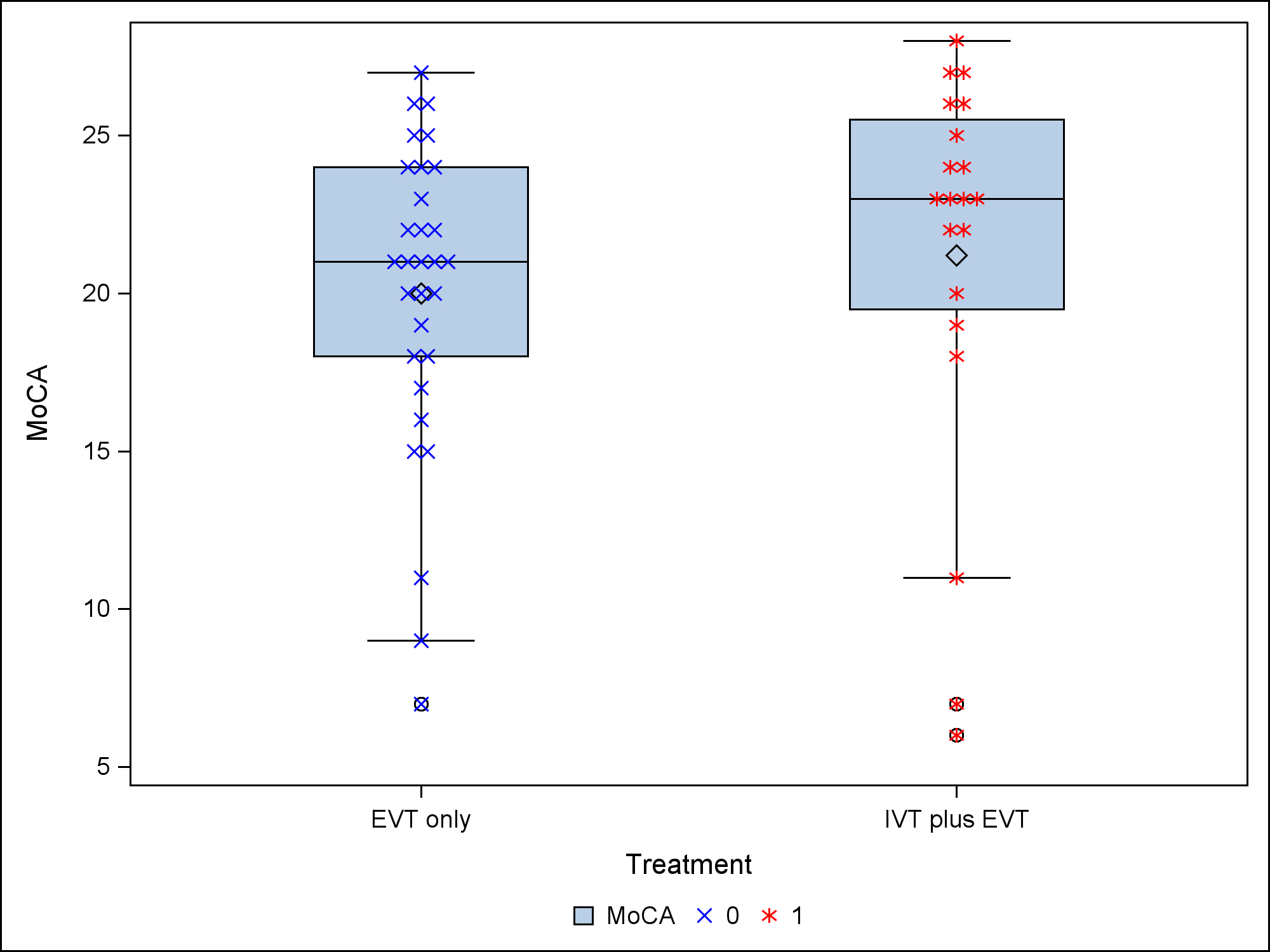
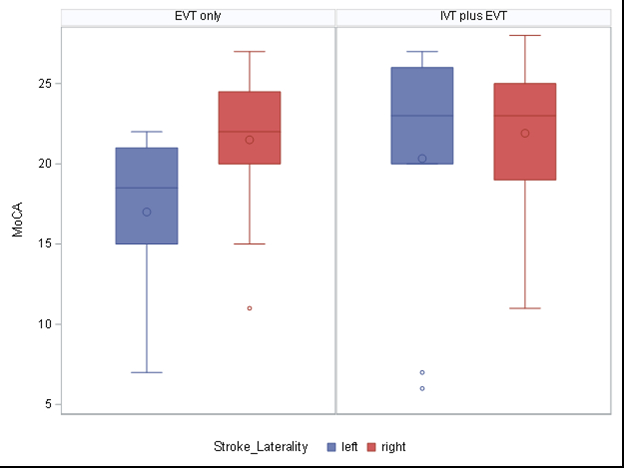
Methods: This prospective ongoing longitudinal study included patients with a first-ever ischemic stroke with large vessel occlusions admitted to our comprehensive stroke center who received EVT only vs IVT + EVT. Blinded investigators administered the Montreal Cognitive Assessment (MoCA) during the hospital stay. A linear model was used to estimate the difference in MoCA scores between the two treatment groups while adjusting for age, NIHSS obtained within 24 hours of MoCA, and pre-stroke mRS. A visual inspection of residuals was performed to check model assumptions. Box plots were utilized to compare MoCA differences across treatment groups, NIHSS scores, and stroke laterality.
Results: 50 participants had a mean age of 66.7 years (64% male). The mean post treatment NIHSS was 3.6, and the mean MoCA score was 20.5. The adjusted difference in MoCA scores between the treatment groups (IVT + EVT vs EVT only) was 0.83 points (95% CI –2.4 - 4.0), indicating no statistically significant difference. Higher NIHSS showed a trend toward negative association with MoCA scores, –0.41 (CI –0.90 - 0.07). For right sided strokes, there was minimal difference between treatment groups. However, for left sided strokes, there was a trend towards improved mean MoCA in the IVT + EVT group (20.3; CI 20.0 - 26.0) compared to EVT only (17.0; CI 15.0 - 21.0). The TICI revascularization score of 2c had the highest mean MoCA (22.1; CI 19.4 - 24.8), followed by TICI score of 3 (20.7; CI 18.9 - 22.7) and then 2b (16.6; CI 9.0 - 24.1).
Conclusion: There was no significant difference of MoCA with combination treatment vs EVT alone, but there was a trend showing improvement in combination treatment for left-sided strokes. There was also a trend showing decreased MoCA with higher NIHSS. We are currently assessing neurocognitive outcomes with a larger sample size post treatment and at 6 months post-stroke.
  • San, Ali  ( University of Kansas Medical Center , Kansas City , Missouri , United States )
  • Sanchez-crawford, Cesar  ( University of Kansas Medical Center , Kansas City , Kansas , United States )
  • Panico, Nicholas  ( Lake Erie College of Osteopathic Medicine , Erie , Pennsylvania , United States )
  • Hunt, Suzanne  ( University of Kansas Medical Center , Kansas City , Kansas , United States )
  • Yoksh, Lauren  ( University of Kansas Medical Center , Kansas City , Kansas , United States )
  • Mahnken, Jonathan  ( University of Kansas Medical Center , Kansas City , Kansas , United States )
  • Abraham, Michael  ( UNIVERSITY OF KANSAS HOSPITAL , Kansas City , Missouri , United States )
  • Slavin, Sabreena  ( University of Kansas Medical Center , Kansas City , Missouri , United States )
  • Author Disclosures:
    Ali San: DO NOT have relevant financial relationships | Cesar Sanchez-Crawford: DO NOT have relevant financial relationships | Nicholas Panico: DO NOT have relevant financial relationships | Suzanne Hunt: DO NOT have relevant financial relationships | Lauren Yoksh: DO NOT have relevant financial relationships | Jonathan Mahnken: No Answer | Michael Abraham: DO have relevant financial relationships ; Consultant:Stryker Neurovascular:Active (exists now) ; Consultant:Q'Apel Medical:Active (exists now) | Sabreena Slavin: DO NOT have relevant financial relationships
Meeting Info:
Session Info:

Neuroendovascular Posters I

Wednesday, 02/05/2025 , 07:00PM - 07:30PM

Poster Abstract Session

More abstracts on this topic:
Association Between Computed Tomography Perfusion Parameters and Functional Independence in Acute Ischemic Stroke Post-Endovascular Therapy: A Secondary Analysis from the SELECT Study

Narangoli Adeeb, Sila Cathy, Opaskar Amanda, Xiong Wei, Degeorgia Michael, Duncan Kelsey, Ray Abhishek, Hu Yin, Sunshine Jeffrey, Bambakidis Nicholas, Sarraj Amrou, Yaghmoor Bassam, Pujara Deep, Alshaibi Faisal, Saidi Yazid, Shafiq Ameena, Albedaiwi Mohammed, Al Mostaneer Alhassin, Sundararajan Sophia

ADC-based Infarct Density – Validating a Novel Imaging Biomarker of Functional Outcome after Endovascular Thrombectomy

Favilla Christopher, Bonkhoff Anna, Rost Natalia, Messe Steven, Regenhardt Robert, Denny Braden, Simonsen Claus, Shakibajahromi Banafsheh, Patel Aman, Leslie-mazwi Thabele, Dmytriw Adam, Schirmer Markus

More abstracts from these authors:
Chronic kidney disease testing in patients with hypertension

Ramakrishnan Madhuri, Burns Jeffrey, Gupta Aditi, Supiano Mark, Adomako Emmanuel, Song Xing, Young Kate, Pradeep Kumar Danya, Mahnken Jonathan, Chandaka Sravani, Abu-el-rub Noor

Blood Pressure Variability and Implications for Trial Screening

Song Xing, Burns Jeffrey, Gupta Aditi, Supiano Mark, Conroy Molly, Chandaka Sravani, Abu-el-rub Noor, Young Kate, Mahnken Jonathan, Barlocker Jackson, King Jordan

You have to be authorized to contact abstract author. Please, Login
Not Available

Readers' Comments

We encourage you to enter the discussion by posting your comments and questions below.

Presenters will be notified of your post so that they can respond as appropriate.

This discussion platform is provided to foster engagement, and simulate conversation and knowledge sharing.


You have to be authorized to post a comment. Please, Login or Signup.


   Rate this abstract  (Maximum characters: 500)