Characterization of Clot Composition with Radiomics
Abstract Body: Introduction Approximately 30% of strokes are cryptogenic. Radiomics is a non-invasive imaging tool to analyze images at a voxel-by-voxel level. We correlated the histology of clots from patients with LVO with specific radiomic features, for a better determination of clot composition.
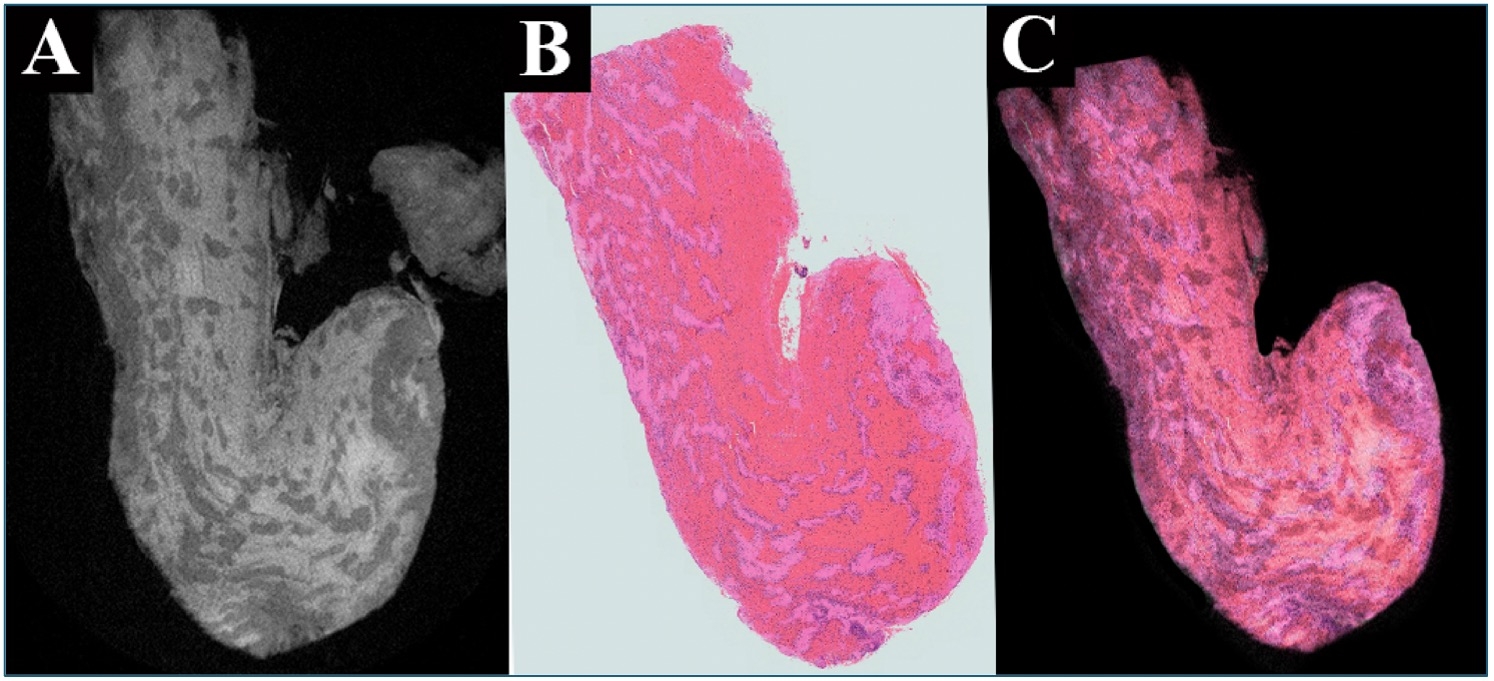
Methods Patients diagnosed with AIS due to LVO between 2019 to 2024 were analyzed. Ten clots retrieved from mechanical thrombectomy were imaged with micro-computed tomography (micro-CT) and histologically analyzed. Radiomic features (RFs) from each clot were extracted and correlated with different clot components. NCCT images were co-registered with the corresponding slices obtained from histology. A larger cohort of 426 patients with NCCT scans obtained at presentation was subsequently analyzed. Clots displaying a hyperdense sign on NCCT were included. Stroke etiology was adjudicated based on the TOAST classification.
Results The analysis of micro-CT showed that total energy (TE), joint average (JA) and large dependence high gray level emphasis (LDHGLE) were specific for red blood cells (RBCs, p<0.001, p 0.003, and p<0.002, respectively). Fibrin’s RFs included minimum (MI) and 10 percentile (p .005, and p<0.001, respectively), and calcium RF’s difference variance (DV, p 0.05).TE, JA and LDHGLE were correlated with clots that had at least 70% RBCs (Rho 0.654 and 0.652, respectively). MI was correlated (Rho 0.795) with clots that had at least >80% of fibrin. The RFs of the NCCT segmentations of these clots revealed strong correlation with corresponding micro-CT values of TE (Rho 0.687) JA (0.809) and LDHGLE (rho 0.657). TE (AUC 0.800, sensitivity 0.750, specificity 0.800, cutoff 38244.3089) and LDHGLE (AUC 0.750, sensitivity 0.750, specificity 0.800, cutoff: 52.64) had significant accuracy for determining clots with higher RBC composition in NCCT. MI (AUC: 0.350, sensitivity: 0.500, specificity: 0.400, cutoff: 32.3) did not have accuracy in the identification of fibrin. A total of 145 of 426 patients had optimal clot visualization on NCCT. Fifty patients had a cardioembolic stroke, 45 LAA and 50 were cryptogenic. RFs for identification of RBCs (> 70%) were present in 60% of cardioembolic, 27% of LAA and 42% cryptogenic strokes.
Conclusion RFs are sensitive and specific to determine clots rich in RBC composition. Cardioembolic clots have higher RBCs compared with LAA and cryptogenic. Radiomic analysis is a novel non-invasive tool of determining stroke etiology.
Gudino, Andres
(
University of Iowa
, Iowa City , Iowa , United States )
Ghannam, Malik
(
University of Iowa
, Iowa City , Iowa , United States )
Sagues, Elena
(
University of Iowa
, Iowa City , Iowa , United States )
Dier, Carlos
(
University of Iowa
, Iowa City , Iowa , United States )
Torres, María Belén
(
University of Iowa
, Iowa City , Iowa , United States )
Garces, Emily
(
University of Iowa
, Iowa City , Iowa , United States )
Ojeda, Diego
(
University of Connecticut
, Hartford , Connecticut , United States )
Saenz, Samantha
(
University of Iowa
, Iowa City , Iowa , United States )
Vargas-sanchez, Ariel
(
University of Iowa
, Iowa City , Iowa , United States )
Samaniego, Edgar
(
University of Iowa
, Iowa City , Iowa , United States )
Author Disclosures:
Andres Gudino:DO NOT have relevant financial relationships
| Edgar Samaniego:DO NOT have relevant financial relationships
| Malik Ghannam:No Answer
| Elena Sagues:No Answer
| Carlos Dier:DO NOT have relevant financial relationships
| María Belén Torres:DO NOT have relevant financial relationships
| Emily Garces:No Answer
| Diego Ojeda:No Answer
| Samantha Saenz:No Answer
| Ariel Vargas-Sanchez:No Answer