
Logo

American Heart Association

  139
  0


Final ID: TMP10

Impact of eicosapentaenoic acids and cilostazol in patients with intracranial arterial disease

Abstract Body: INTRODUCTION: An optimal strategy for the treatment of intracranial atherosclerotic disease (ICAD) has remained unclear, despite medical therapy (antiplatelet therapy and LDL control management) or endovascular therapy (angioplasty or stenting). Recently, cilostazol plus other antiplatelet agents combined therapy (CT) has been reported to reduce recurrent stroke, and eicosapentaenoic acid (EPA) has been reported to reduce the risk of cardiovascular events and plaque progression. Therefore, our hypothesis is that the addition of CT and EPA therapy may reduce stroke recurrence and further regression of stenosis.

METHODS: Patients with symptomatic and asymptomatic intracranial artery stenosis treated and followed at our institution from January 2009 to December 2023 were included in this study: 198 ICAD lesions in 155 patients (mean follow-up 11 months) were retrospectively evaluated. Each patient was divided into antiplatelet therapy alone (AA) (monotherapy (MT) or CT), antiplatelet therapy plus statin (AS), and antiplatelet therapy plus statin and EPA (AE). Antiplatelet drug monotherapy was aspirin, clopidogrel, or prasugrel and combination therapy was any of them plus cilostazol. ICAD was assessed by MRA and the stenosis rate was calculated by the warfarin-aspirin symptomatic intracranial disease (WASID) method.

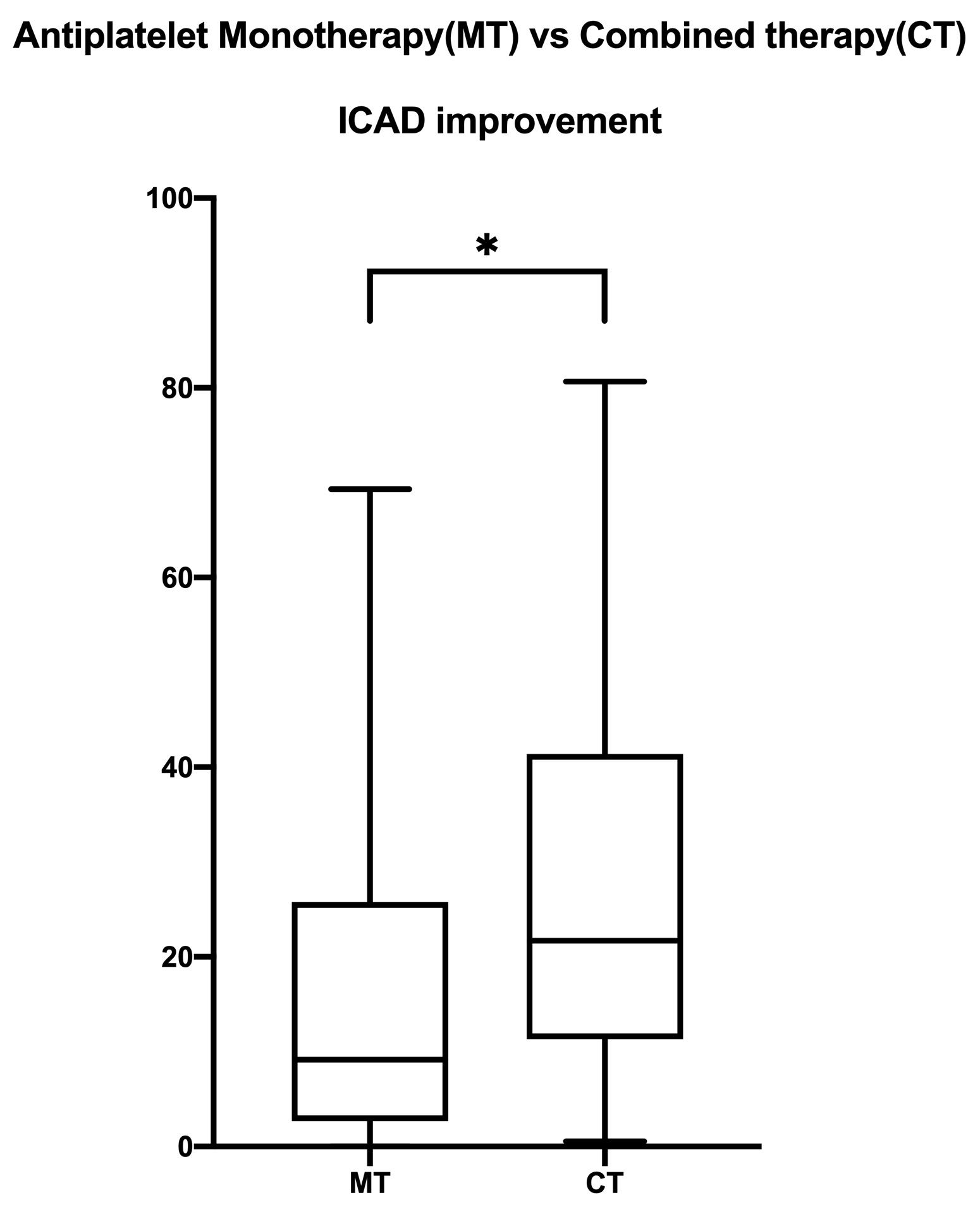
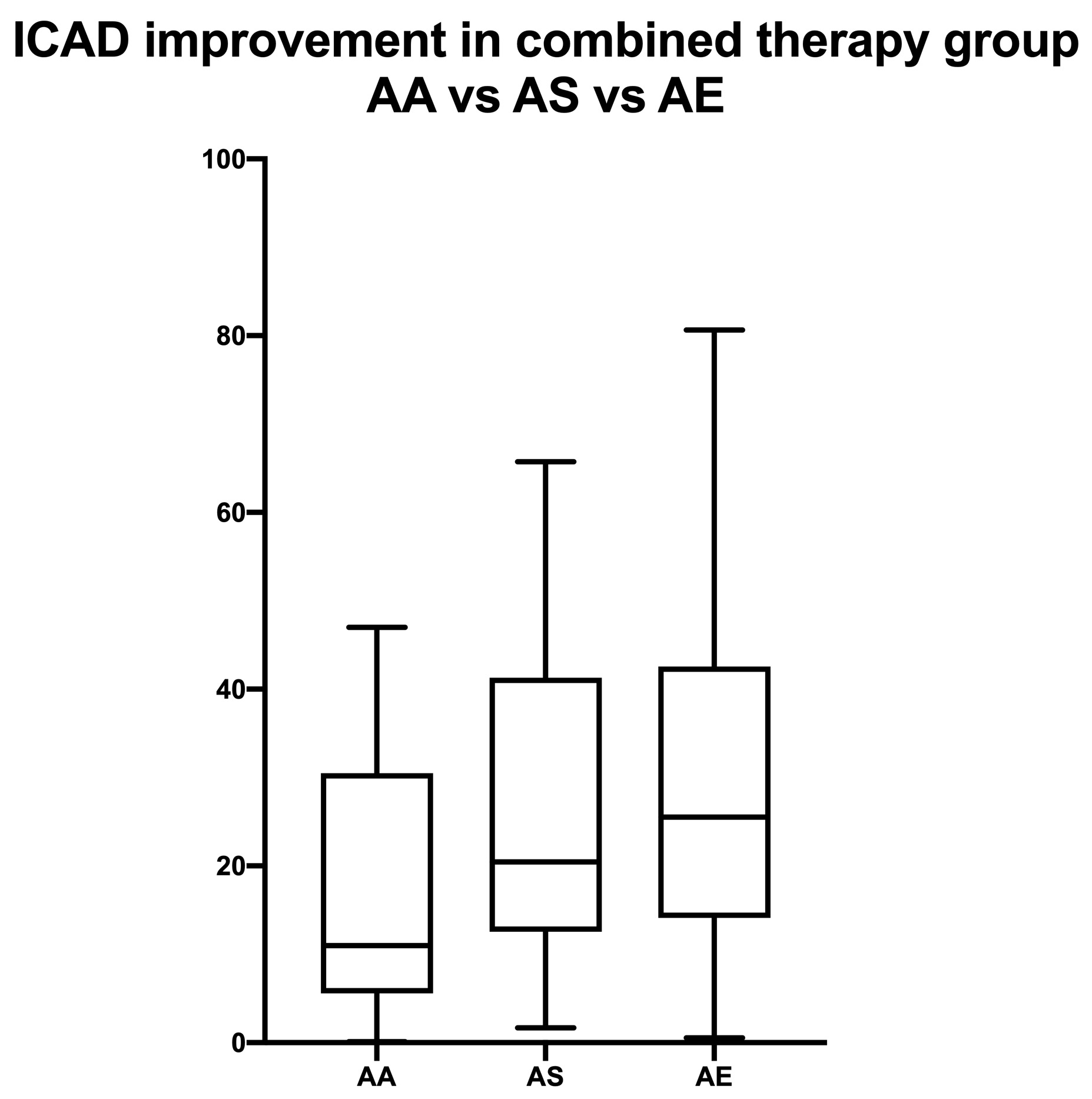
RESULTS: The improvement in stenosis was significantly better with CT than with MT (Median% interquartile range(IQR)= CT: 21.71% (11.33-41.40) vs. MT: 9.15% (2.69-25.78), P<0.0001 Mann-Whitney test). Within the CT group, the AE group showed the greatest improvement in stenosis (Median% (IQR)= AA: 10.95% (5.55-30.45) vs AS: 20.41% (12.54-41.26) vs AE: 25.51% (14.11-42.55), Kruskal-Wallis test p:0.0181), while there were no significant differences between the MT groups (Kruskal-Wallis test p:0.7185). Stroke recurrence rates were 16.2% in the AA group, 13.8% in the AS group, and 5.9% in the AE group, with no significant difference, but a trend toward lower recurrence rates in the AE group was observed; in a comparison of the CT+AE group with the MT+AA group, the CT+AE group had significantly lower recurrence rates than the MT+AA group (Fisher's exact test P: 0.0455).

CONCLUSION: Cilostazol and EPA added to the conventional therapy was associated with less stroke recurrence, and it also showed significant regression in ICAD. Larger studies should investigate the role of cilostazol and EPA in stroke recurrence and plaque regression.
  • Takeishi, Yusuke  ( Matsuyama red cross hospital , Matsuyama , Japan )
  • Watanabe, Yosuke  ( Matsuyama red cross hospital , Matsuyama , Japan )
  • Matsuda, Shingo  ( Hiroshima general hospital , Hatsukaichi , Japan )
  • Okada, Yoshio  ( Matsuyama red cross hospital , Matsuyama , Japan )
  • Dowaki, Ryosuke  ( Matsuyama red cross hospital , Matsuyama , Japan )
  • Kuroki, Kazuhiko  ( Hiroshima general hospital , Hatsukaichi , Japan )
  • Author Disclosures:
    Yusuke Takeishi: DO NOT have relevant financial relationships | Yosuke Watanabe: DO NOT have relevant financial relationships | Shingo Matsuda: No Answer | Yoshio Okada: No Answer | Ryosuke Dowaki: DO NOT have relevant financial relationships | Kazuhiko Kuroki: No Answer
Meeting Info:
Session Info:
More abstracts on this topic:
Efficacy and Safety of Extended Dual Antiplatelet Therapy in Stable Patients With Multivessel Coronary Artery Disease Undergoing Drug-Eluting Stent Implantation (DAPT-MVD): An Investigator-Initiated, Multicenter, Randomized, Open-Label, Assessor-Masked, Superiority Trial

Tian Jinwei, Yu Xi, Gao Guangren, Liu Ying, Zhao Jie, Hou Xinyu, Qin Zhexue, Lu Haijing, Zhang Shujiang, Li Shengli, Weng Zhiyuan, Wang Zhuozhong, Tang Huifang, He Yuquan, Zhang Chunpeng, Liu Yong, Jiang Jun, Zhang Jinying, Cai Lei, Mintz Gary, Wang Duolao, Stone Gregg, Wang Yan, Yu Bo, Xiao Jiandong, Wang Fan, Peng Xiang, Li Chunjie, Zhao Peng, Tong Qian

Comparative Effect of Tirofiban vs Dual Antiplatelet Therapy or Aspirin Alone on Neurological Deterioration in Patients with Ischemic Stroke: A Systematic Review and Meta-Analysis

Oliveira Mariana, Jesus Ana Carolina, Moro Izabela, Pinto Manoela, Leite Fatima, Queiroz Ivo, Ferreira Marcio

You have to be authorized to contact abstract author. Please, Login
Not Available

Readers' Comments

We encourage you to enter the discussion by posting your comments and questions below.

Presenters will be notified of your post so that they can respond as appropriate.

This discussion platform is provided to foster engagement, and simulate conversation and knowledge sharing.


You have to be authorized to post a comment. Please, Login or Signup.


   Rate this abstract  (Maximum characters: 500)