Logo

American Heart Association

  119
  0


Final ID: WMP11

Temporal Pulse Pressure Trajectory Associated with Poor Prognosis in Acute Ischemic Stroke with Large Vessel Occlusion After Endovascular Thrombectomy

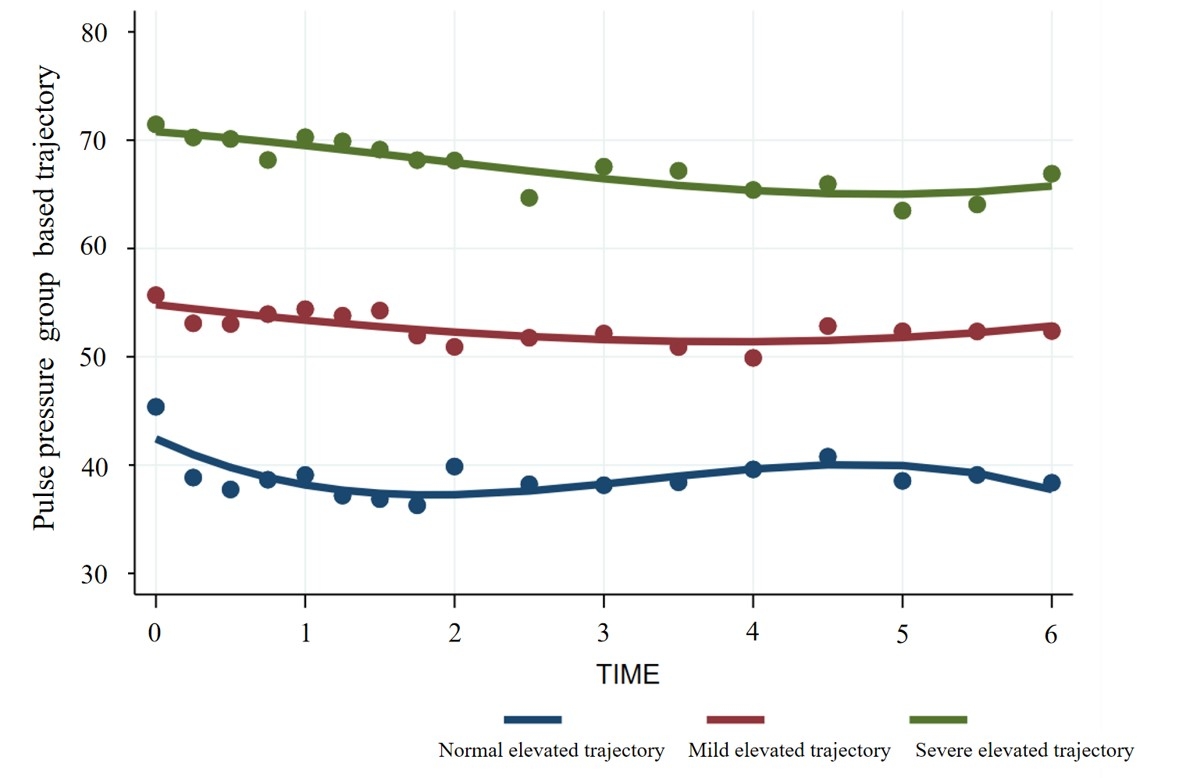
Abstract Body: Background: Endovascular thrombectomy (EVT) has improved both short-term and long-term outcomes for acute ischemic stroke (AIS) patients caused by large vessel occlusion (LVO). However, the relationships between blood pressure (BP) after EVT and outcomes had not been determined. As BP is dynamically changes, the present study investigated the effects of BP trajectories after EVT on the outcomes in AIS patients with LVO using Group-Based Trajectory Modeling (GBTM).
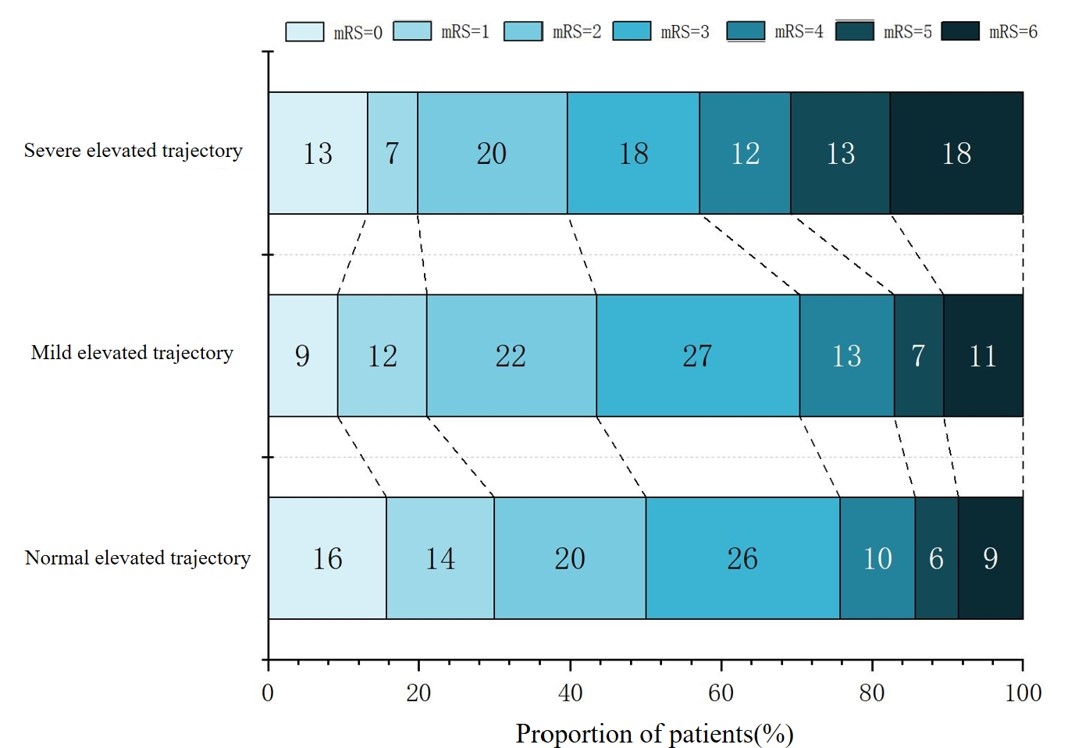
Methods: This was a retrospective, single-center observational study. The AIS patients with LVO in the anterior circulation within 24 hours of symptom onset, baseline modified Rankin Scale (mRS) score ≤2, and Alberta Stroke Program Early CT Score (ASPECTS) score ≥6 were included. BP was monitored frequently post-EVT, and PP was calculated as the difference between systolic and diastolic BP. GBTM identified distinct PP trajectories over 0-6 hours and 0-48 hours post-EVT. Short-term outcomes included hemorrhagic transformation (HT) and symptomatic intracranial hemorrhage (SICH), while long-term outcomes included National Institutes of Health Stroke Scale (NIHSS) at 7 days and mRS score at 3 months.
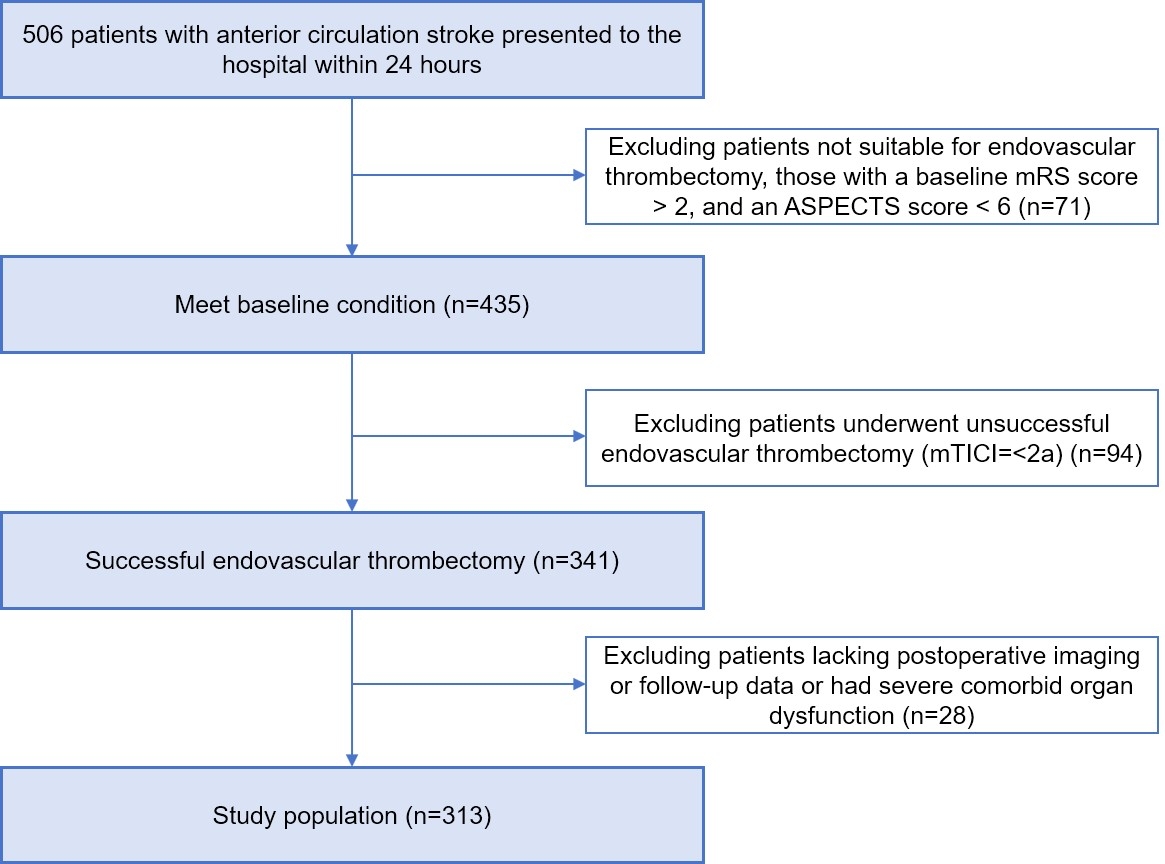
Results: Out of 506 screened patients, 313 were included in the final analysis. GBTM identified three distinct PP trajectories within the first 6 and 48 hours post-EVT. The 0–6 hour PP trajectory was significantly correlated with HT (OR=1.81, 95% CI 1.28-2.54), which remained significant after adjustment (OR = 1.72, 95% CI 1.17-2.53). An elevated PP trajectory was associated with a 3.04-fold higher risk of HT compared to the normal trajectory. Mediation analysis indicated the 7-day NIHSS score mediated 88.92% of the association between severe elevated PP trajectory and mRS.
Conclusion: Severely elevated PP trajectory post-EVT is independently associated with poor short-term outcomes in AIS patients with LVO. Effective management of PP in the acute phase post-EVT may be crucial for improving prognosis of AIS patients with LVO.
  • Huo, Kang  ( The first affiliated hospital of XJTU , Xian , Shaanxi Sheng , China )
  • Han, Jiaxin  ( The first affiliated hospital of XJTU , Xian , Shaanxi Sheng , China )
  • Su, Hua  ( University of California, San Franc , San Francisco , California , United States )
  • Qu, Qiumin  ( The first affiliated hospital of XJTU , Xian , Shaanxi Sheng , China )
  • Han, Jianfeng  ( The first affiliated hospital of XJTU , Xian , Shaanxi Sheng , China )
  • Author Disclosures:
    kang huo: DO NOT have relevant financial relationships | Jiaxin Han: No Answer | Hua Su: DO NOT have relevant financial relationships | qiumin qu: DO NOT have relevant financial relationships | Jianfeng Han: No Answer
Meeting Info:
Session Info:

Acute Treatment: Systemic Thrombolysis and Cerebroprotection Moderated Poster Tour

Wednesday, 02/05/2025 , 06:00PM - 07:00PM

Moderated Poster Abstract Session

More abstracts on this topic:
Association of Estimated Pulse Wave Velocity on Endovascular Treatment Outcome: A Secondary Analysis of the OPTIMAL-BP trial

Han Minho, Joo Haram, Lee Hyungwoo, Heo Joonnyung, Jung Jae Wook, Kim Young Dae, Park Eunjeong, Nam Hyo Suk

Acute intracranial stenting among patients with large vessel occlusion: Clinical and radiological outcomes of the RESISTANT International registry

Requena Manuel, Lopez-frias Alfonso, Hassan Ameer, Miller Samantha, Zapata-arriaza Elena, De Alboniga-chindurza Asier, Bergui Mauro, Molinaro Stefano, Sousa Joao Andre, Gomes Fábio, Alexandre Andrea, Olive-gadea Marta, Pedicelli Alessandro, Hofmeister Jeremy, Machi Paolo, Scarcia Luca, Kalsoum Erwah, Meira Torcato, Amorim José, Ortega-gutierrez Santiago, Rodriguez Aaron, Capasso Francesco, Kaesmacher Johannes, Renieri Leonardo, Romano Daniele, Barcena Eduardo, Abdalkader Mohamad, Perry Da Camara Catarina, Yavagal Dileep, Vega Pedro, Ozdemir Atilla Ozcan, Smajda Stanislas, Khalife Jane, Mujanovic Adnan, Biraschi Francesco, Castro Pedro, Siddiqui Adnan, Navia Pedro, Ntoulias Nikolaos, Velo Mariano, Zamarro Joaquin, Zaidat Osama, Sierra-gomez Alicia, Marto Joao Pedro, Geyik Serdar, Tomasello Alejandro, Senadim Songul, Cervo Amedeo, Salcuni Andrea, Moreu Manuel

More abstracts from these authors:
Long-term post-stroke cognitive dysfunction in aged subjects is associated with increased synapse pruning by reactive astrocytes

Shabani Nabikandi Zahra, Pan Peipei, Li Qifeng, Wang Zhanqiang, Huo Kang, Su Hua

Can the reduction of mutant endothelial cells hold promise for treating brain arteriovenous malformation?

Shabani Nabikandi Zahra, Prado Leandro, Shaligram Sonali, Zhang Rui, Zhu Wan, Liang Rich, Yadav Alka, Wang Calvin, Su Hua

You have to be authorized to contact abstract author. Please, Login
Not Available

Readers' Comments

We encourage you to enter the discussion by posting your comments and questions below.

Presenters will be notified of your post so that they can respond as appropriate.

This discussion platform is provided to foster engagement, and simulate conversation and knowledge sharing.


You have to be authorized to post a comment. Please, Login or Signup.


   Rate this abstract  (Maximum characters: 500)