
Logo

American Heart Association

  104
  0


Final ID: TP15

Argatroban Among Patients with Acute Ischemic Stroke: A Systematic Review and Meta-Analysis of Randomized Controlled Trials

Abstract Body: Introduction: Argatroban, a direct thrombin inhibitor, is currently being investigated as a potential adjunct to the standard of care for the treatment of acute ischemic stroke (AIS). However, data regarding its impact on functional neurological outcomes have been inconclusive. Our objective was to compare neurological outcomes at 90 days among individuals with AIS randomized to argatroban with standard of care versus standard of care alone.
Methods: We systematically searched MEDLINE, EMBASE, and Cochrane CENTRAL databases from their inception to July 2024 for randomized controlled trials of argatroban. The primary outcome was excellent functional outcome, as defined by a modified Rankin Scale (mRS) score of 0-1 at 90 days. The secondary endpoints were favorable functional outcome, defined by a mRS score of 0-2 at 90 days, and repeat stroke or other vascular events within 90 days. Safety endpoints included symptomatic intracranial hemorrhage and parenchymal hematoma at 90 days. Risk of bias was assessed using the Cochrane Risk of Bias Tool (RoB 2). Random-effects meta-analytic models were used to estimate pooled risk ratios (RRs) and 95% confidence intervals (CIs). Our protocol was preregistered on Open Science Framework (https://osf.io/tygwx/).
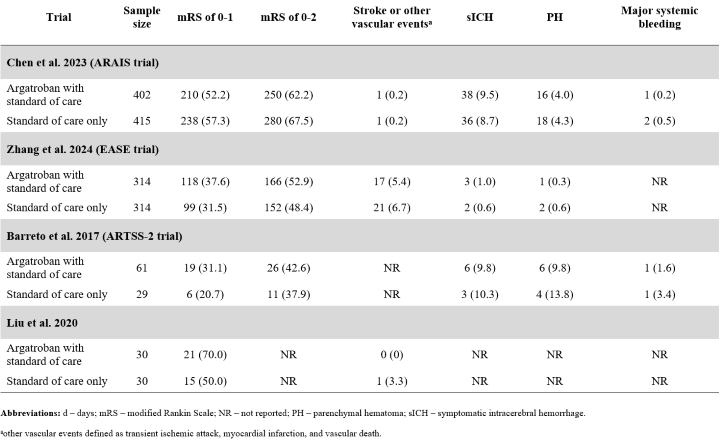
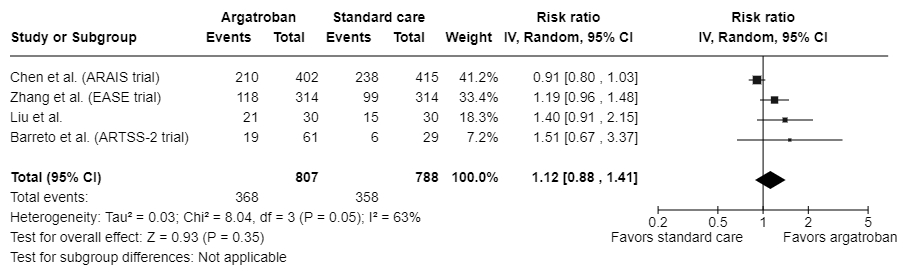
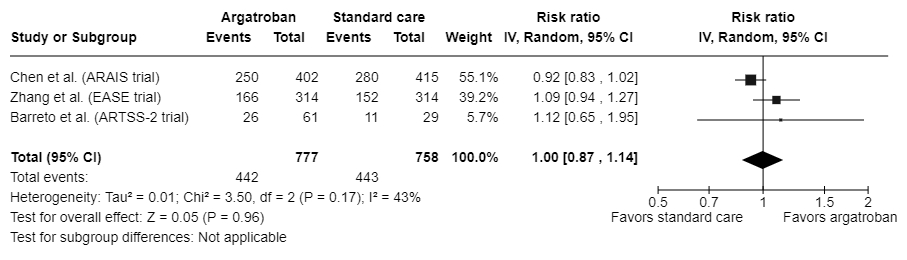
Results: Four randomized controlled trials were included. A total of 1,595 participants were randomized to receive either argatroban with standard of care (n=807) or standard of care alone (n=788). Participants were mostly male (67.1%), and their median/mean age ranged from 57 to 69 years. When data were pooled across trials, the impact of argatroban on the likelihood to have a mRS score of 0-1 was inconclusive due to a wide CI (RR: 1.12; 95% CI: 0.88-1.41; I2: 63%) (Figure 1). Similar trends were observed for the other predefined outcomes. The RRs were 1.00 (95% CI: 0.87-1.14) for a mRS score of 0-2 (Figure 2) and 0.79 (95% CI: 0.44-1.44) for stroke or other vascular events. The pooled RRs for symptomatic intracranial hemorrhage and parenchymal hematoma were 1.09 (95% CI: 0.73-1.63) and 0.84 (95% CI: 0.48-1.47), respectively.
Conclusions: Results were inconclusive due to small sample sizes. Currently, there is insufficient data to support the addition of argatroban to standard of care for the treatment of AIS. Evidence from available trials in this area supports the conduct of larger trials to determine the clinical value of argatroban.
  • Dobromir Angheluta, Adelina  ( McGill University , Montreal , Quebec , Canada )
  • Zolotarova, Tetiana  ( Lady Davis Institute for Medical Research, Jewish General Hospital/McGill University , Montreal , Quebec , Canada )
  • Levett, Jeremy  ( McGill University , Montreal , Quebec , Canada )
  • Seirafi, Tara  ( McGill University , Montreal , Quebec , Canada )
  • Filion, Kristian  ( McGill University , Montreal , Quebec , Canada )
  • Eisenberg, Mark  ( Jewish General Hospital/McGill University , Montreal , Quebec , Canada )
  • Author Disclosures:
    Adelina Dobromir Angheluta: DO NOT have relevant financial relationships | Tetiana Zolotarova: DO NOT have relevant financial relationships | Jeremy Levett: DO have relevant financial relationships ; Ownership Interest:Stenoa Inc.:Active (exists now) ; Employee:Stenoa Inc.:Active (exists now) ; Executive Role:Stenoa Inc.:Active (exists now) | Tara Seirafi: DO NOT have relevant financial relationships | Kristian Filion: DO NOT have relevant financial relationships | Mark Eisenberg: DO NOT have relevant financial relationships
Meeting Info:
Session Info:

Acute Treatment: Systemic Thrombolysis and Cerebroprotection Posters II

Thursday, 02/06/2025 , 07:00PM - 07:30PM

Poster Abstract Session

More abstracts on this topic:
A distinct clot transcriptomic signature is associated with atrial fibrillation-derived ischemic stroke in the INSIGHT Registry

Seah Carina, Rivet Dennis, Fraser Justin, Kellner Christopher, Devarajan Alex, Vicari James, Dabney Alan, Baltan Selva, Sohrabji Farida, Pennypacker Keith, Nanda Ashish, Woodward Britton

A machine learning approach to classifying ischemic stroke etiology using variables available in the Get-with-the-Guidelines Stroke Registry

Lee Ho-joon, Schwamm Lee, Turner Ashby, De Havenon Adam, Kamel Hooman, Brandt Cynthia, Zhao Hongyu, Krumholz Harlan, Sharma Richa

More abstracts from these authors:
Comparative Efficacy of Glucagon-Like Peptide-1 Receptor Agonists and Co-Agonists for Weight Loss Among Patients Without Diabetes: A Network Meta-Analysis

Moiz Areesha, Filion Kristian, Reynier Pauline, Lelievre Audrey, Toutounchi Helia, Tsoukas Michael, Yu Oriana, Peters Tricia, Eisenberg Mark

Comparison of Immediate and Staged Complete Revascularization in STEMI Patients with Multivessel Disease: Meta-Analysis of Randomized Controlled Trial

Almizel Abdulrahman, Levett Jeremy, Zolotarova Tetiana, Eisenberg Mark

You have to be authorized to contact abstract author. Please, Login
Not Available

Readers' Comments

We encourage you to enter the discussion by posting your comments and questions below.

Presenters will be notified of your post so that they can respond as appropriate.

This discussion platform is provided to foster engagement, and simulate conversation and knowledge sharing.


You have to be authorized to post a comment. Please, Login or Signup.


   Rate this abstract  (Maximum characters: 500)