
Logo

American Heart Association

  116
  0


Final ID: WMP98

Use of Direct Oral Anticoagulants (DOACs) Compared to Aspirin for Secondary Prevention of Embolic Stroke of Undetermined Source (ESUS): A Systematic Review and Meta-analysis.

Abstract Body: Abstract
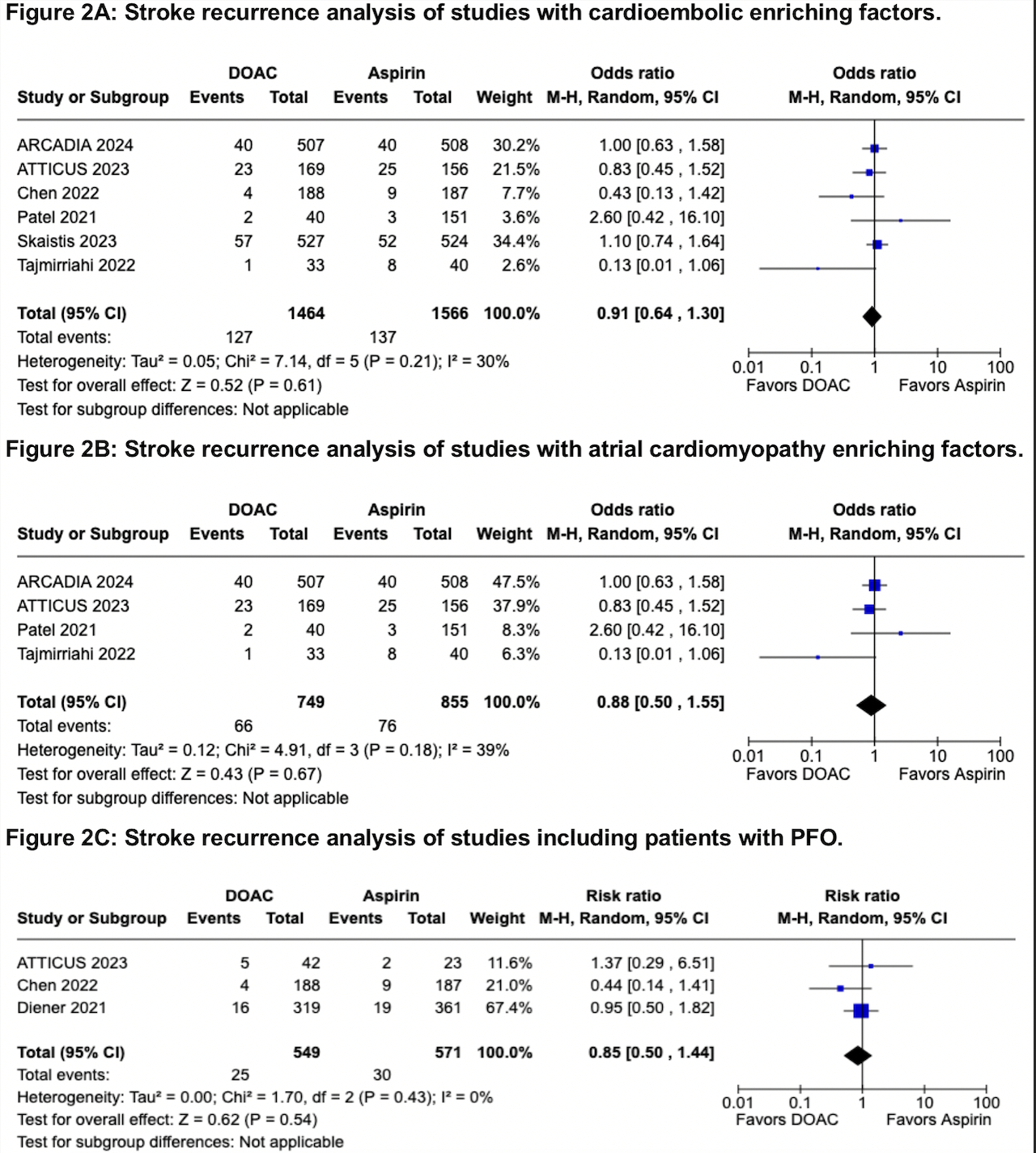
Background: The use of oral anticoagulation (OAC) for stroke prevention in embolic stroke of undetermined source (ESUS) is hypothesized to be beneficial over conventional antiplatelet use. However, large randomized controlled trials (RCTs) have not found clear benefits, even when assessing cardioembolic enriching features. Therefore, this study aimed to perform a meta-analysis exploring the efficacy and safety of direct oral anticoagulants (DOACs) following ESUS.
Methods: PubMed, Scopus, and Cochrane Central were systematically searched for studies comparing DOACs versus aspirin after ESUS. The primary outcome was stroke recurrence, and the safety outcome was major bleeding. A random-effects model was used for the analyses. Statistical analysis was performed using Review Manager Web 8.0.0 (RevMan Web).
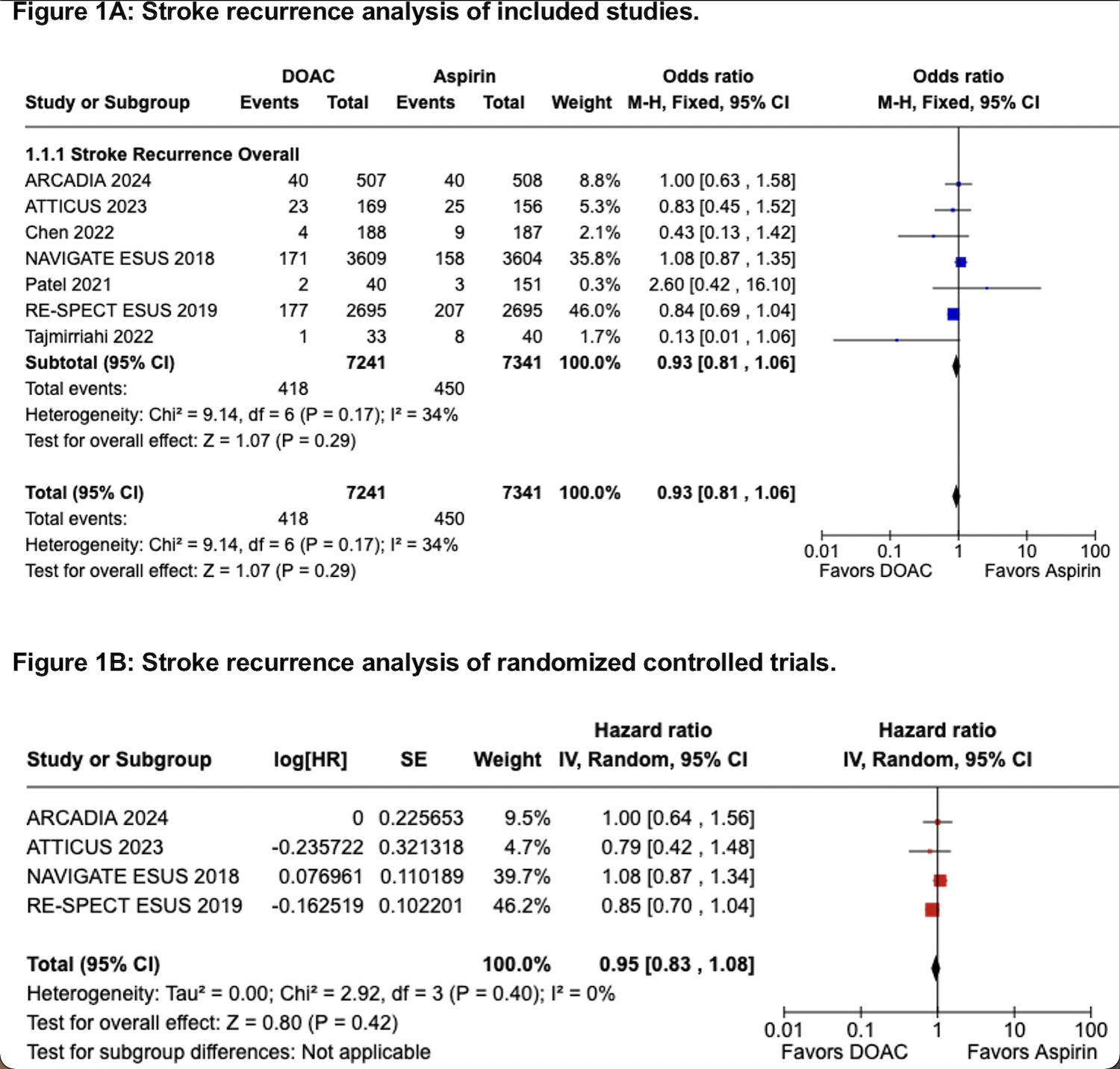
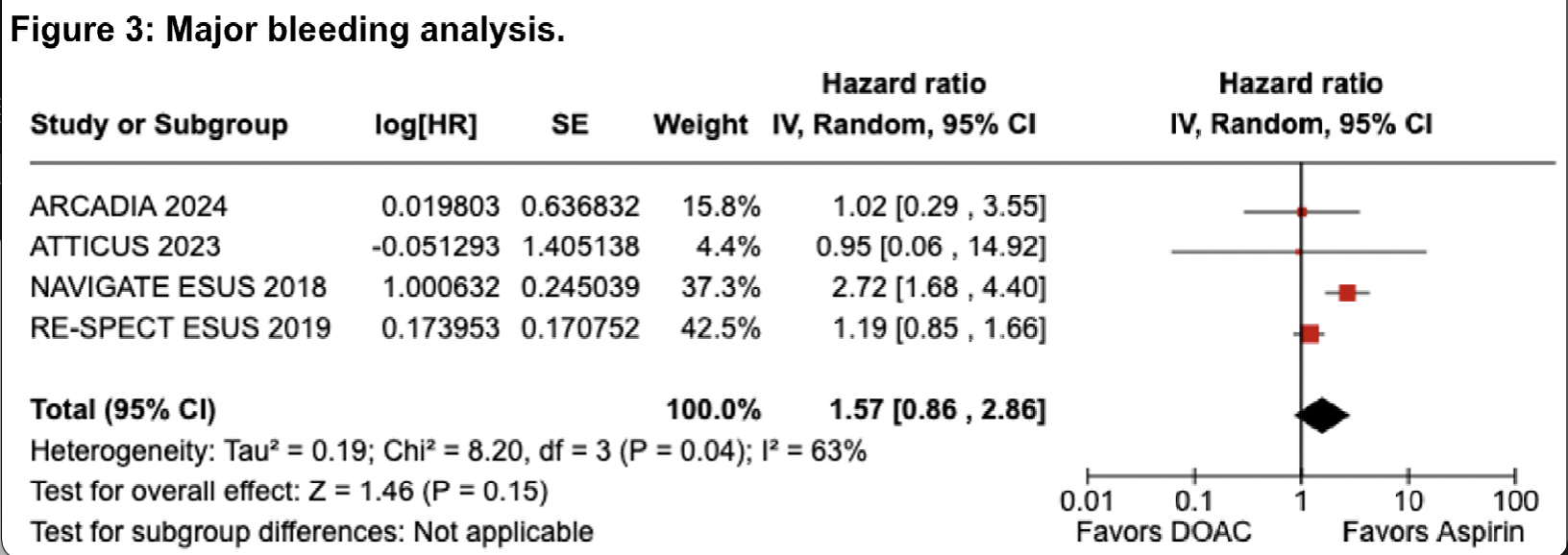
Results: 14,582 patients were included from 9 studies, of which 4 were RCTs. 7,341 (50.3%) received DOACs as secondary prevention. For stroke recurrence, there was noted non-statistically significant trends towards benefit for DOACs (OR 0.93; 95% CI 0.81 - 1.06; p = 0.29; I2 = 34%). No differences were found for major bleeding (HR 1.57; 95% CI 0.86 - 2.86; p = 0.15; I2 = 63%). Among the atrial cardiomyopathy subgroup, no benefit was observed (OR 0.88; 95% CI 0.50 - 1.55; p = 0.67; I2 = 39%).
Conclusion: There is insufficient evidence to recommend the use of DOACs instead of aspirin following ESUS for the prevention of stroke recurrence. Nevertheless, the fears of increased bleed risks were also not seen. Further efforts should be directed towards identifying potential embolic sources and the specific population that could benefit from OAC.
  • Varkey, Thomas  ( The University of Arizona , Phoenix , Arizona , United States )
  • Restrepo, Natalia  ( Universidad ces , Medellin Antioquia , Colombia )
  • Koppanatham, Aishwarya  ( Andhra Medical College , Visakhapatnam , India )
  • Chochol, Pawel  ( SPSK im.prof.Orlowskiego , Warszawa , Poland )
  • Rizwan Ahmed, Aisha  ( Jinnah Medical And Dental College , Karachi City , Pakistan )
  • Alexandrov, Andrei  ( University of Arizona COMP , Phoenix , Arizona , United States )
  • Author Disclosures:
    Thomas Varkey: DO NOT have relevant financial relationships | Natalia Restrepo: No Answer | aishwarya koppanatham: DO NOT have relevant financial relationships | Pawel Chochol: DO NOT have relevant financial relationships | Aisha Rizwan Ahmed: DO NOT have relevant financial relationships | Andrei Alexandrov: DO NOT have relevant financial relationships
Meeting Info:
Session Info:

Risk Factors and Prevention Moderated Poster Tour I

Wednesday, 02/05/2025 , 06:00PM - 07:00PM

Moderated Poster Abstract Session

More abstracts on this topic:
Development of scoring system for predicting recurrent ischemic stroke in patients with atrial fibrillation

Kim Do Yeon, Yum Kyu Sun, Shin Dong Ick, Kim Dae Hyun, Cha Jae-kwan, Kim Dong-eog, Park Jong-moo, Kang Kyusik, Kim Jae, Lee Soo Joo, Lee Minwoo, Han Seokgil, Oh Mi-sun, Yu Kyung-ho, Lee Byung-chul, Park Hong-kyun, Cho Yong-jin, Hong Keun-sik, Kang Chul-hoo, Kim Joonggoo, Choi Jay Chol, Park Hyungjong, Guk Hyung Seok, Hong Jeong-ho, Sohn Sung-il, Park Tai, Lee Jeongyoon, Lee Kyungbok, Kim Wook-joo, Kwon Jee-hyun, Kwon Doo Hyuk, Lee Jun, Ryu Wi-sun, Jeong Han-gil, Lee Juneyoung, Bae Hee-joon, Lee Keon-joo, Kim Beom Joon, Han Moon-ku, Choi Kangho, Kim Joon-tae

3-HKA Promotes the Vascular Remodeling after Stroke by Modulating the Activation of A1/A2 Reactive Astrocytes

Chen Jun-min, Shi Guang, Yu Lulu, Shan Wei, Zhang Xiangjian, Wang Qun

More abstracts from these authors:
You have to be authorized to contact abstract author. Please, Login
Not Available

Readers' Comments

We encourage you to enter the discussion by posting your comments and questions below.

Presenters will be notified of your post so that they can respond as appropriate.

This discussion platform is provided to foster engagement, and simulate conversation and knowledge sharing.


You have to be authorized to post a comment. Please, Login or Signup.


   Rate this abstract  (Maximum characters: 500)