Logo

American Heart Association

  209
  0


Final ID: 2

Endovascular thrombectomy plus intravenous thrombolysis versus endovascular thrombectomy alone in patients with large core infarct

Abstract Body: Background: For patients meeting eligibility criteria, endovascular thrombectomy (EVT) remains the gold standard treatment for acute ischemic stroke (AIS) caused by large vessel occlusion (LVO). A few randomized trials have investigated EVT in AIS-LVO with large ischemic infarcts (LII). We studied the impact of intravenous thrombolysis (IVT) on the outcomes of EVT in those patients.
Methods: We conducted a meta-analysis using the Preferred Reporting Items for Systematic Reviews and Meta-Analyses (PRISMA) checklist and the Cochrane Handbook of Systematic Reviews and Interventions. We searched 4 databases (PubMed, Scopus, Web of Science, and Cochrane CENTRAL) from inception till June 11, 2024. We performed our analysis with RevMan utilizing a pooled risk ratio (RR) with a 95% confidence interval (CI).
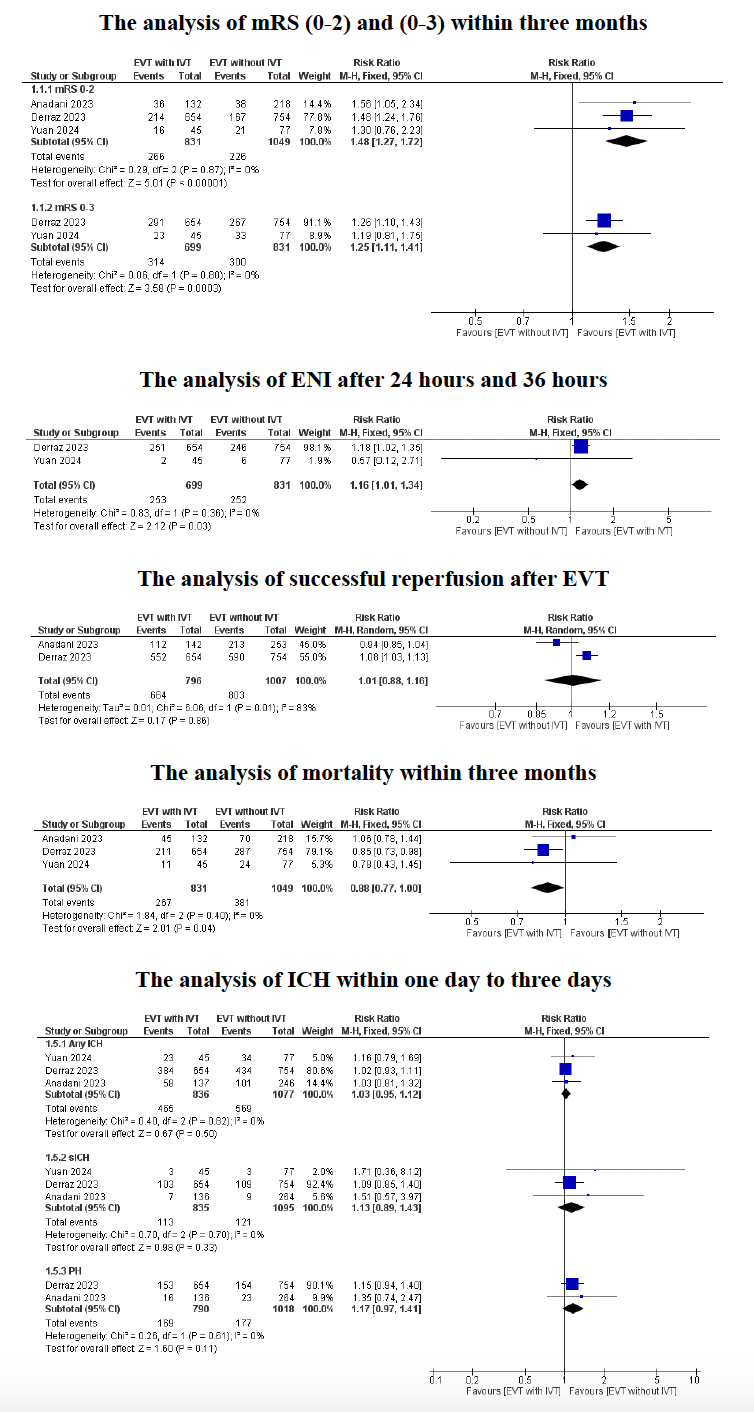
Results: Three studies with a total of 1,927 patients investigated EVT with and without IVT in AIS-LVO patients with LII. All 3 studies reported on modified Rankin Scale (mRS) score of 0-2 at 3 months, (831 patients in the EVT+IVT group and 1,049 patients in the EVT-only group), with a statistically significant difference favoring EVT+IVT (RR: 1.48, 95%CI: 1.27, 1.72, P< 0.00001). Two studies reported on mRS score of 0-3 (699 patients in the EVT+IVT group and 831 patients in the EVT-only group). The analysis also favored EVT+IVT (RR: 1.25, 95%CI: 1.11, 1.41, P= 0.0003). Two studies reported on early neurological improvement (ENI) after 24 and 36 hours (699 patients in the EVT+IVT group and 831 patients in the EVT-only group). The analysis revealed a statistically significant difference favoring EVT+IVT (RR: 1.16, 95%CI: 1.01, 1.34, P= 0.03). Two studies reported on successful reperfusion after EVT with no statistically significant difference between the two groups (RR: 1.01, 95%CI: 0.88, 1.16, P= 0.86). All 3 studies reported on mortality (831 patients in the EVT+IVT group and 1,049 patients in the EVT-only group), and the analysis favored EVT+IVT (RR: 0.88, 95%CI: 0.77, 1, P= 0.04). Lastly, our subgroup analysis did not favor any of the two groups across different types of intracranial hemorrhage (ICH).
Conclusion: Our results indicate a beneficial impact of IVT on the clinical outcomes of EVT in AIS-LVO patients with LII regarding functional outcomes and early neurological improvement. IVT was also associated with a lower mortality rate but not with an increased risk of ICH. More studies of larger sample sizes are needed to corroborate such results.
  • Elfil, Mohamed  ( University of Miami/Jackson Health System , Miami , Florida , United States )
  • Abbas, Abdallah  ( Al-Azhar University , Damietta , Egypt )
  • Fountain, Hayes  ( University of Miami , Miami , Florida , United States )
  • Abdul-hamid, Ebrahem  ( Al-Azhar University , Damietta , Egypt )
  • Aladawi, Mohammad  ( University of Alabama Medical Cent , Birmingham , Alabama , United States )
  • Najdawi, Zaid  ( University of Nebraska Medical Center , Omaha , Nebraska , United States )
  • Elmashad, Ahmed  ( Westchester Medical Center , Valhalla , New York , United States )
  • Ghaith, Hazem  ( Al-Azhar University , Cairo , Egypt )
  • Dawod, Giana  ( Weill Cornell Medical Center , Manhattan , New York , United States )
  • Malik, Amer  ( University of Miami/Jackson Health System , Miami , Florida , United States )
  • Al-mufti, Fawaz  ( Westchester Medical Center , Valhalla , New York , United States )
  • Author Disclosures:
    Mohamed Elfil: DO NOT have relevant financial relationships | Amer Malik: DO NOT have relevant financial relationships | Fawaz Al-Mufti: No Answer | Abdallah Abbas: No Answer | Hayes Fountain: DO NOT have relevant financial relationships | Ebrahem Abdul-Hamid: No Answer | Mohammad Aladawi: DO NOT have relevant financial relationships | Zaid Najdawi: DO NOT have relevant financial relationships | Ahmed Elmashad: DO NOT have relevant financial relationships | Hazem Ghaith: DO NOT have relevant financial relationships | Giana Dawod: No Answer
Meeting Info:
Session Info:

Acute Treatment: Systemic Thrombolysis and Cerebroprotection Oral Abstracts I

Wednesday, 02/05/2025 , 07:30AM - 09:00AM

Oral Abstract Session

More abstracts on this topic:
Bridging thrombolysis prior to thrombectomy does not modify the association between Direct-to-angiography vs Repeat Imaging approaches and functional outcomes after EVT in transferred patients

Shafiq Ameena, Elijovich Lucas, Dannenbaum Mark, Mir Osman, Tekle Wondwossen, Maali Laith, Narangoli Adeeb, Yaghmoor Bassam, Al-shaibi Faisal, Saidi Yazid, Al Mostaneer Alhassin, Pujara Deep, Albedaiwi Mohammed, Montgomery Kelly, Sundararajan Sophia, Opaskar Amanda, Xiong Wei, Degeorgia Michael, Duncan Kelsey, Ray Abhishek, Hu Yin, Sunshine Jeffrey, Goyal Nitin, Alenzi Bader, Abdulrazzak Mohammad, Hoit Daniel, Martin-schild Sheryl, Song Sarah, Sitton Clark, Tsivgoulis Georgios, Arthur Adam, Sila Cathy, Bambakidis Nicholas, Chen Michael, Hassan Ameer, Ribo Marc, Sarraj Amrou, Grotta James, Blackburn Spiros, Requena Manuel, Kamal Haris, Abraham Michael

Albumin for Patients With Acute large Vessel Occlusive Stroke Undergoing Endovascular Treatment: A Multicenter, Randomized Double-blind, Placebo-Controlled Clinical Trail

Ji Xunming, Wu Chuanjie, Li Chuanhui, Liu Yuanyuan, Dong Xiao, Ma Zhengfei, Wu Di, Xu Yi, Zhou Chen

More abstracts from these authors:
First line aspiration versus stent retriever for posterior circulation stroke; A meta-analysis

Thapa Sangharsha, Chong Ji, Santarelli Justin, Al-mufti Fawaz, Gandhi Chirag, Kaur Gurmeen

Tenecteplase Beyond 4.5 Hours in Acute Ischemic Stroke: A Systematic Review and Meta-analysis of Clinical Trials

Aladawi Mohammad, Hataway Felicia, Bakradze Ekaterina, Lyerly Michael, Abuawwad Mohammad, Taha Mohammad, Kozaa Yasmeena, Alrubasy Warda, Hamad Abdullah, Alhnidi Fatema, Elfil Mohamed, Najdawi Zaid

You have to be authorized to contact abstract author. Please, Login
Not Available

Readers' Comments

We encourage you to enter the discussion by posting your comments and questions below.

Presenters will be notified of your post so that they can respond as appropriate.

This discussion platform is provided to foster engagement, and simulate conversation and knowledge sharing.


You have to be authorized to post a comment. Please, Login or Signup.


   Rate this abstract  (Maximum characters: 500)