Efficacy of Glucagon-Like Peptide-1 Receptor Agonists for Prevention of Stroke among Patients with Type 2 Diabetes Mellitus, Heart Failure, or Obesity: A Meta-Analysis of 12 Randomized Controlled Trials.
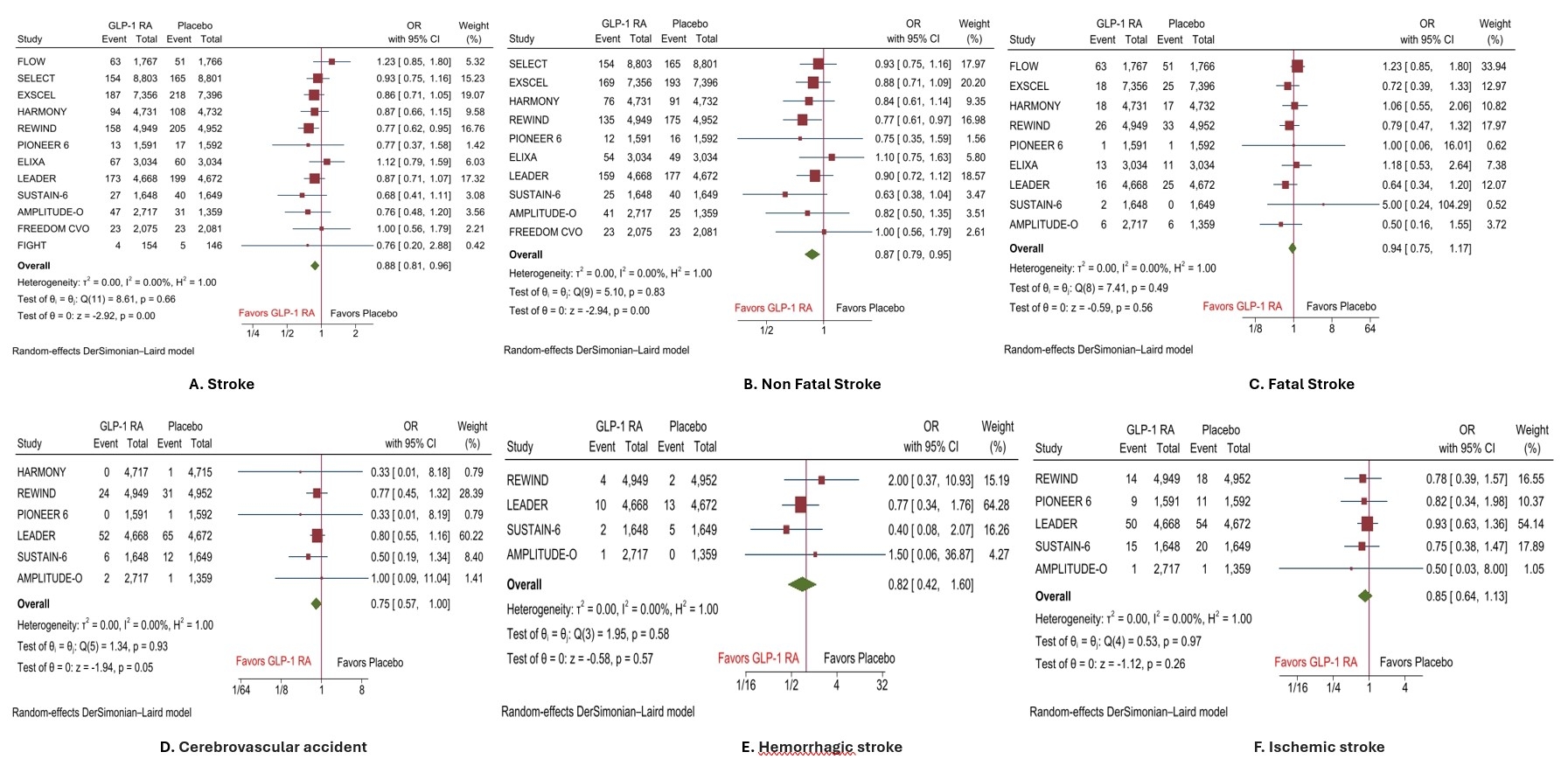
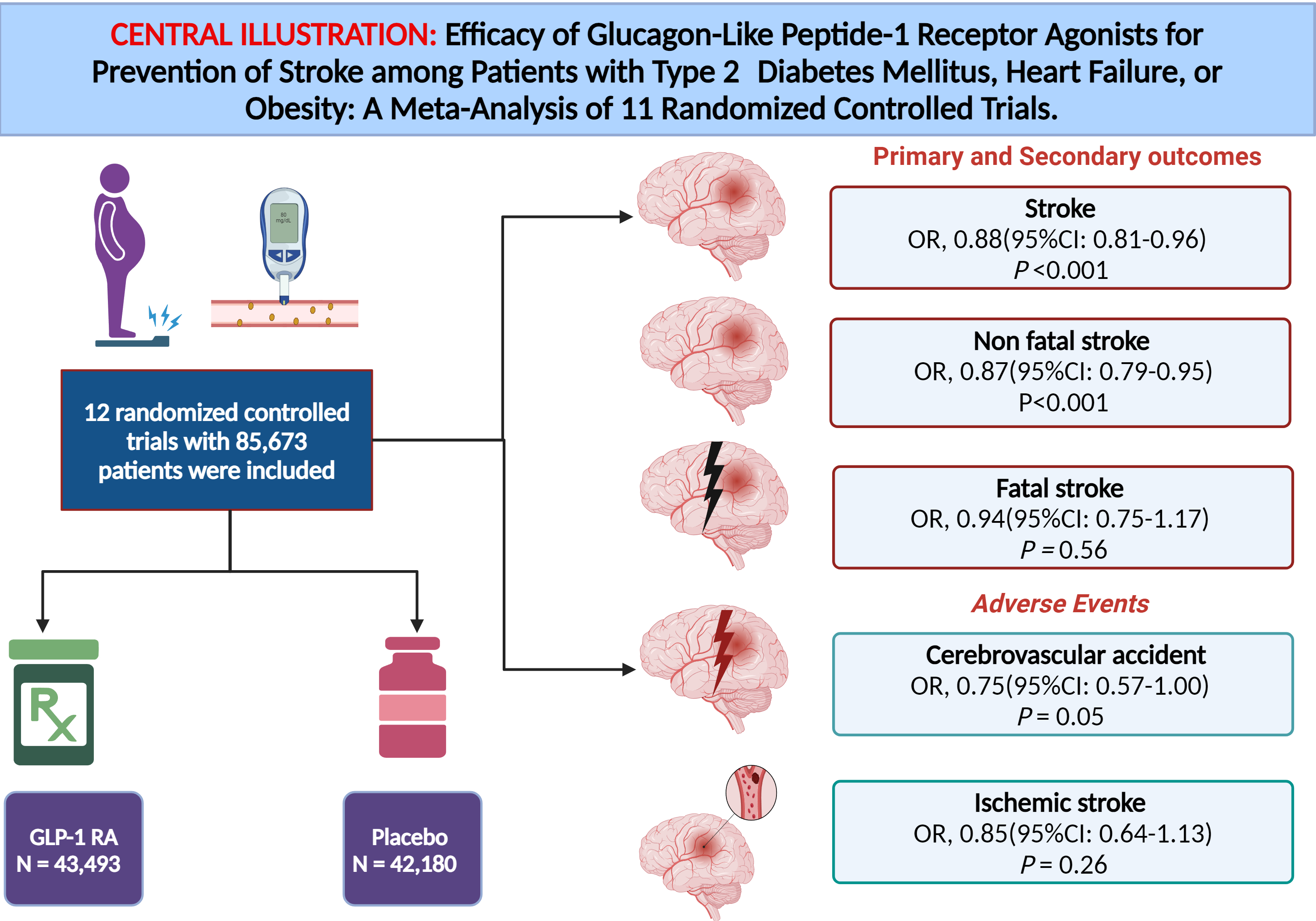
Abstract Body: Background Glucagon-like peptide-1 receptor agonists (GLP-1 RAs) have shown a reduction in major adverse cardiovascular events (MACE) among patients with type 2 diabetes mellitus (T2DM). However, its efficacy on cerebrovascular events is yet to be well established, with conflicting results to date. Objective We sought to evaluate the efficacy of GLP-1 RAs on stroke risk among its different types in patients with T2DM, heart failure, or obesity. Methods We performed a systematic literature search on PubMed, EMBASE, and ClinicalTrials.gov for relevant randomized controlled trials (RCTs) from inspection until June 30th, 2024, without any language restrictions. Odds ratios (OR) and 95% confidence intervals (CI) were pooled using a random-effect model, and a p-value of <0.05 was considered statistically significant. Results A total of 12 RCTs with 85,673 patients (43,493 in GLP-1 RAs and 42,180 in the placebo group) were included in the analysis. The mean age of the patients in GLP-1 RAs and the placebo groups was 63.5 and 63.1 years, respectively. Pooled analysis of primary and secondary endpoints showed that GLP-1 RAs significantly reduced the risk of incidence of stroke by 12% (OR, 0.88(95%CI: 0.81-0.96), P<0.001), and nonfatal stroke by 13% (OR, 0.87(95%CI: 0.79-0.95), P<0.001) compared with placebo. However, the risk of fatal stroke (OR, 0.94(95%CI: 0.75-1.17), P=0.56) was comparable between both groups of patients. Similarly, the risk of serious adverse events such as cerebrovascular accident (OR, 0.75(95%CI: 0.57-1.00), P=0.05), hemorrhagic stroke (OR, 0.82(95%CI: 0.42-1.60), P=0.57, and ischemic stroke (OR, 0.85(95%CI: 0.64-1.13), P=0.26) was comparable between GLP-1RAs and placebo.
Conclusion GLP-1 RAs therapy was associated with an overall reduction in the risk of stroke and nonfatal stroke in T2DM and/or heart failure or obese patients. However, no such effect was observed for fatal stroke.
Jaiswal, Vikash
(
JCCR Cardiology Research
, Jaunpur , India )
Jaiswal, Akash
(
AIIMS
, New Delhi , India )
Borra, Vamsikalyan
(
UTRGV
, Weslaco , Texas , United States )
Latif, Fakhar
(
Dow University of Health Sciences
, Karachi , Pakistan )
Gera, Asmita
(
Tainjin Medical University
, Tainjin , China )
Ang, Song Peng
(
Rutgers Health CMC
, Toms River , New Jersey , United States )
Kalra, Kriti
(
JCCR Cardiology Research
, Jaunpur , India )
Danisha, Fnu
(
JCCR Cardiology Research
, Jaunpur , India )
Mashkoor, Yusra
(
Dow University of Health Sciences
, Karachi , Pakistan )
Mattumpuram, Jishanth
(
University of Louisville School of Medicine
, Louisville , Kentucky , United States )
Biswas, Monodeep
(
University of Maryland Medical
, Landisville , Pennsylvania , United States )
Author Disclosures:
Vikash Jaiswal:DO NOT have relevant financial relationships
| Jishanth Mattumpuram:DO NOT have relevant financial relationships
| Monodeep Biswas:DO NOT have relevant financial relationships
| Akash Jaiswal:DO NOT have relevant financial relationships
| Vamsikalyan Borra:DO NOT have relevant financial relationships
| Fakhar Latif:DO NOT have relevant financial relationships
| Asmita Gera:DO NOT have relevant financial relationships
| Song Peng Ang:DO NOT have relevant financial relationships
| Kriti Kalra:DO NOT have relevant financial relationships
| FNU Danisha:DO NOT have relevant financial relationships
| Yusra Mashkoor:DO NOT have relevant financial relationships