Impact of Switching From High- to Low-Sodium Oxybate on Ambulatory and Office Blood Pressure in Subgroups of People With Narcolepsy From the XYLO Study
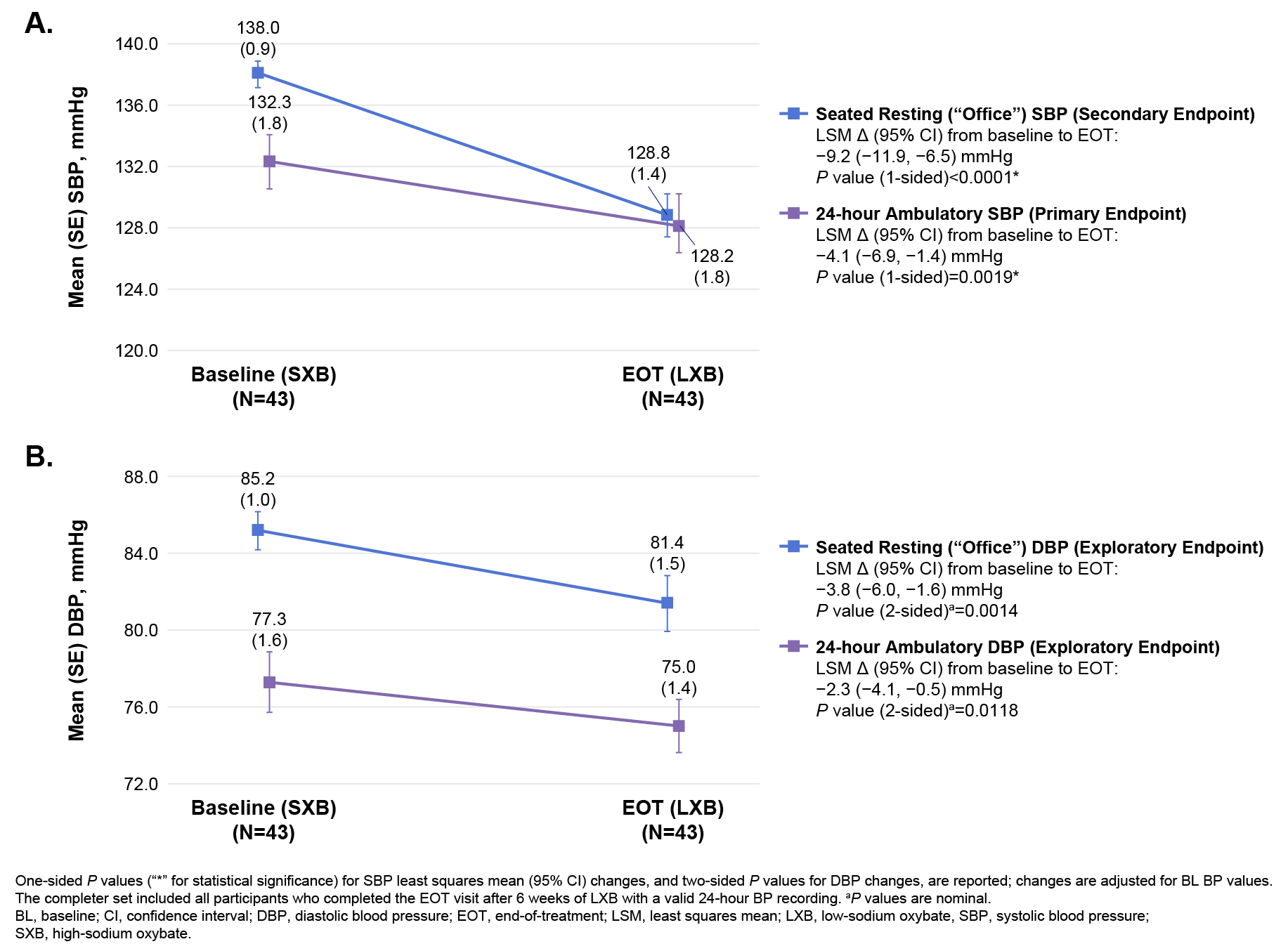
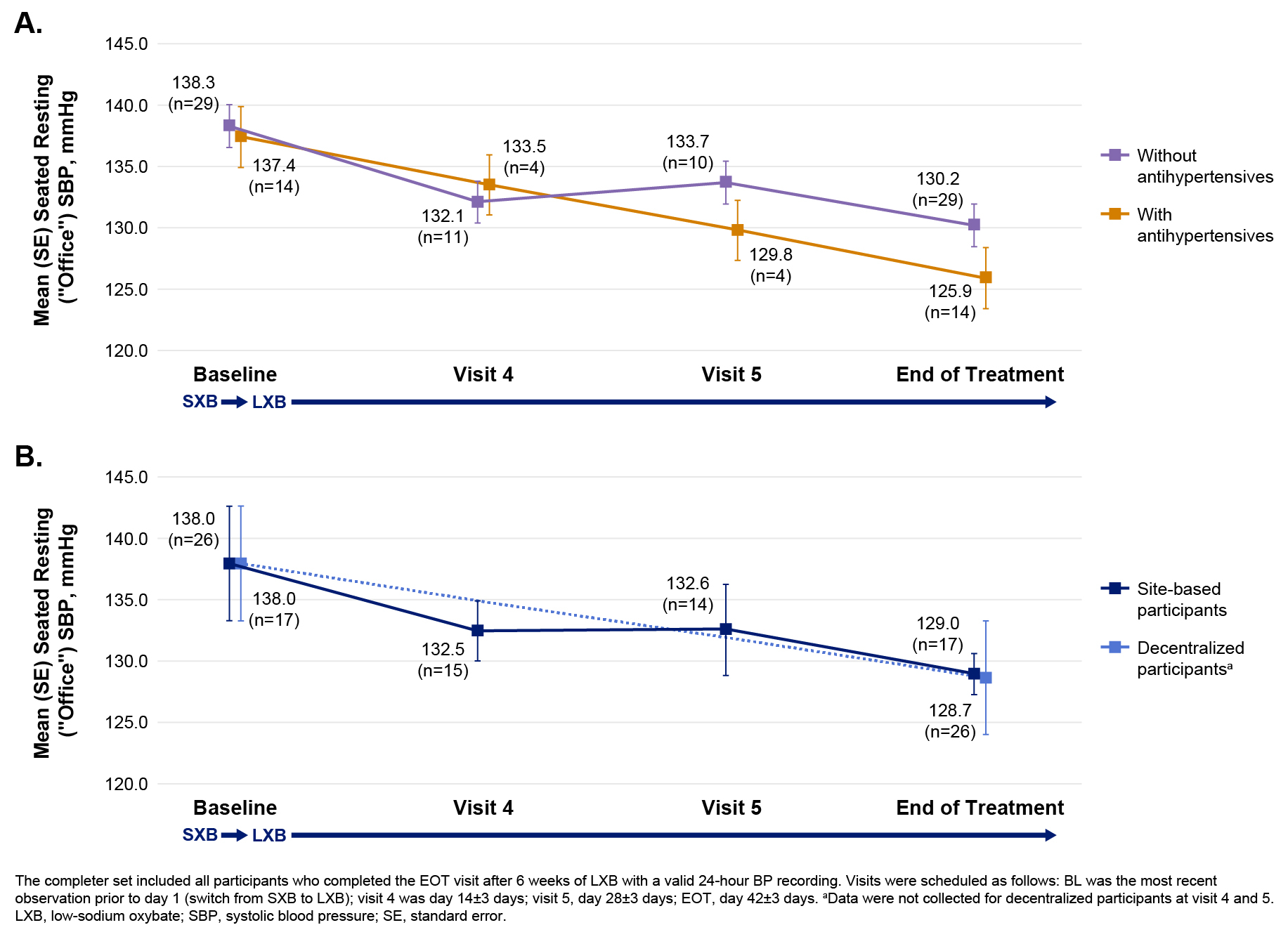
Abstract Body: Introduction: Excess sodium intake is strongly linked with hypertension and cardiovascular disease (CVD); people with narcolepsy (PwN) have increased CV risk. Hypothesis: Switching from high-sodium oxybate (SXB; Xyrem®; 6–9 g for ≥6 wks) to low-sodium oxybate (LXB; Xywav®; same regimen) reduces mean 24-hr ambulatory systolic blood pressure (ASBP) after ≈6 wks in PwN, regardless of antihypertensive (anti-HTN) use and site type. Methods: XYLO, an open-label, single-arm study (NCT05869773), assessed PwN aged 18−70 y with office SBPs of 130−155 mmHg. The primary and key secondary endpoints were changes from baseline (BL) to end-of treatment (EOT) in mean 24-hr ASBP and seated resting (“office”) SBP (OSBP), respectively; exploratory endpoints were diastolic BP (DBP) changes. Changes are baseline adjusted. Prespecified subgroup analyses explored BL anti-HTN use and participation site (ie, site-based [at study site] vs decentralized [at-home]). Results: In 43 PwN (mean age, 45 y; female, 65%; anti-HTN, 33%), mean±SD BL OSBP and DBP were 138.0±5.7 and 85.2±6.6 mmHg, respectively. Mean±SD total SXB vs LXB dosages were 8.0±1.1 vs 8.1±1.1 g/night, reflecting 1457±206 vs 118±16 mg sodium (difference: ≈1339 mg); median 24-hr urinary sodium was 4232 mg/d at BL and 2703 mg/d at EOT (median change: 1288 mg/d). Mean change in 24-hr ASBP (least squares mean [95% CI]) was −4.1 (−6.9, −1.4; 1-sided P=0.0019) mmHg (Fig 1); mean change in OSBP was −9.2 (−11.9, −6.5; 1-sided P<0.0001). Mean changes in 24-hr ambulatory and office DBP were −2.3 (−4.1, −0.5; 2-sided P=0.0118; nominal) and −3.8 (−6.0, −1.6; 2-sided P=0.0014; nominal) mmHg, respectively. In subgroups, mean change in 24-hr ASBP was −4.6 (−9.6, 0.3) mmHg with BL anti-HTN use and −3.9 (−7.3, −0.5) mmHg without BL anti-HTN use; changes in OSBP were −11.8 (−16.5, −7.1) and −7.9 (−11.1, −4.6) mmHg. Mean change in 24-hr ASBP was −3.6 (−8.0, 0.9) mmHg for site-based and −4.5 (−8.1, −1.0) mmHg for decentralized participation. Corresponding changes in OSBP were −9.0 (−13.3, −4.6; site-based) and −9.3 (−12.8, −5.8; decentralized) mmHg with a downward trend over 6 wks (Fig 2). Treatment-emergent adverse events (all mild/moderate) occurred in 40% of PwN (N=67). Conclusions: Switching from SXB to LXB reduced daily medication-related sodium intake in PwN and was associated with clinically meaningful BP reductions overall and across subgroups, consistent with evidence on dietary and medication-related sodium effects.
Somers, Virend
(
Mayo Clinic
, Rochester , Minnesota , United States )
Kovacs, Richard
(
Indiana University School of Medicine
, Indianapolis , Indiana , United States )
Alexander, Jessica
(
Jazz Pharmaceuticals
, Philadelphia , Pennsylvania , United States )
Baranak, Christine
(
Jazz Pharmaceuticals
, Philadelphia , Pennsylvania , United States )
Nichols, Deborah
(
Jazz Pharmaceuticals
, Palo Alto , California , United States )
Dai, Jing
(
Jazz Pharmaceuticals
, Palo Alto , California , United States )
Whalen, Marisa
(
Jazz Pharmaceuticals
, Palo Alto , California , United States )
Ajayi, Akinyemi
(
Children’s Lung, Asthma and Sleep Specialists
, Winter Park , Florida , United States )
Hutchinson, Barbara
(
Chesapeake Cardiac Care
, Bowie , Maryland , United States )
Dauvilliers, Yves
(
University of Montpellier
, Montpellier , France )
White, William
(
Calhoun Cardiology Center, University of Connecticut School of Medicine
, Farmington , Connecticut , United States )
Author Disclosures:
Virend Somers:DO have relevant financial relationships
;
Consultant:ApniMed:Active (exists now)
; Other (please indicate in the box next to the company name):Sleep Number Scientific Advisory Board:Active (exists now)
; Consultant:Mineralys:Active (exists now)
; Consultant:Lilly:Active (exists now)
; Consultant:Jazz Pharmaceuticals:Active (exists now)
; Consultant:Axsome:Active (exists now)
| Yves Dauvilliers:No Answer
| William White:No Answer
| Richard Kovacs:DO have relevant financial relationships
;
Consultant:Jazz :Active (exists now)
; Other (please indicate in the box next to the company name):Relmada DSMB:Active (exists now)
; Other (please indicate in the box next to the company name):GSK DSMB:Active (exists now)
; Other (please indicate in the box next to the company name):Axsome DSMB:Active (exists now)
; Other (please indicate in the box next to the company name):Immunovant DSMB:Active (exists now)
; Other (please indicate in the box next to the company name):Cook CEC:Active (exists now)
| Jessica Alexander:No Answer
| Christine Baranak:No Answer
| Deborah Nichols:No Answer
| Jing Dai:DO have relevant financial relationships
;
Employee:Jazz Pharma:Active (exists now)
| Marisa Whalen:No Answer
| Akinyemi Ajayi:No Answer
| barbara hutchinson:No Answer