Cell-Free Mitochondrial DNA Drives PANoptosis in the Perivascular Adipose Tissue Promoting Vascular Dysfunction in Mice Exposed to Chronic Stress
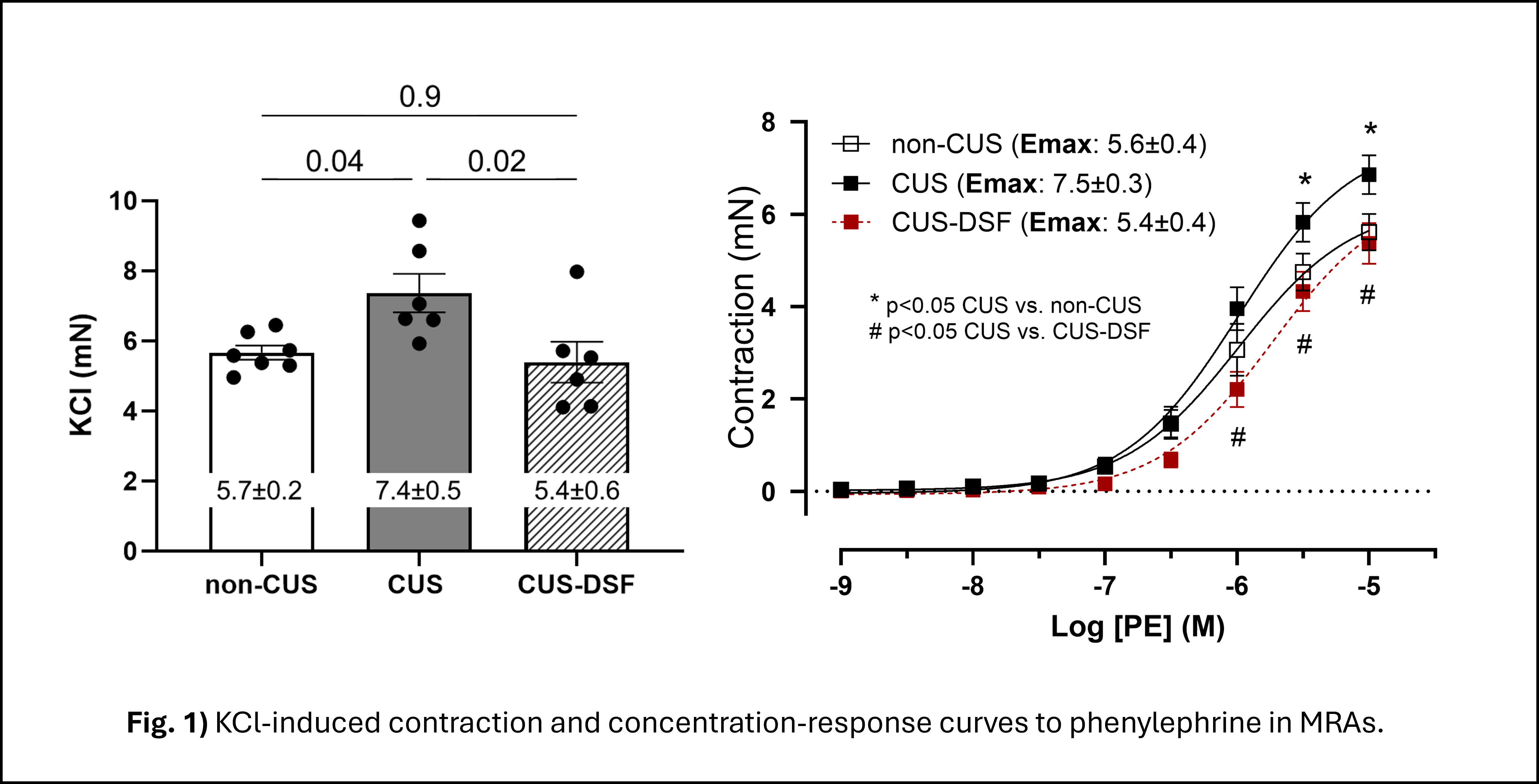
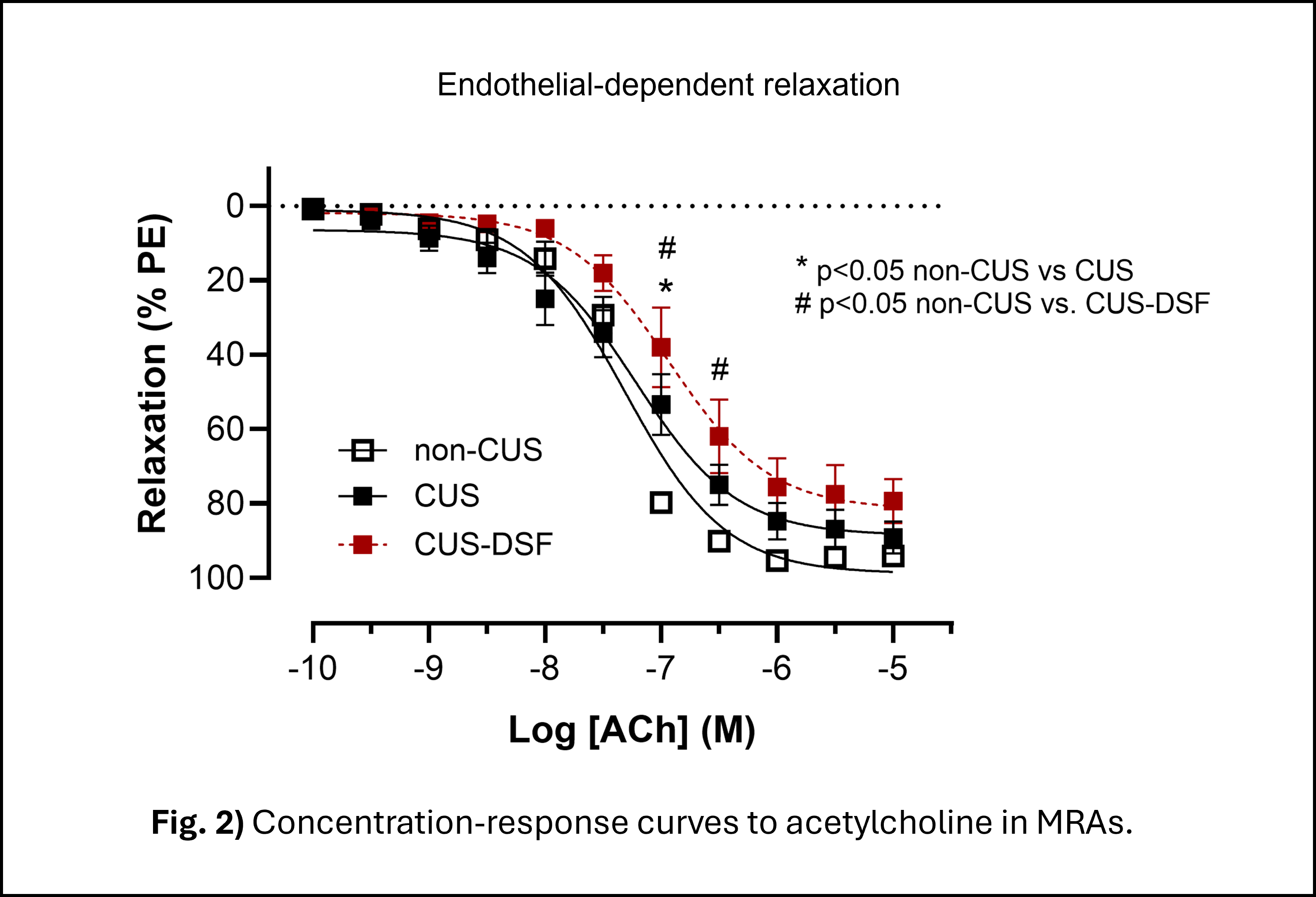
Abstract Body: Introduction: Chronic stress promotes mitochondrial DNA (mtDNA) release via gasdermin D (GSDMD) driving inflammasome activation and vascular dysfunction. Absent in melanoma 2 (AIM2) senses mtDNA and triggers PANoptosis via Z-DNA-binding protein 1 (ZBP1). We hypothesize that mtDNA drives PANoptosis, a novel type of coordinated lytic cell death, via AIM2 causing stress-induced vascular dysfunction. Methods: Male C57Bl/6 mice underwent 28 days of chronic unpredictable stress (CUS, n=6), and controls went weekly handling (non-CUS, n=6). Another CUS group (n=6) received a disulfiram-enriched diet, GSDMD inhibitor, during the protocol (CUS-DSF). Behavior was assessed by forced swim test (FST) and elevated plus maze (EPM). Following euthanasia, mesenteric resistance arteries (MRAs) were mounted in wire myograph to assess vascular reactivity. Concentration-response curves to phenylephrine and acetylcholine (1 nM–10 uM) were performed and maximal response (Emax) was obtained via non-linear regression. The perivascular adipose tissue (PVAT) surrounding MRAs was collected to assess gene expression (RT-qPCR). Circulating mtDNA was measured in plasma via mtND1 expression. Group comparisons used Student’s t-test or two-way ANOVA with Tukey’s post-hoc; data are mean ± SEM; significance at p<0.05. Results: Circulating mtDNA levels were elevated in CUS mice vs. non-CUS (fold change, 4±0.7 vs 1±0.5; p=0.003). CUS mice had lower latency to immobility in the FST vs. non-CUS (%, 32 ± 12 vs 111 ± 20; p=0.006) and DSF partially prevented this (%, 63±10; p=0.05). In the EPM, CUS mice spent less time in the open arms vs. non-CUS (%, 27±6 vs 47±8; p=0.04), which worsened in CUS-DSF (%, 13 ± 2; p=0.0003). In the vasculature, MRAs from CUS mice had increased KCl-induced contraction and higher Emax to phenylephrine, which was prevented by DSF (fig. 1). A displacement in the endothelium-dependent relaxation curve was observed in CUS, which was exacerbated in DSF-CUS (fig. 2). In the PVAT, CUS significantly increased the expression of Aim2, Zbp1, Caspase-1 and Gsdmd, key genes to AIM2-PANoptosis, and this upregulation was prevented in CUS-DSF group (p<0.05). Conclusion: Chronic stress drives mtDNA release into circulation and AIM2-PANoptosis in the PVAT, contributing to stress-induced dysfunction in MRAs. Disulfiram diet prevented some of the stress-induced changes but also induced noticeable negative effects, highlighting the need for further studies to understand its dual action.
Dos Passos, Rinaldo
(
University of South Carolina
, Columbia , South Carolina , United States )
Tomazini Goncalves, Tiago
(
University of South Carolina
, Columbia , South Carolina , United States )
Dos Anjos Moraes, Raiana
(
University of South Carolina
, Columbia , South Carolina , United States )
Silva-velasco, Diana
(
University of South Carolina
, Columbia , South Carolina , United States )
Crockett, Alexia
(
University of South Carolina
, Columbia , South Carolina , United States )
Cavalli, Eliana
(
University of South Carolina
, Columbia , South Carolina , United States )
Mullaly, Alaina
(
University of South Carolina
, Columbia , South Carolina , United States )
Cloude, Nazharee
(
University of South Carolina
, Columbia , South Carolina , United States )
Pernomian, Laena
(
University of South Carolina
, Columbia , South Carolina , United States )
Frambes, Noelle
(
University of South Carolina
, Columbia , South Carolina , United States )
Vieira Dos Santos, Cintia
(
University of Sao Paulo
, Ribeirao Preto , Brazil )
Wilczynski, Stephanie
(
University of South Carolina
, Columbia , South Carolina , United States )
Zhang, Tianxin
(
University of South Carolina
, Columbia , South Carolina , United States )
Wood, Susan
(
University of South Carolina
, Columbia , South Carolina , United States )
Wenceslau, Camilla
(
University of South Carolina
, Columbia , South Carolina , United States )
Hollis, Fiona
(
University of South Carolina
, Columbia , South Carolina , United States )
Priviero, Fernanda
(
University of South Carolina
, Columbia , South Carolina , United States )
Webb, R Clinton
(
University of South Carolina
, Columbia , South Carolina , United States )
Author Disclosures:
Rinaldo dos Passos:DO NOT have relevant financial relationships
| Noelle Frambes:DO NOT have relevant financial relationships
| Cintia Vieira dos Santos:DO NOT have relevant financial relationships
| Stephanie Wilczynski:DO NOT have relevant financial relationships
| Tianxin Zhang:No Answer
| Susan Wood:No Answer
| Camilla Wenceslau:DO NOT have relevant financial relationships
| Fiona Hollis:DO have relevant financial relationships
;
Research Funding (PI or named investigator):MitoQ:Active (exists now)
| Fernanda Priviero:DO NOT have relevant financial relationships
| R Clinton Webb:DO NOT have relevant financial relationships
| Tiago Tomazini Goncalves:No Answer
| Raiana dos Anjos Moraes:No Answer
| Diana Silva-Velasco:DO NOT have relevant financial relationships
| Alexia Crockett:No Answer
| Eliana Cavalli:No Answer
| Alaina Mullaly:No Answer
| Nazharee Cloude:No Answer
| Laena Pernomian:DO NOT have relevant financial relationships