Identifying Gaps in Hypertension Training Across Canadian Health Professions: A National Survey
Abstract Body: Introduction Hypertension is the most prevalent cardiovascular risk factor in Canada and a major driver of morbidity. Despite its importance, no national standard exists for how hypertension is taught across professions. The extent and consistency of hypertension education in Canadian healthcare training programs remain unclear.
Hypothesis We hypothesized that hypertension education across Canadian health professions is variable, with gaps in practical skills, guideline adherence, and interprofessional care.
Methods We conducted a cross-sectional national survey (March–April 2025), distributed via trainee representatives of healthcare associations. All accredited Canadian MD, NP, PharmD, RN/RPN, and family medicine programs were eligible. The 22-item questionnaire assessed seven domains, including curriculum structure, hypertension pathophysiology, BP measurement, risk assessment, and team-based care. Responses were selected from predefined options and mapped post hoc to a 4-point scale, with scores ≥3 considered adequate. The primary outcome was the proportion of programs meeting this threshold in each domain. Items also asked students to list secondary hypertension causes, treatment options, and BP measurement steps. Programs reported total instruction hours. Data were analyzed descriptively, stratified by profession, and grouped by institution, within an implementation science lens. Ethics approval was obtained from the University of Toronto REB (#47478).
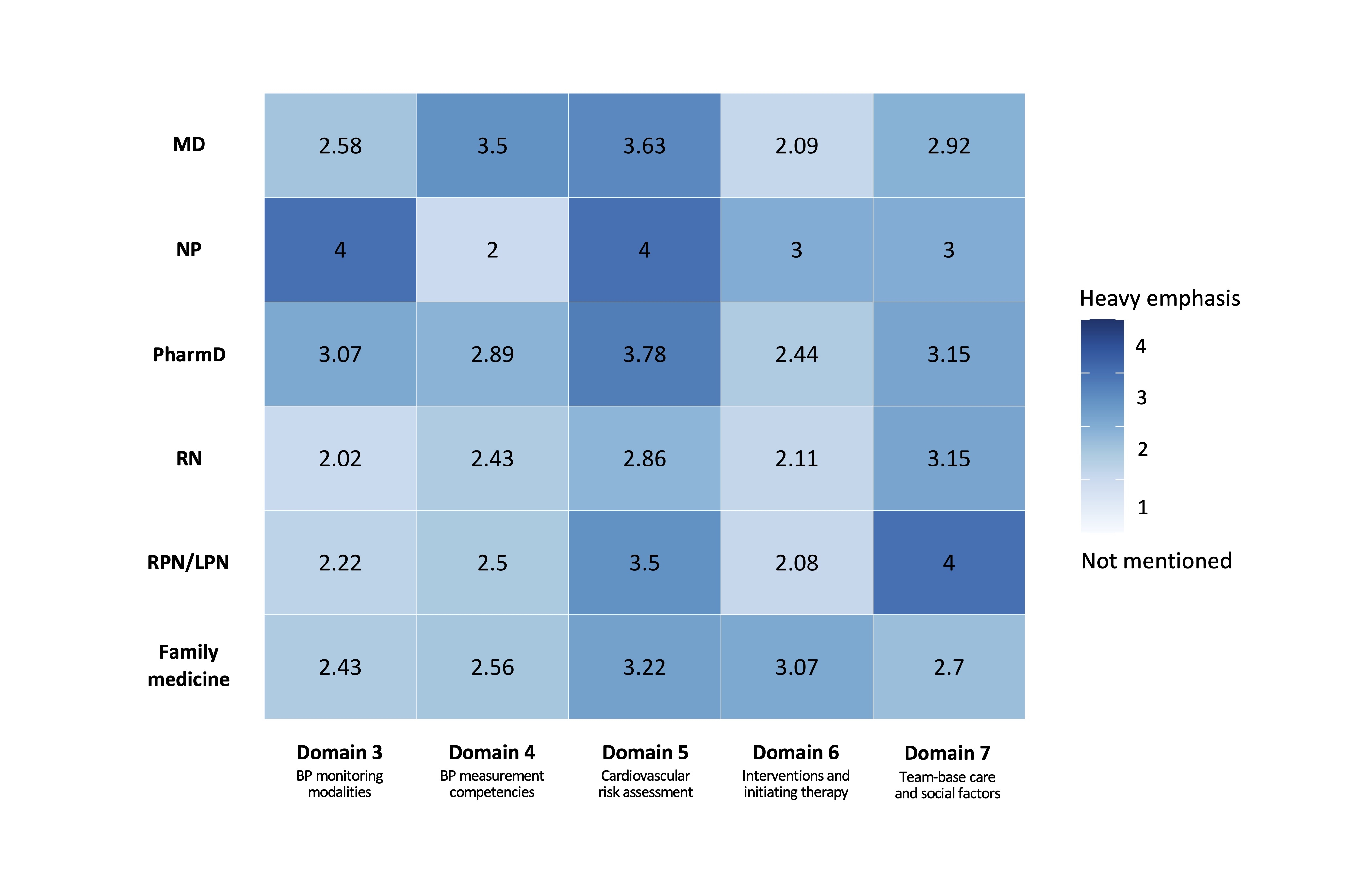
Results Sixty-three programs responded (60% response rate): 10 MD, 10 PharmD, 10 family medicine, 32 RN/RPN, and one NP. Most programs adequately covered hypertension pathophysiology and cardiovascular risk assessment but multidisciplinary care and hands-on skills were inconsistently addressed. Only 30% reported adequate training in guideline-based BP measurement. PharmD, MD, and RN students correctly identified a mean of 4.2, 3.75, and 3.2 of six BP measurement steps, respectively. Fewer than 30% of programs met benchmarks for use of digital tools or adherence counseling. Only 30% of MD programs reported adequate team-based care training, compared to 100% of RPN/LPN and 60% of RN and PharmD programs. Instructional hours ranged from 66.8 in MD to 9.5 in RPN/LPN programs.
Conclusions Hypertension education across Canadian healthcare training programs is variable, with notable gaps in hands-on skills. These findings establish a baseline to guide standardized interprofessional hypertension training development.
Glassman, Isaac
(
University of Ottawa
, Ottawa , Ontario , Canada )
Ho, Certina
(
University of Toronto
, Toronto , Ontario , Canada )
Fan, Lloyd
(
Canadian Federation of Medical Students
, Ottawa , Ontario , Canada )
Smith, Keirsten
(
Canadian Nursing Students' Association
, Ottawa , Ontario , Canada )
Patel, Shrusti
(
Canadian Nursing Students' Association
, Ottawa , Ontario , Canada )
Dsouza, Alisha
(
Canadian Nursing Students' Association
, Ottawa , Ontario , Canada )
Herrera, Marc
(
Canadian Association of Pharmacy Students and Interns
, Toronto , Ontario , Canada )
Zhao, Linsday
(
Canadian Association of Pharmacy Students and Interns
, Toronto , Ontario , Canada )
Walters, Joanna
(
University of Western Ontario
, London , Ontario , Canada )
Taylor, Laurel
(
Covenant Health
, Edmonton , Alberta , Canada )
Tsuyuki, Ross
(
University of Alberta
, Edmonton , Alberta , Canada )
Campbell, Norman
(
University of Calgary
, Calgary , Alberta , Canada )
Pasricha, Sachin Vidur
(
University of Toronto
, Toronto , Ontario , Canada )
Author Disclosures:
Isaac Glassman:DO NOT have relevant financial relationships
| Laurel Taylor:No Answer
| Ross Tsuyuki:No Answer
| Norman Campbell:DO NOT have relevant financial relationships
| Sachin Vidur Pasricha:DO have relevant financial relationships
;
Consultant:AstraZeneca:Active (exists now)
| Certina Ho:No Answer
| Lloyd Fan:No Answer
| Keirsten Smith:DO NOT have relevant financial relationships
| Shrusti Patel:DO NOT have relevant financial relationships
| Alisha Dsouza:No Answer
| Marc Herrera:No Answer
| Linsday Zhao:No Answer
| Joanna Walters:No Answer
Binesh Marvasti Tina, Moayedi Yas, Murray Kevin R, Kozusko Stella, Brum Margaret, Verhoeff Natasha, Fan Chun-po, Ho Gloria, Ross Heather, Duero Posada Juan