
Logo

American Heart Association

  36
  0


Final ID: FR439

Discrepancies Between Office and Home Blood Pressure Measurement: Insights from a Prospective, Real World-Evidence Study in Cardiovascular Practices in Brazil

Abstract Body: Background
Standardized measurement of blood pressure in both clinical and home settings is essential for the accurate diagnosis of hypertension and for the implementation of adequate therapy.
The aim of the present study was to evaluate the discrepancies between measurements taken in a clinical setting and those obtained through home blood pressure monitoring (HBPM) using an automated device in a real-world setting in Brazil.
Methods
This was a multicenter, prospective, observational, real-world evidence study Consecutive adult participants without an established diagnosis of hypertension or use of antihypertensive medications were recruited over a 12-month period across Brazil. All included participants underwent in-office BP measurement followed by HBPM using a validated device (HEM-7156T, Omron) for automated data collection and transmission to a specialized platform over four consecutive days. The classification of BP levels followed the Brazilian Society of Cardiology guidelines recommendations. The 4-day mean HBPM value for each participant was computed and compared with in-office BP using a chi-square test Results are presented as proportions and 95% confidence intervals (CI).
Results
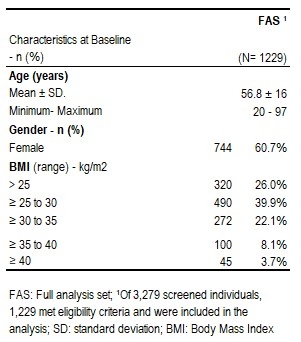
Of 3,279 screened individuals, 1,229 met eligibility criteria and were included in the analysis. The mean age was 56.8 ± 16 years, 60.7% were female, 39.9% had a BMI ≥25 and <30 kg/m2.
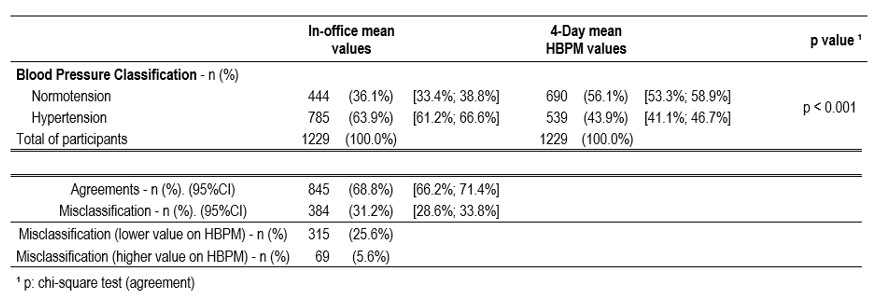
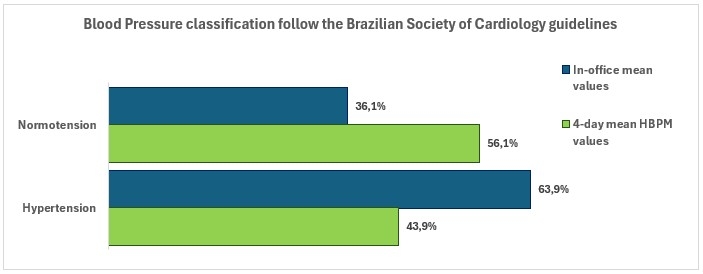
Regarding blood pressure classification, 36.1% (95% CI 28.6% to 33.8%) of the patients were classified as normotensive according to office measurements and 56.1% (95% CI 53.3% to 58.9%) with HPBM measurements, resulting in a misclassification rate of 31.2%. A total of 63.9% (95% CI 61.2% to 66.6%) of patients were classified as hypertensive (elevated BP to grade 3 hypertension, systolic hypertension or diastolic hypertension) based on office BP levels, whereas 43.9% (95% CI 41.1% to 46.7%) were classified as hypertensive according to the HBPM. All differences between groups were statistically significant (P< 0.05).
Conclusions
Among a real-world sample of individuals managed in cardiology practices in Brazil, we found relevant discrepancies between office and HBPM BP measurements. These findings highlight the importance of using out-of-office BP measurements, such as HBPM devices, along with office measurements, to accurately differentiate between hypertension and normotension phenotypes, avoiding misdiagnosis based solely on office BP measurements.
  • Borges, Jairo  ( UNIFESP , Sao Paulo , Brazil )
  • Faco, Lara  ( Libbs Pharmaceutical , Embu das Artes , Brazil )
  • Melo, Edielle  ( University of São Paulo , São Paulo , Brazil )
  • Povoa, Rui  ( UNIFESP , Sao Paulo , Brazil )
  • Lapa, Maura  ( Libbs Pharmaceutical , Embu das Artes , Brazil )
  • Oliveira Pereira, Renata  ( Libbs Pharmaceutical , Embu das Artes , Brazil )
  • Fernandes, Paula  ( Libbs Pharmaceutical , Embu das Artes , Brazil )
  • Castilho, Vivienne Carduz  ( Libbs Pharmaceutical , Embu das Artes , Brazil )
  • Author Disclosures:
    Jairo Borges: No Answer | Lara Faco: DO have relevant financial relationships ; Employee:Libbs Pharmaceutical:Active (exists now) | Edielle Melo: No Answer | Rui Povoa: No Answer | Maura Lapa: No Answer | Renata Oliveira Pereira: DO NOT have relevant financial relationships | Paula Fernandes: DO NOT have relevant financial relationships | Vivienne Carduz Castilho: DO NOT have relevant financial relationships
Meeting Info:
Session Info:

Poster Session 2 with Breakfast Reception

Friday, 09/05/2025 , 09:00AM - 10:30AM

Poster Session

More abstracts on this topic:
A First-In-Human Phase 1 Study of the Safety, Tolerability, and Pharmacodynamics of REGN7544, a Novel Natriuretic Peptide Receptor 1–Blocking Monoclonal Antibody

Ahmed Mohsin, Morton Lori, Olenchock Benjamin, Herman Gary, Wynne Chris, Marin Ethan, Tuckwell Katie, Xu Meng, Cheng Xiping, Redington Emily, Koyani Bharatkumar, Mateo Katrina, Thakur Mazhar, Devalaraja-narashimha Kishor

A closed-loop system based on piezoelectric thin-film sensors and photothermal nanomaterials enables precise renal denervation for the treatment of hypertension

Liu Chengzhe, Zhou Liping, Yu Lilei

You have to be authorized to contact abstract author. Please, Login
Not Available