Logo

American Heart Association

  38
  0


Final ID: FR465

Long-Term Systolic Blood Pressure Time in Target Range and Risk of Cardiovascular Disease Events in Community-Dwelling Older Adults

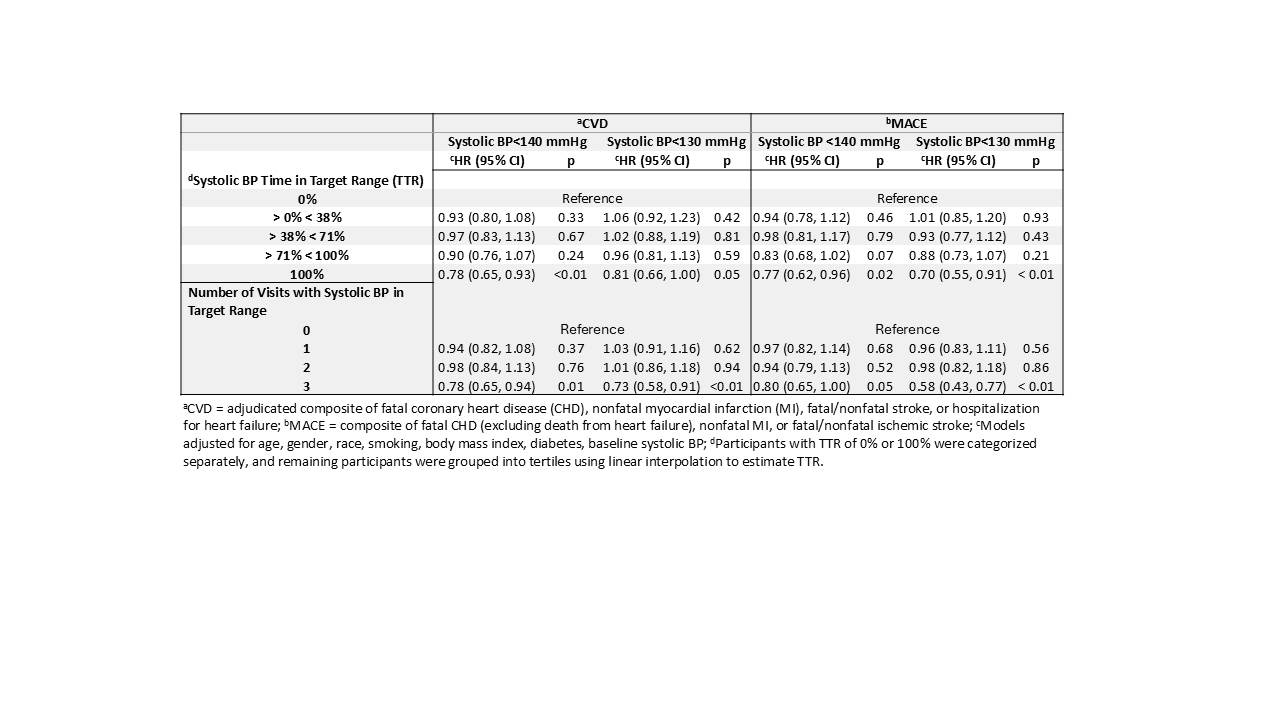
Abstract Body: Blood pressure (BP) is a dynamic entity, but BP control is typically judged from a single clinical visit or an average across multiple visits. Single visit BPs may not accurately reflect BP control over time, and an average BP can be within a target range even if none of its contributing measurements fall within that range. Time in target range (TTR) is a newer metric of BP control which encapsulates both average BP and BP variability over time to reflect the consistency of effective BP control. High TTR has been independently associated with lower risk of cardiovascular disease (CVD) events; however, prior research has been conducted almost exclusively in middle-aged hypertensives, or within hypertension intervention trials, and used TTR estimates over relatively short time periods (3 to 6 months) rather than long-term (yearly), prior to outcome ascertainment. Thus, the utility of long-term TTR has not been specifically evaluated in a general older-aged cohort of treated and untreated individuals. To address this gap, we performed a post-hoc analysis of 16,753 community-dwelling adults (mean age=74 years) without prior CVD enrolled in the ASPirin in Reducing Events in the Elderly study. Cumulative systolic BP TTR was calculated in each participant using the visit averages of triplicate BPs obtained at baseline and the first and second annual study visits. Cox proportional hazards models, adjusted for important covariates including baseline systolic BP, were used to examine TTR for two systolic BP targets (<140, <130 mmHg) and time to adjudicated incident CVD and major adverse cardiovascular events (MACE) occurring after the TTR index period. Participants with TTRs of 0% or 100% were categorized separately, with 0% as the reference group, and remaining participants were grouped into tertiles using linear interpolation to estimate TTR. TTR was also defined discreetly by the number of study visits at each of the two BP targets. Our results (Table) consistently showed that 100% TTR for systolic BP<140 mmHg was independently associated with approximately 20% lower risk of CVD and MACE, and for systolic BP<130 mmHg was associated with 19-42% lower risk. Results were consistent for participants treated with, and without, antihypertensives (data not shown). We conclude that long-term TTR is a useful metric to evaluate BP control in a general population of older adults, and our findings emphasize the importance of sustained BP control to lower risk of CVD.
  • Ernst, Michael  ( University of Iowa , Iowa City , Iowa , United States )
  • Stocks, Nigel  ( University of Adelaide , Adelaide , South Australia , Australia )
  • Wolfe, Rory  ( Monash University , Melbourne , Victoria , Australia )
  • Reid, Christopher  ( Curtin University , Perth , Western Australia , Australia )
  • Webb, Katherine  ( Monash University , Melbourne , Victoria , Australia )
  • Fravel, Michelle  ( University of Iowa , Iow City , Iowa , United States )
  • Woods, Robyn  ( MONASH UNIVERSITY , Melbourne , Victoria , Australia )
  • Beilin, Lawrence  ( University of Western Australia , Perth , Western Australia , Australia )
  • Orchard, Suzanne  ( Monash University , Melbourne , Victoria , Australia )
  • Polkinghorne, Kevan  ( Monash University , Melbourne , Victoria , Australia )
  • Owen, Alice  ( Monash University , Melbourne , Victoria , Australia )
  • Nelson, Mark  ( University of Tasmania , Hobart Tas Tas , Tasmania , Australia )
  • Author Disclosures:
    Michael Ernst: DO NOT have relevant financial relationships | Nigel Stocks: No Answer | Rory Wolfe: No Answer | Christopher Reid: No Answer | Katherine Webb: No Answer | Michelle Fravel: No Answer | Robyn Woods: No Answer | Lawrence Beilin: DO NOT have relevant financial relationships | Suzanne Orchard: No Answer | Kevan Polkinghorne: DO NOT have relevant financial relationships | alice owen: No Answer | Mark Nelson: DO NOT have relevant financial relationships
Meeting Info:
Session Info:

Poster Session 2 with Breakfast Reception

Friday, 09/05/2025 , 09:00AM - 10:30AM

Poster Session

More abstracts on this topic:
A Community Outreach Program Focused on Hypertension Awareness Reaches 600+ People in Rural Georgia and Works to Build the Next Generation of Biomedical Scientists

Dent Elena, Ilatovskaya Daria, Pinkerton Brittany, Crider Emily, Ryan Michael, Sullivan Jennifer

Clearing Senescent Cells Improves Mouse Survival Rate Post Myocardial Infarction through Alteration of Cardiomyocyte and Immune Cell Subpopulations

Mehdizadeh Mozhdeh, Leblanc Francis, Naud Patrice, Lettre Guillaume, Thorin Eric, Ferbeyre Gerardo, Nattel Stanley

More abstracts from these authors:
APOe Genotype Modifies the Association Between Long-Term Blood Pressure Variability and Cognitive Decline/Dementia in Older Adults

Ernst Michael, Wolfe Rory, Murray Anne, Shah Raj, Polkinghorne Kevan, Reid Christopher, Lacaze Paul, Ryan Joanne, Webb Katherine, Sheets Kerry, Woods Robyn, Fravel Michelle, Beilin Lawrence, Espinoza Sara, Orchard Suzanne, Owen Alice

Long-Term Blood Pressure Variability and Physical Performance Measures in Community-Dwelling Older Adults

Ernst Michael, Wolfe Rory, Murray Anne, Ryan Joanne, Shah Raj, Polkinghorne Kevan, Reid Christopher, Webb Katherine, Sheets Kerry, Woods Robyn, Fravel Michelle, Beilin Lawrence, Espinoza Sara, Orchard Suzanne, Owen Alice

You have to be authorized to contact abstract author. Please, Login
Not Available