Improving Blood Pressure Control Using Voice-Based AI Agents: A Scalable Approach to Quality Improvement for Seniors
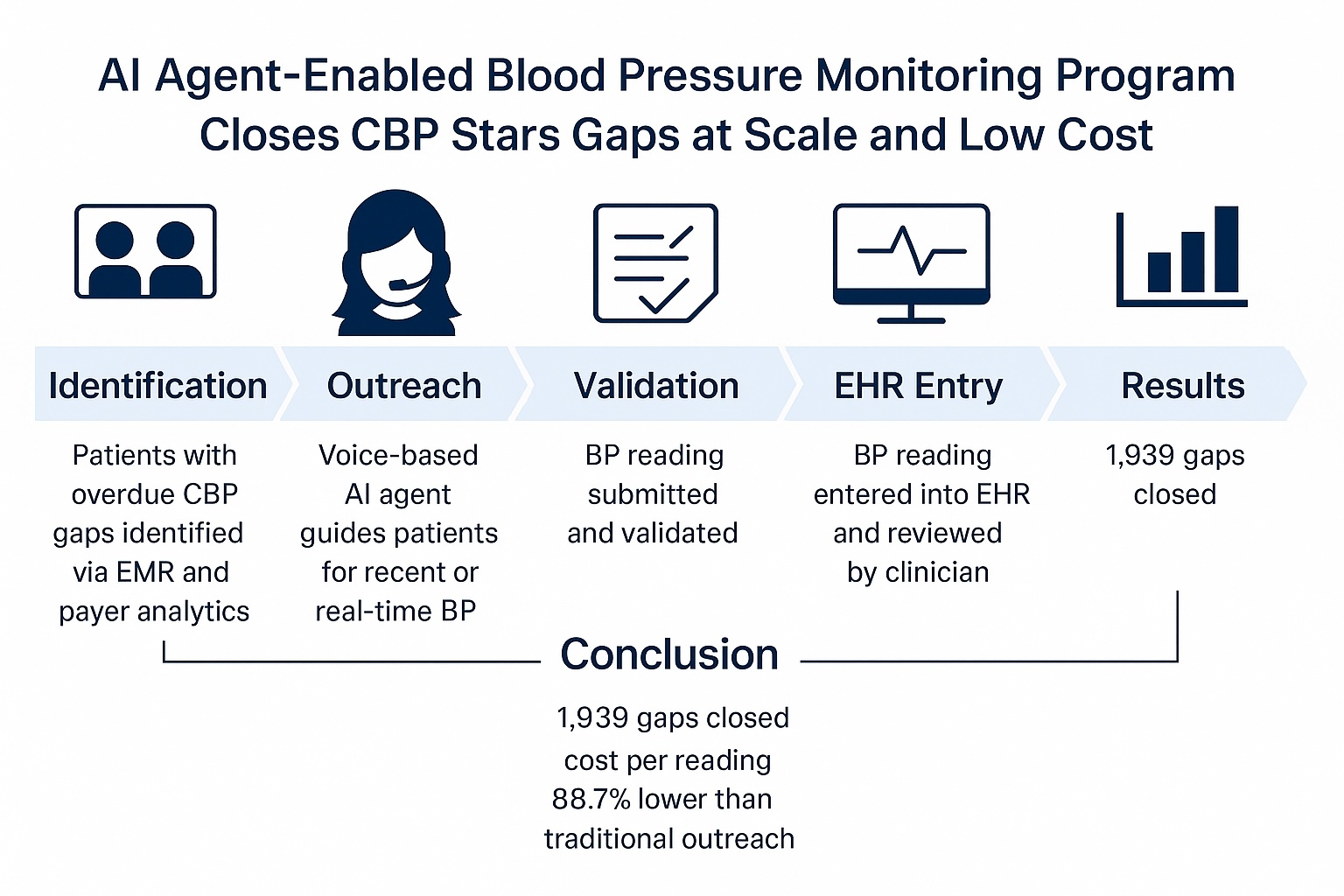
Abstract Body: Background Controlling blood pressure (CBP) remains a cornerstone for cardiovascular outcomes and MA Stars performance. Yet, capturing timely, compliant BP readings remains a challenge—particularly among patients with limited access to care. Emory Healthcare Network (EHN) and Guidehealth, a tech-enabled services company piloted a patient-centered, voice-based AI agent to collect and validate self-reported BP readings, rapidly closing gaps and boosting Stars outcomes. Objective: To evaluate the effectiveness and scalability of a voice-enabled AI agent in engaging patients to self-report accurate BP readings, supporting rapid quality gap closure in CBP Stars performance. Methods: A cohort of 2,000 patients with open CBP gaps was identified via EMR and payer analytics. Patient lists were scrubbed and validated by Guidehealth’s clinical operations team, ensuring real-time accuracy of gaps before outreach. Using multimodal methodology including generative AI voice agents, patients were contacted to provide recent BP readings or conduct live measurements during the call. The workflow integrated a post-call validation step where readings were entered into the EHR, clinician-reviewed, and submitted as supplemental data to close the Stars quality gap. Exception routing and care management referrals were triggered for uncontrolled BP cases. This process reduced the manual clinician workload and achieved a cost per compliant reading of 88.7% lower than by traditional outreach. Results: In a 10-week agile sprint, 85% of patients were successfully reached. Of those, 67% completed the call and 60% took a compliant BP reading. Among these patients, 68% met CBP Stars compliance thresholds. Overall, 1,939 CBP gaps were closed, elevating the measure from 1-Star to 4-Star performance—a 17% absolute improvement. Of the completed calls, patient-reported satisfaction exceeded 9/10, reflecting positive experiences with the voice-based AI agent interactions. Conclusion: Voice-based AI agents offer a scalable, patient-centered modality for improving BP control by enabling accurate self-reported measurements at home, closing Stars gaps rapidly and cost-effectively. This model reduced clinician burden, enhanced patient engagement, and accelerated quality improvement, demonstrating potential for broader hypertension control strategies across MA populations and health systems.
Kerr Thompson, Tina Ann
(
Emory University School of Medicine
, Atlanta , Georgia , United States )
Crowley, Mckay
(
Guidehealth
, Dallas , Texas , United States )
Doddamani, Sanjay
(
Guidehealth
, Dallas , Texas , United States )
Rai, Shaswath
(
Guidehealth
, Dallas , Texas , United States )
Salinas, Daniel
(
Emory Healthcare
, Atlanta , Georgia , United States )
Author Disclosures:
Tina Ann Kerr Thompson:DO NOT have relevant financial relationships
| McKay Crowley:No Answer
| Sanjay Doddamani:DO NOT have relevant financial relationships
| Shaswath Rai:No Answer
| Daniel Salinas:No Answer