
Logo

American Heart Association

  47
  0


Final ID: FR473

Leveraging a Learning Collaborative Framework to Drive Quality Improvement in Hypertension Management

Abstract Body: Background
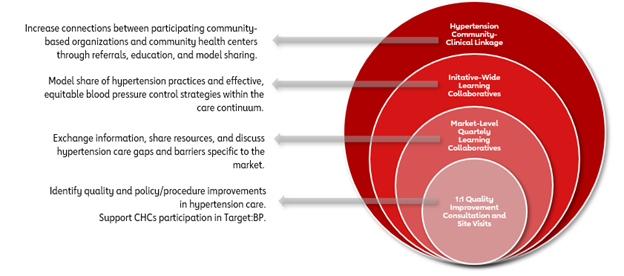
Hypertension (HTN) is a leading modifiable risk factor for cardiovascular disease, contributing to approximately 75% of acute cardiovascular events1. Health systems play a crucial role in addressing this burden through systemic HTN management and partnerships with community-based organizations (CBOs) to reduce structural barriers and empower patients. The American Heart Association (AHA) launched an equity-focused HTN initiative in Buffalo, Columbus, and Houston to improve HTN control across health care organizations (HCOs) and engage CBOs. The initiative uses a structured Learning Collaborative (LC) framework to support quality improvement (QI) through peer learning, model sharing, and culturally relevant adaptations. The goal is to achieve ≥70% HTN control rates among participating HCOs.

Methods
The Institute for Healthcare Improvement (IHI) LC model was used to guide implementation with two cohorts2 . HCOs began particpating in quarterly initiative-wide and market-level meetings in Janurary 2024. Both cohorts engaged in joint activities, such as biannual LCs and in-person discussions. LCs focused on model sharing and guided conversations to identify system-level barriers, such as care coordination gaps and patient engagement. The AHA provided QI consultation to support workflow improvement and alignment with site-level objectives. All HCOs also participated in the AHA/AMA Target: Blood Pressure program to reinforce evidence-based practices and standarized data collection. Survey and interviews were conducted in early 2025 to assess progress.

Results
The initiative established two cohorts consisting of 14 HCOs and 14 CBOs to strengthen community-clinical linkages (CCLs) and advance HTN care models. All HCOs established site-level objectives and reported progress toward sustainable strategies for improving HTN care. The dual-cohort model strengthened nearly 10 CCLs and fostered integrated care pathways between the two cohorts. Both cohorts noted improved integration and collaboration.

Conclusion
An equity-focused, dual-cohort LC model is both feasible and effective for improving HTN control rates in HCOs. Early indicators show increased leadership engagement, enhanced coordination, and uptake of QI strategies. The LC also serves as a tool for external review of internal processes, enabling organizations to identify gaps and refine strategies. Ongoing evaluation will assess HTN control outcomes and sustainability across participating sites.
  • Rizvi, Alizay  ( American Heart Association , Dallas , Texas , United States )
  • Johnson, Aleah  ( American Heart Association , Dallas , Texas , United States )
  • Pressley, Bianca  ( American Heart Association , Huntsville , Alabama , United States )
  • Harmon, Gary  ( American Heart Association , Dallas , Texas , United States )
  • Atkins, Jacqlyn  ( American Heart Association , Dallas , Texas , United States )
  • Serdynski, Lynn  ( American Heart Association , Dallas , Texas , United States )
  • Congdon, Michelle  ( American Heart Association , Waukesha , Wisconsin , United States )
  • Author Disclosures:
    Alizay Rizvi: DO NOT have relevant financial relationships | Aleah Johnson: No Answer | Bianca Pressley: No Answer | Gary Harmon: DO NOT have relevant financial relationships | Jacqlyn Atkins: No Answer | Lynn Serdynski: No Answer | Michelle Congdon: No Answer
Meeting Info:
Session Info:

Poster Session 2 with Breakfast Reception

Friday, 09/05/2025 , 09:00AM - 10:30AM

Poster Session

More abstracts on this topic:
A Case of Right Coronary Artery Chronic Total Occlusion in a Transplanted Heart: To Stent or Not to Stent?

Krayem Hussein, Cooke Richard, Abouzaki Nayef, Kutkut Issa

A Multifaceted Blood Pressure Intervention Improves Medication Adherence in Low Income Adults with Hypertension

Krousel-wood Marie, Mitchell Tammy, Gray Winfrey Lea, Williams Shondra, Wiltz Gary, Winfrey Keith, Chen Jing, He Jiang, Peacock Erin, Mills Katherine, Allouch Farah, Cyprian Alecia, Davis Gerrelda, Fuqua Sonja, S Gilliam Darie, Greer Angel

More abstracts from these authors:
A Model-Sharing Approach for Quality Improvement of Diabetes and Cardiovascular Disease

Elligers Kyle, Pollner Meghan, Overton Katherine, Congdon Michelle, Greenway Stacey, Lambro Patricia, Sadiku Steven, Schechter Rona, Whelan John, Pressley Bianca, Sednew Renee, Duckett Sara

Implementing Blood Pressure Kiosks in Community Hubs

Johnson Aleah, Harmon Gary, Atkins Jacqlyn, Siemering Kirstin, Rizvi Alizay, Pressley Bianca

You have to be authorized to contact abstract author. Please, Login
Not Available