Unique Stress, Cultural Resources, and Psychological Resilience in Young African American Women: Insights for Effective Intervention and CVD Prevention
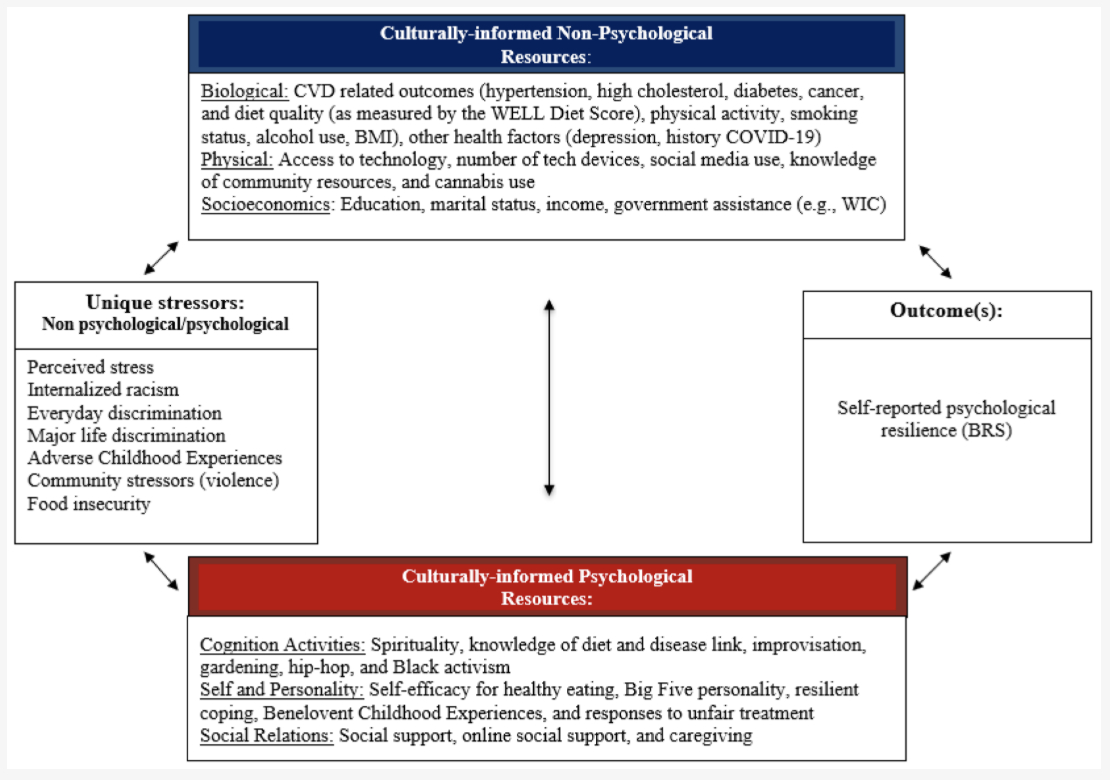
Abstract Body: Objective: Psychological resilience, defined as one’s self-reported ability to bounce back from stress, is understudied in young African American women (YAAW). Guided by community feedback, this study examined the associations between resilience and the following three constructs from Staudinger’s 2015 resilience and aging model: perceived stress, non-psychological resources, and psychological resources. We aimed to identify cultural resources that can enhance resilience in the face of unique stressors.
Methods: A cross-sectional survey was administered to 512 self-identified YAAW aged 18–35 years. Resilience was measured by the Brief Resilience Scale, ranging from one to five, with higher scores indicating greater resilience. We employed linear regression to examine the relationships among stressors, resources, and resilience, and then used elastic net (EN) regularization to identify the resources most strongly associated with resilience after adjusting for age and stressors. Data were analyzed using SAS version 9.4.
Results: YAAW with higher resilience experienced fewer stressors and reported greater access to both non-psychological and psychological resources. In the adjusted EN model, perceived stress (β = −0.16), internalized racism (β = −0.06), and adverse childhood experiences (β = −0.03) demonstrated the strongest associations with lower resilience. Conversely, improvisational skills (β = 0.23), (emotional stability or the absence of) neurotic personality traits, β = −0.22), presence of conscientious personality traits (β = 0.08), and not expressing anger to cope with discrimination (β = −0.04) had the strongest associations with higher resilience. Notably, high improvisation skills and low levels of neuroticism were identified as key resilience resources.
Conclusion: Stress reduction techniques that focus on addressing racial trauma and highlight the health-promoting aspects of AA cultural identity, such as improvisation, may play an important role in fostering resilience among YAAW. Further research is needed to validate these findings and to help inform the development of effective intervention strategies in this group.
Springfield, Sparkle
(
Loyola University Chicago
, Chicago , Illinois , United States )
Joyce, Cara
(
Erikson Institute
, Chicago , Illinois , United States )
Penny Williams-wolford, Penny
(
Erikson Institute
, Chicago , Illinois , United States )
Wolford, Dinishia
(
Loyola University Chicago
, Chicago , Illinois , United States )
Onyeise, Destiny
(
Department of Population Health Sciences, School of Medicine and Public Health
, Madison , Wisconsin , United States )
Battles, Natalie
(
Melanated in America
, Chicago , Illinois , United States )
Milton, Dionne
(
The Healing Academy
, Chicago , Illinois , United States )
Mogbo, Chineze
(
The Healing Academy
, Chicago , Illinois , United States )
Robinson, Raigine
(
The Healing Academy
, Chicago , Illinois , United States )
Stovall, Dave
(
University of Illinois at Chciago
, Chicago , Illinois , United States )
Hatchett, Lena
(
Loyola University Chicago
, Chicago , Illinois , United States )