EPI-Lifestyle Scientific Sessions 2026
/
Poster Session 2
/
Trends in Hypertension Control Using Traditional and New Guideline-Directed Blood Pressure Control Parameters: Results from the National Health and Nutrition Examination Survey (NHANES), 2011–2020
American Heart Association
72
0
Final ID: WE461
Trends in Hypertension Control Using Traditional and New Guideline-Directed Blood Pressure Control Parameters: Results from the National Health and Nutrition Examination Survey (NHANES), 2011–2020
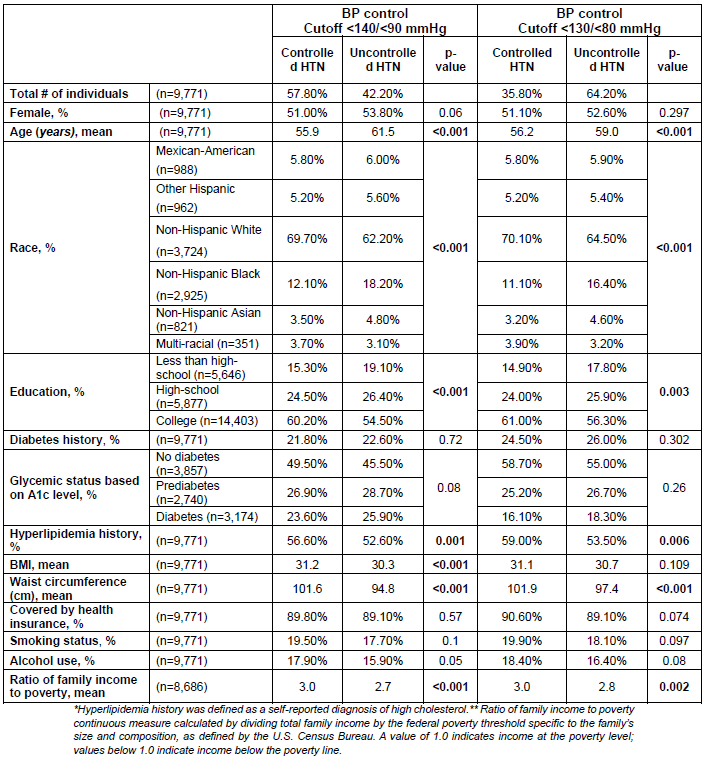
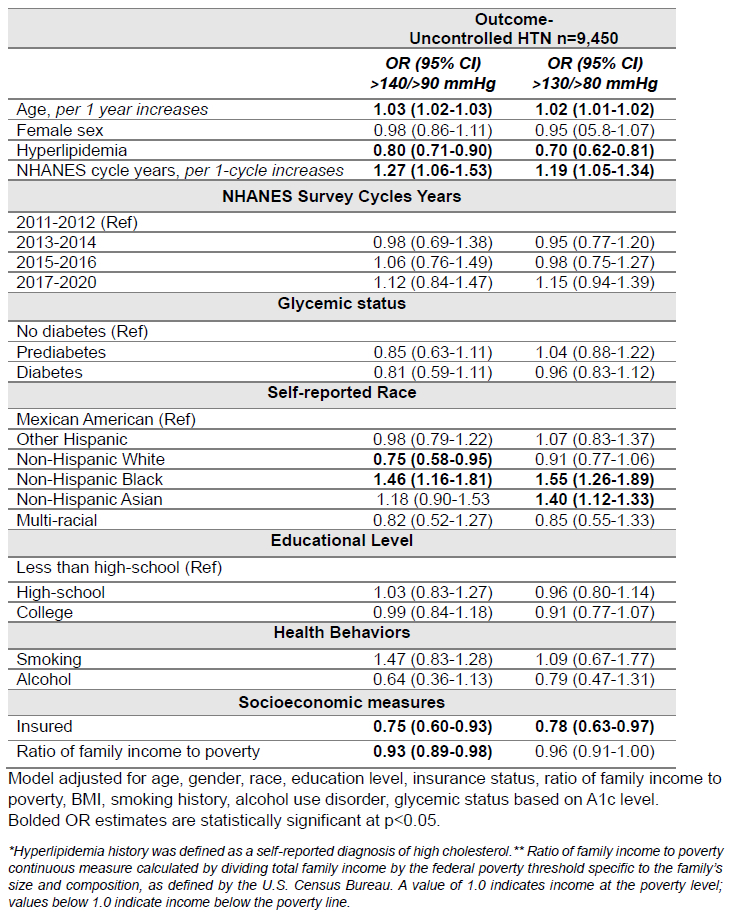
Abstract Body: Background Hypertension (HTN) is a key modifiable cardiovascular risk factor. The 2025 AHA/ACC blood pressure (BP) guidelines reaffirmed <130/80 mmHg as the new BP treatment target, yet national trends of BP control under this cutoff vs. the traditional <140/90 mmHg remains unclear. We examined trends in BP control across both definitions using data from the National Health and Nutrition Examination Survey (NHANES). Methods NHANES data from four survey cycles (years 2011–2012, 2013–2014, 2015–2016, and 2017–2020) was analyzed, identifying 9,771 non-pregnant adults with self-reported HTN and/or antihypertensive medication use. Uncontrolled BP was defined as cutoffs >140/90 mmHg and >130/80 mmHg. Sociodemographic and clinical covariates (Table 1) were examined. Multivariate logistic regression assessed sociodemographic and clinical factors associated with uncontrolled BP over time. All analyses accounted for the complex sampling design using survey weights. Results Among 9,771 adults with HTN (mean age 47.7 years; 51% female), 76% reported antihypertensive use. BP control was 57.8% at <140/90 mmHg and 35.8% at <130/80 mmHg. Regardless of BP control definition, adults with uncontrolled HTN were older, more likely to be non-Hispanic (NH) Black adults (18.2% vs 12.1% [>140/90 mmHg] and 16.4% vs 11.1% [>130/80 mmHg]), and had lower educational attainment and income-to-poverty ratios, smaller waist circumference, and less self-reported hyperlipidemia compared with adults with controlled HTN (all p<0.01, Table 1). Older age, later NHANES cycle years, and NH Black race (vs Mexican Americans) were associated with higher odds of uncontrolled HTN under both BP control cutoffs, while NH Asian adults emerged with 40% higher odds of uncontrolled HTN using the new guideline-directed definition <130/80 mmHg (Table 2). Hyperlipidemia and insurance coverage were inversely associated with uncontrolled HTN across both BP control cutoffs. In contrast, NH White (vs Mexican Americans) had lower odds of uncontrolled HTN using the >140/90 mmHg cutoff, but the association was lost with >130/80 mmHg cutoff. A similar pattern was observed for the family income-to-poverty ratio, Table 2. Conclusions BP control remains suboptimal nationwide, particularly under the <130/80 mmHg target, underscoring a widening gap between evidence-based goals and real-world outcomes. Persistent racial and socioeconomic disparities highlight the need for tailored and equitable strategies to improve HTN control.
Rodriguez Szaszdi, David Jose Javier
(
Albert Einstein College of Medicine
, Bronx , New York , United States )
Duran Luciano, Priscilla
(
Albert Einstein College of Medicine
, Bronx , New York , United States )
Satish, Vikyath
(
Albert Einstein College of Medicine
, Bronx , New York , United States )
Modak, Vishakha
(
Albert Einstein College of Medicine
, Bronx , New York , United States )
Borkowski, Pawel
(
UPMC HAarrisburg
, Camp Hill , Pennsylvania , United States )
Woo, Evan
(
Albert Einstein College of Medicine
, Bronx , New York , United States )
Rodriguez, Carlos
(
Albert Einstein School of Medicine
, Bronx , New York , United States )