
Logo

American Heart Association

  3
  0


Final ID: TU186

Plasma Metabolomics and Incident Heart Failure in Patients with Gout

Abstract Body: Background: Individuals with gout have an elevated risk of developing heart failure (HF) compared to the general population. Larger HDL particle size associates with a higher HF risk in community-dwelling adults. Small HDL particles exert anti-inflammatory effects that may protect against gout attacks and cardiac dysfunction.
Objectives: We sought to identify potentially causal metabolic contributors to the development of HF in patients with gout.
Methods: We performed targeted 1H-NMR metabolomics (Nightingale Health) on plasma samples from 1,454 Mass General Brigham (MGB) Biobank participants with a history of gout and no history of heart failure. The primary outcome was incident HF, ascertained using two ICD billing codes for heart failure. Where available, LVEF was used to categorize HF events as HFpEF (LVEF > 50%) or HFrEF (LVEF < 50%). We used multivariable Cox proportional hazards regression to quantify the associations between a 1-SD difference in metabolite level and the time to incident HF at FDR significance < 0.05. We compared metabolite-HF associations in patients with gout to those observed in a matched cohort.
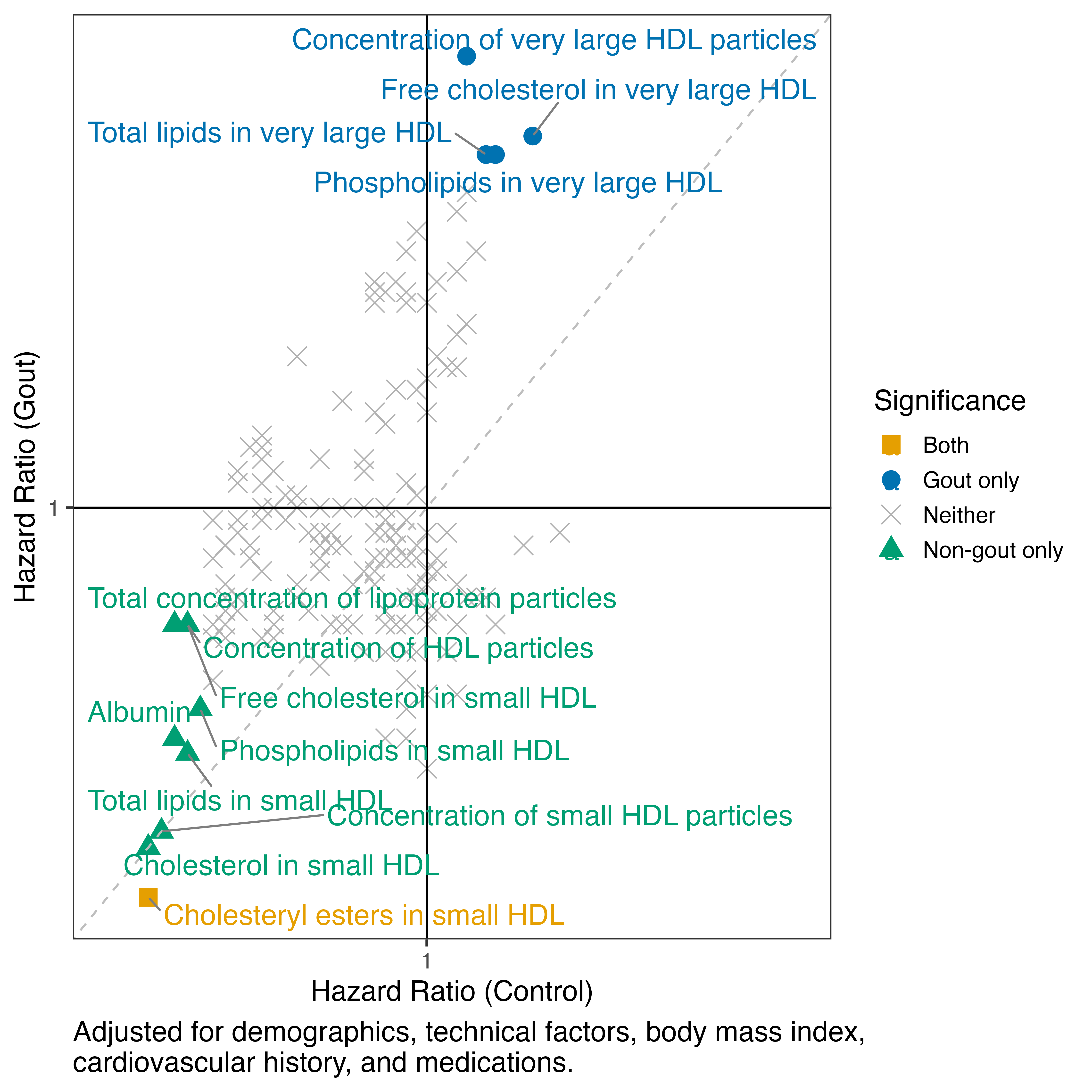
Results: The mean age was 75 ± 11 years, 81% of the patients were male, and 88% were self-reported as White. A total of 280 HF events (20 events per 1,000 person-years; 35 HFrEF and 143 HFpEF) occurred over a median follow-up period of 7 years. Among participants with gout, a higher concentration of extra large HDL particles significantly associated with a higher risk of incident HF (HR [95% CI]: 1.44 [1.17-1.76]). In addition, higher levels of free cholesterol (1.35 [1.12-1.62]), phospholipids (1.33 [1.10-1.61]) and total lipids (1.33 [1.10-1.60]) within each extra large HDL particle significantly associated with higher HF risk in participants with gout (Figure), with larger effect sizes for HFrEF than HFpEF. In contrast, higher concentrations of small HDL particles, and higher concentrations of free cholesterol, phospholipids and cholesteryl esters in small HDL particles, associated with lower HF risk in the matched controls only (Figure), with similar effect sizes for HFpEF and HFrEF.
Conclusions: Extra large HDL particles significantly associate with a higher risk of incident HF in patients with gout. In contrast, small HDL particles associate with a lower risk of incident HF in individuals without gout. The mechanisms underlying these associations warrant further study.
  • Buckley, Leo  ( The University of Texas Southwestern Medical Center , Dallas , Texas , United States )
  • Kotanidis, Christos  ( University of Oxford , Oxford , United Kingdom )
  • Lasky-su, Jessica  ( Brigham and Women's Hospital , Dover , Massachusetts , United States )
  • Karlson, Elizabeth  ( Brigham and Women's Hospital , Dover , Massachusetts , United States )
  • Liao, Katherine  ( Brigham and Women's Hospital , Dover , Massachusetts , United States )
  • Rohatgi, Anand  ( The University of Texas Southwestern Medical Center , Dallas , Texas , United States )
  • Hegde, Sheila  ( The University of Texas Southwestern Medical Center , Dallas , Texas , United States )
  • Weber, Brittany  ( The University of Texas Southwestern Medical Center , Dallas , Texas , United States )
  • Author Disclosures:
Meeting Info:

EPI-Lifestyle Scientific Sessions 2026

2026

Boston, Massachusetts

Session Info:

Poster Session 1

Tuesday, 03/17/2026 , 05:00PM - 07:00PM

Poster Session

More abstracts on this topic:
9-Year Longitudinal Assessment of the 12-lead Electrocardiogram of Volunteer Firefighters

Bae Alexander, Dzikowicz Dillon, Lai Chi-ju, Brunner Wendy, Krupa Nicole, Carey Mary, Tam Wai Cheong, Yu Yichen

A Novel Machine Learning Strategy to Integrate Multi-Omics Data and Detect Genomic Loci and Gene-Environment Interactions for LDL Cholesterol

Li Changwei, Zhang Ruiyuan, Sun Yixi, Chen Jing, Wang Tao, Bazzano Lydia, Kelly Tanika, He Jiang

More abstracts from these authors:
You have to be authorized to contact abstract author. Please, Login
Not Available