Logo

American Heart Association

  27
  0


Final ID: 58

Clinical and Biomarker Subtypes of Preeclampsia and Future Cardiovascular Health

Abstract Body: Background: Preeclampsia is a leading cause of maternal-fetal morbidity and strongly linked to future cardiovascular disease. Prediction and prevention remain limited, in part due to preeclampsia heterogeneity and poorly defined biological subtypes. Better delineation of preeclampsia subtypes could inform strategies to reduce preeclampsia and its short- and long-term morbidity. We aimed to identify novel clinical and biomarker defined subtypes of preeclampsia using unsupervised machine learning and evaluate their associations with postpartum cardiovascular health.

Methods: Participants with preeclampsia, defined per ACOG criteria, were identified from the multicenter, prospective Nulliparous Pregnancy Outcomes Study: Monitoring Mothers-to-Be (NuMoM2b)-Heart Health Study. Participants with pre-pregnancy hypertension were excluded. Clinical and demographic data, placental and cardiovascular biomarkers, and proteomic profiles were analyzed. Two-stage feature selection (Boruta SHAP and volcano filtering) identified informative proteomic markers, integrated with clinical variables. UMAP dimensionality reduction and Gaussian Mixture Model clustering (optimized by silhouette scores) identified subtypes, followed by refinement to maximize between-cluster variance. The resulting subgroups represented phenotypically and biologically distinct preeclampsia endotypes. Postpartum incident hypertension (>=130/80 mmHg or medication use at 2-7 years) was compared across subtypes using modified Poisson regression.

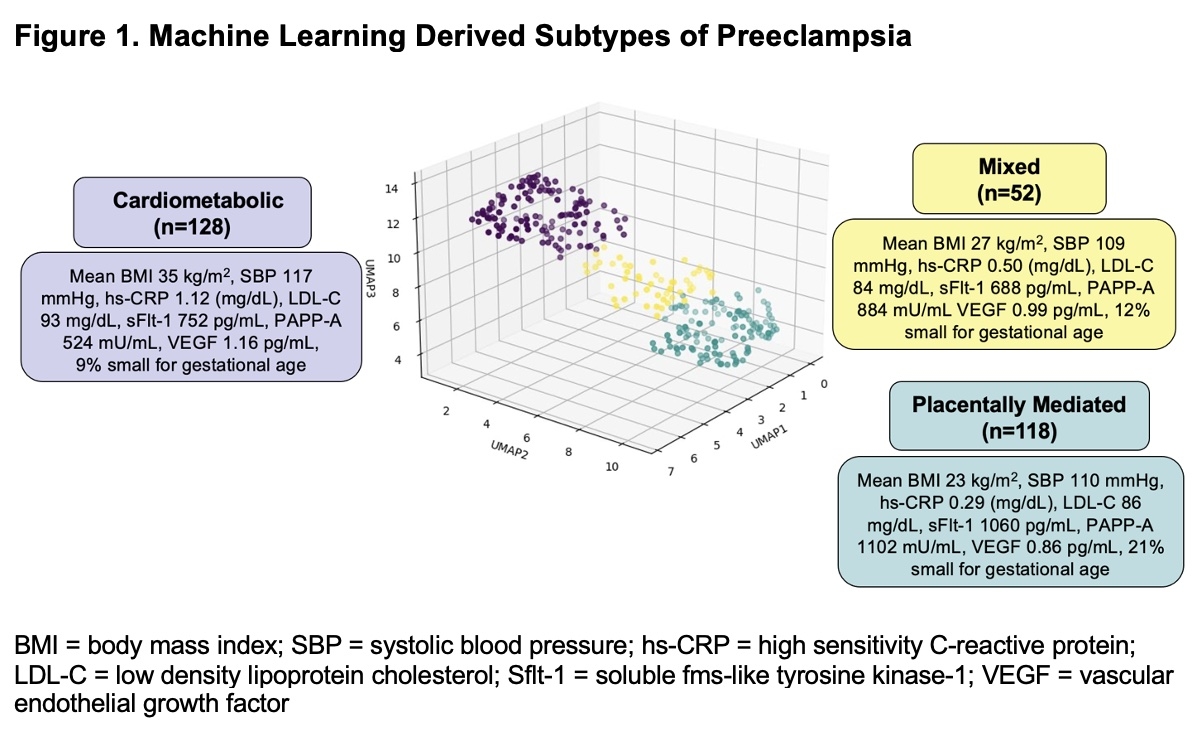
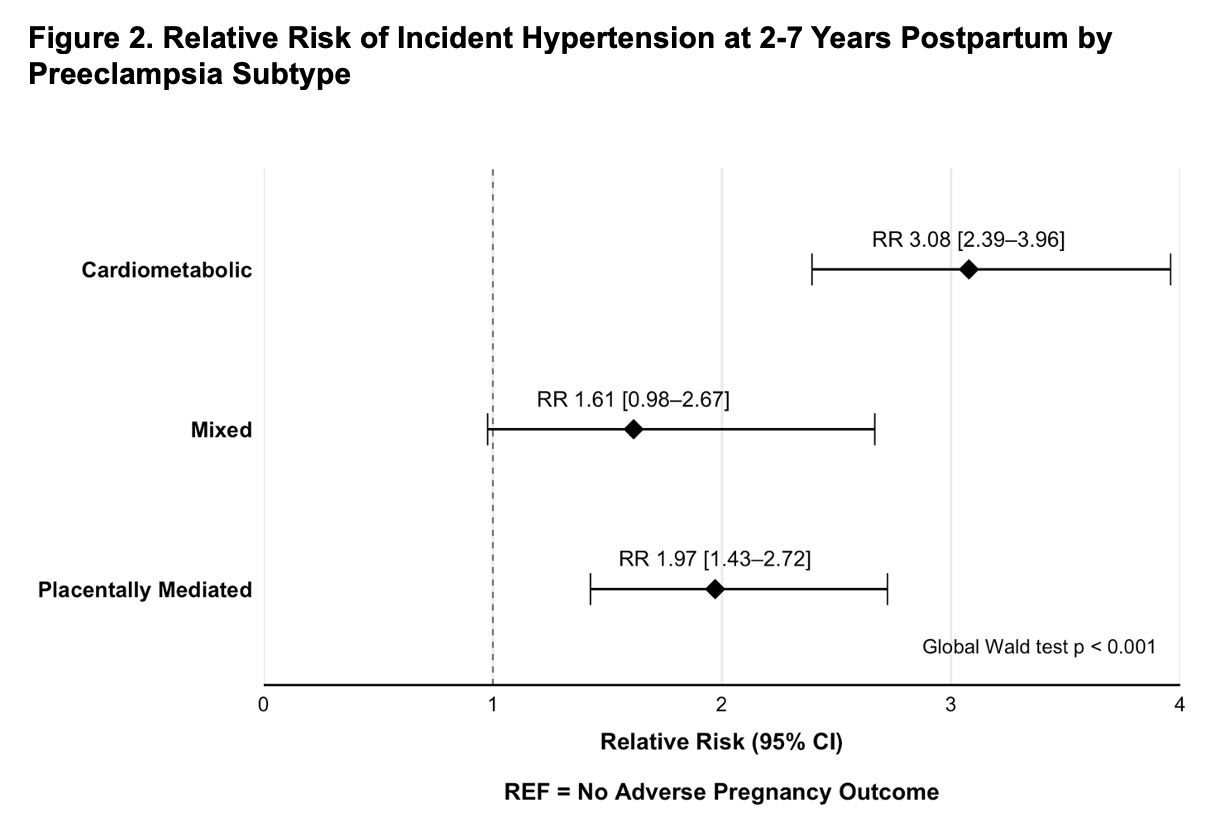
Results: Among 298 women with preeclampsia, three subtypes emerged (Figure 1): (1) cardiometabolic – higher body mass index, blood pressure, and maternal inflammatory markers; (2) placentally-mediated – elevated placental analytes and normal maternal cardiometabolic features; and (3) mixed – intermediate cardiometabolic and placental analyte profiles. All subtypes showed high risk of incident hypertension versus women without adverse pregnancy outcomes (n=755). Risk was highest in the cardiometabolic subtype (RR 3.09 [95%CI 2.39-3.97]), followed by placentally mediated (RR 1.97 [1.43-2.73]) and mixed (RR 1.62 [0.98-2.67]) (global Wald test p<0.001; Figure 2).

Conclusion:
Preeclampsia comprises biologically distinct subtypes with heightened but differential postpartum cardiovascular risk. Recognition of this heterogeneity provides new insights into pathophysiology and may advance precision prevention of preeclampsia and its long-term cardiovascular sequelae.
  • Minhas, Anum  ( Johns Hopkins University , Baltimore , Maryland , United States )
  • Chinni, Bhargava  ( Johns Hopkins University , Baltimore , Maryland , United States )
  • Manlhiot, Cedric  ( THE HOSPITAL FOR SICK CHILDREN , Toronto , Ontario , Canada )
  • Ndumele, Chiadi  ( JOHNS HOPKINS HOSPITAL , Silver Spring , Maryland , United States )
  • Wallace, Amelia  ( JH Bloomberg Sch. of Public Health , Baltimore , Maryland , United States )
  • Boyer, Theresa  ( Johns Hopkins University , Wayne , Pennsylvania , United States )
  • Grobman, William  ( Brown University , Providence , Rhode Island , United States )
  • Merz, Cn  ( Cedars Sinai Medical Center , Los Angeles , California , United States )
  • Saade, George  ( Eastern Virginia Medical School , Norfolk , Virginia , United States )
  • Greenland, Philip  ( FEINBERG SCH OF MEDICINE , Chicago , Illinois , United States )
  • Levine, Lisa  ( University of Pennsylvania , Philadelphia , Pennsylvania , United States )
  • Vandergrift, Nathan  ( RTI International , Research Triangle , North Carolina , United States )
  • Yee, Lynn  ( Northwestern , Chicago , Illinois , United States )
  • Rouse, Caroline  ( Indiana University , Indianapolis , Indiana , United States )
  • Waks, Ashten  ( University of California Irvine , Irvine , California , United States )
  • Khan, Sadiya  ( Northwestern University , Chicago , Illinois , United States )
  • Catov, Janet  ( UNIVERSITY OF PITTSBURGH , Pittsburgh , Pennsylvania , United States )
  • Author Disclosures:
Meeting Info:

EPI-Lifestyle Scientific Sessions 2026

2026

Boston, Massachusetts

Session Info:

Hypertension

Friday, 03/20/2026 , 10:30AM - 12:00PM

Oral Abstract Session

More abstracts on this topic:
Activated CD8+HLA-DR+ T Cells as Immune Biomarkers of Metabolic Dysfunction and Cardiovascular Risk in Prediabetes

Alrashed Fatema, Alsaeed Halemah, Alturaiki Wael, Akhter Nadeem, Alosaimi Bandar, Almutairi Saeedah, Mubarak Ayman, Al-mulla Fahd, Ahmad Rasheed

A Novel EMR-Based Algorithm with the Virtual Echocardiography Screening Tool (VEST) to Screen Patients for Pulmonary Arterial Hypertension

Narowska Gabriela, Anand Suneesh, Gangireddy Chethan, Enevoldsen John, Keane Martin, Edmundowicz Daniel, Forfia Paul, Vaidya Anjali

More abstracts from these authors:
Depressive symptoms during late pregnancy are associated with higher cardiovascular disease risk 2-7 years after delivery.

Donofry Shannon, Yee Lynn, Catov Janet, Grobman William, Bairey Merz C Noel, Saade George, Hoffman Matthew, Pemberton Victoria, Levine Lisa, Khan Sadiya, Reddy Uma

The Duration of Expectant Management During Hypertensive Disorders of Pregnancy and Blood Pressure 2-7 Years After Delivery

Shree Raj, Bairey Merz C Noel, Grobman William, Catov Janet, Pike Mindy, Simhan Hyagriv, Yee Lynn, Levine Lisa, Silver Robert, Hoffman Matthew, Greenland Philip, Saade George

You have to be authorized to contact abstract author. Please, Login
Not Available