Logo

American Heart Association

  31
  0


Final ID: 07

Intergenerational Socioeconomic Mobility and Life’s Essential 8 Cardiovascular Health

Abstract Body: Background:
Intergenerational socioeconomic mobility—a core measure of opportunity in American society—has declined in recent decades, yet its relationship with cardiovascular health (CVH) remains unclear. We investigated the association between intergenerational socioeconomic mobility and Life’s Essential 8 (LE8) CVH and assessed heterogeneities by race and sex.
Methods:
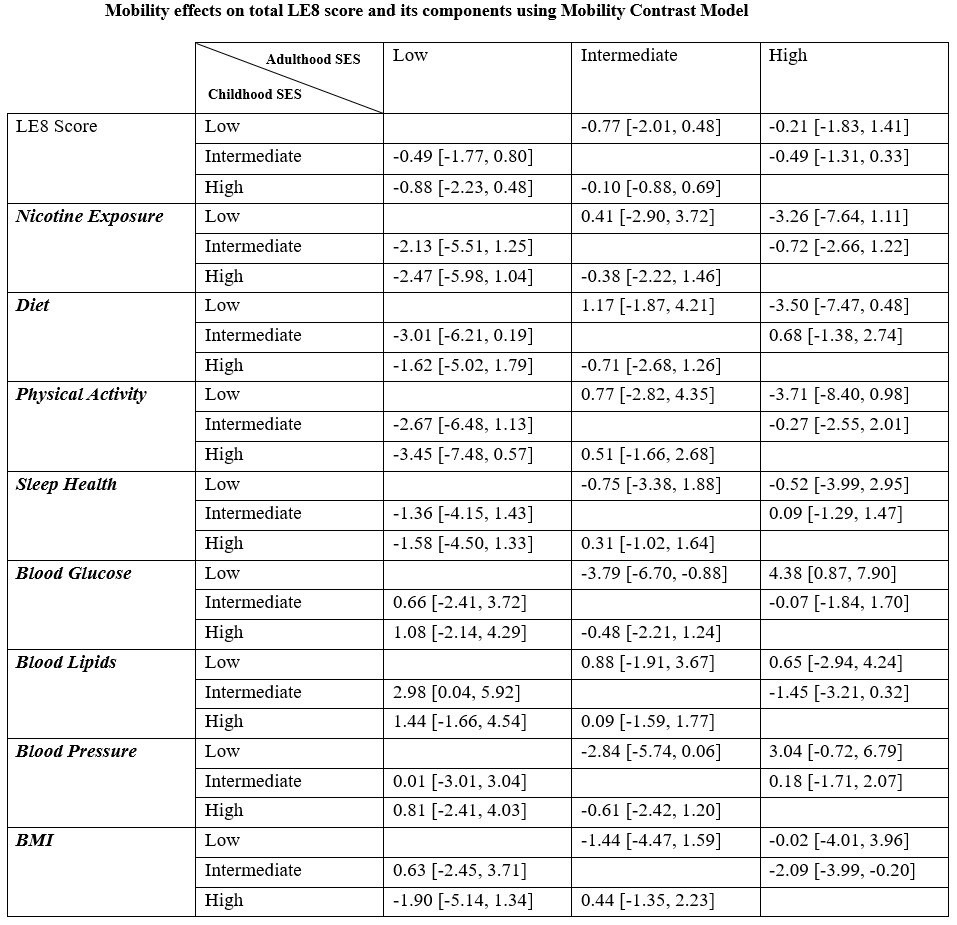
We analyzed 9,979 participants (27.5% Black, 54.5% women; mean age 63.3 years) from the REasons for Geographic and Racial Differences in Stroke (REGARDS) study with complete data on childhood and adult socioeconomic status (SES). Parental SES was derived from education and material assets; adult SES combined education and income. Intergenerational mobility was classified into nine childhood–adulthood SES categories. LE8 scores (0–100) were computed as the mean of eight AHA LE8 components. We applied the Mobility Contrast Model (MCM) to estimate independent effects of upward and downward mobility on total and component LE8 scores by removing the impact of childhood and adulthood SES, adjusting for age, sex, race, marital status, and region.
Results:
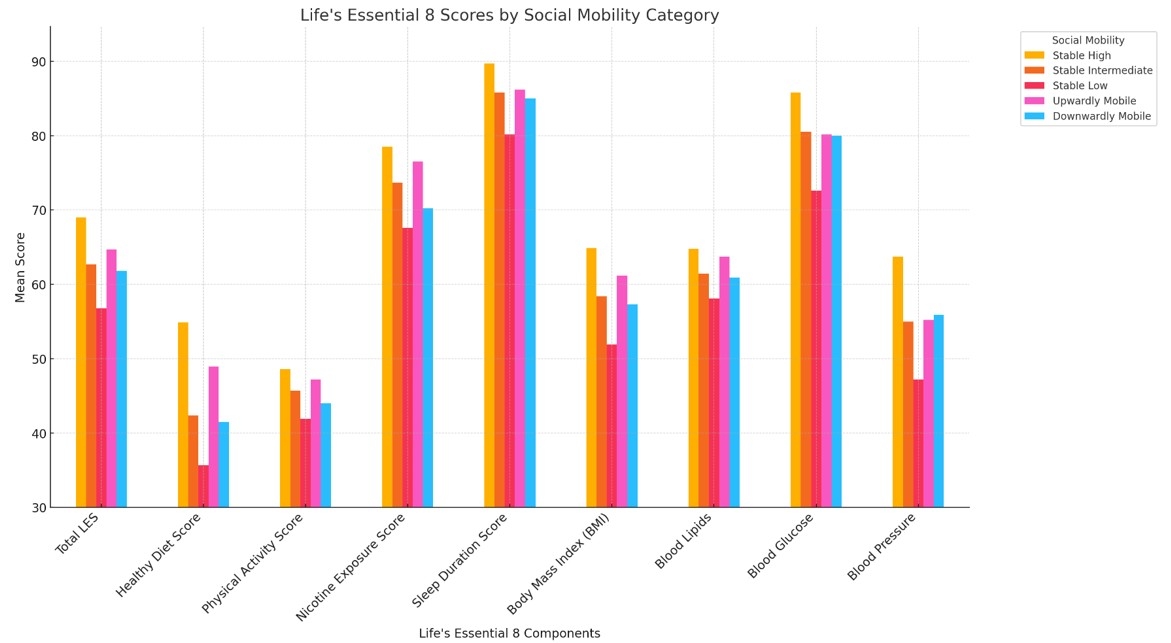
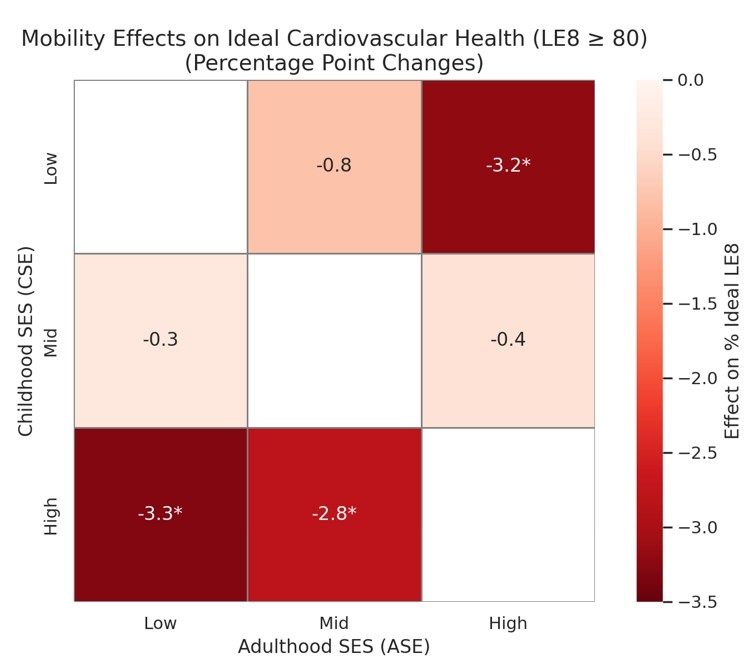
Participants stably high in SES had the most favorable mean LE8 (69.0), whereas those with stably low SES had the poorest (56.8). Upwardly mobile individuals had higher mean LE8 (64.7) than those downwardly mobile (61.8). In MCM analyses, upward and downward mobility effects on total LE8 were modest and not statistically significant, but downward mobility was associated with lower blood glucose (β = −3.8 [−6.7, −0.9]) and higher BMI (β = −2.1 [−4.0, −0.2]). Significant interaction effects indicated that upward mobility conferred smaller CVH benefits for Black participants and women compared with White men, especially for diet, smoking, and diabetes scores (p < 0.05).
Conclusions:
Although stable high SES was consistently linked to ideal CVH, mobility effects were heterogeneous and dependent on race and sex. Upward mobility did not uniformly translate into improved LE8 health, suggesting unequal health returns to social ascent. Findings underscore the need for policies addressing both cardiovascular inequities and the structural barriers limiting equitable health gains from socioeconomic mobility.
  • Moafi-madani, Miremad  ( Brown University School of Public Health , Providence , Rhode Island , United States )
  • Eaton, Charles  ( Center for Primary Care and Prevention, Kent Hospital , Pawtucket , Rhode Island , United States )
  • Author Disclosures:
Meeting Info:

EPI-Lifestyle Scientific Sessions 2026

2026

Boston, Massachusetts

Session Info:

Non-Medical Drivers of Health

Wednesday, 03/18/2026 , 01:30PM - 03:00PM

Oral Abstract Session

More abstracts on this topic:
Comparative Effects of Education and Income Levels and Cardiovascular Risk Factors for the Risk of Ischemic Heart Disease, Ischemic Stroke, or Peripheral Artery Disease Associated Mortality

Fueller David, Quyyumi Arshed, Liu Chang, Boten David Niklas, Ritter Oliver, Doerr Gesine, Jain Vardhmaan, Desai Shivang, Sperling Laurence, Sun Yan

A machine learning approach to classifying ischemic stroke etiology using variables available in the Get-with-the-Guidelines Stroke Registry

Lee Ho-joon, Schwamm Lee, Turner Ashby, De Havenon Adam, Kamel Hooman, Brandt Cynthia, Zhao Hongyu, Krumholz Harlan, Sharma Richa

More abstracts from these authors:
Risk Factors of Atrial Fibrillation, Heart Failure and Their Co-occurrence in Postmenopausal Women: A Womens’s Health Initiative Study

Baig Muhammad, Khan Ali, Moafi-madani Miremad, Larson Joseph, Lamonte Michael, Lu Bing, Shah Nishant, Roberts Mary, Eaton Charles

Temporal Association and Prognosis of Atrial Fibrillation/Flutter with Heart Failure and its Subtypes in Post-menopausal Women: A Women’s Health Initiative Study

Baig Muhammad, Ali Muhammad Zain, Lamonte Michael, Khan Ali, Roberts Mary, Moafi-madani Miremad, Larson Joseph, Shah Nishant, Eaton Charles

You have to be authorized to contact abstract author. Please, Login
Not Available