Inflammation and Long-Term Progression of Cardiovascular-Kidney-Metabolic Syndrome Among Young Adults: Insights from the CARDIA Study
Abstract Body: Background: Chronic, low-grade inflammation is increasingly recognized as an important mechanism underlying the development of cardiovascular, kidney, and metabolic (CKM) conditions. However, whether it is associated with CKM syndrome progression is uncertain.
Methods: In the prospective Coronary Artery Risk Development in Young Adults (CARDIA) study, which recruited young adults (aged 18-30 years) between 1985-1986. For this study, baseline was defined at a follow-up visit in 1992 when high-sensitivity C-reactive protein (hsCRP) was measured. CKM syndrome stages were characterized according to adapted American Heart Association criteria at follow-up visits 3- and 28-years after hsCRP measurement. The association between hsCRP and progression of CKM syndrome (transition to ≥1 higher stages) over 25 years was examined.
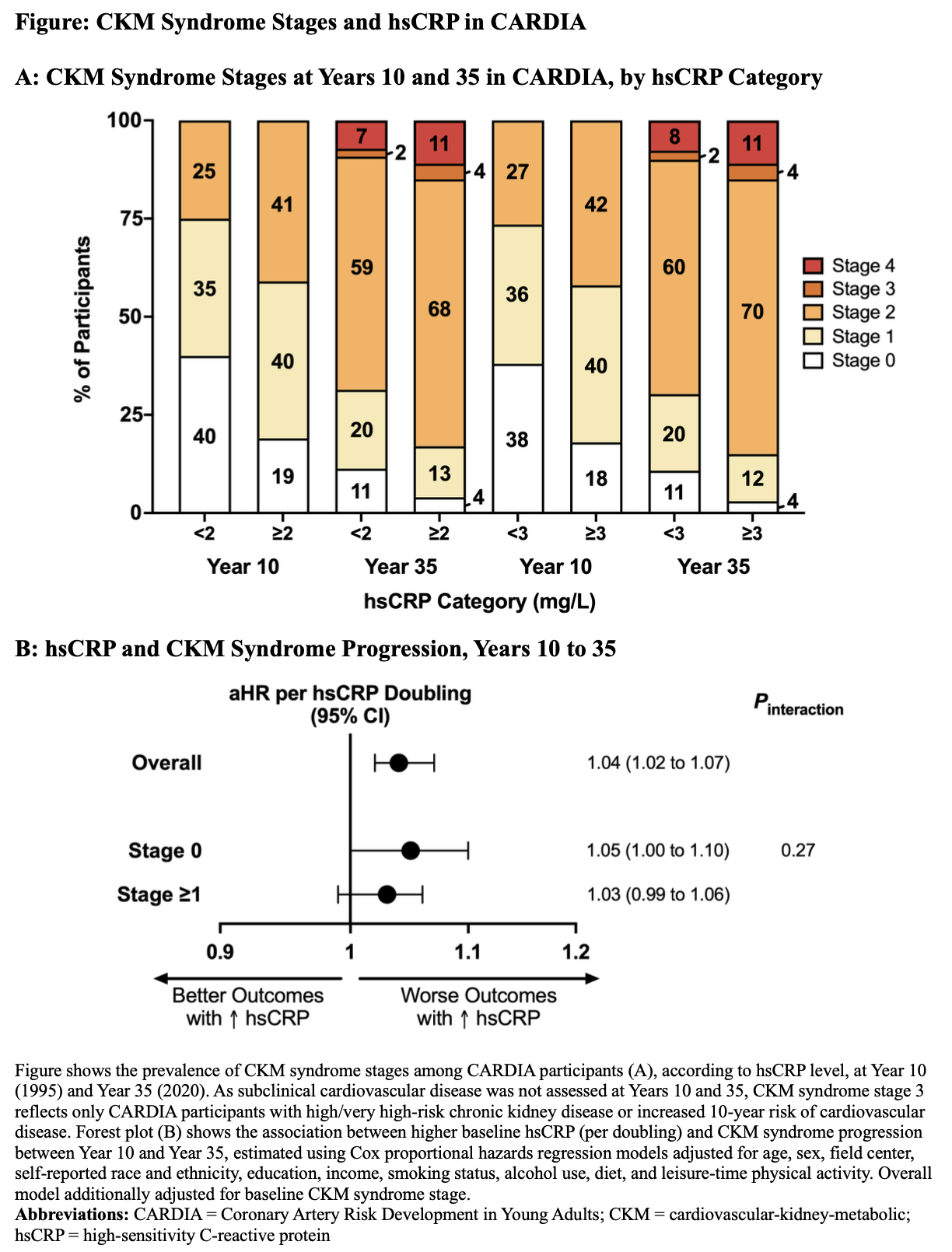
Results: Among 2,952 participants with available hsCRP and without established cardiovascular disease (mean age, 35±4 years), 1,005 (34%) had a hsCRP level ≥2 mg/dL and 740 (25%) had a hsCRP level ≥3 mg/dL. Among those alive at follow-up, 76% experienced any CKM syndrome progression and 40% experienced any regression. Participants with higher hsCRP levels had more advanced CKM syndrome stages at baseline (41% vs. 25% with CKM stages ≥2 if hsCRP ≥2 vs. <2 mg/dL, respectively) and at follow-up (Figure, A). After covariate adjustment, higher baseline hsCRP was incrementally associated with a higher rate of CKM syndrome progression (aHR per doubling of hsCRP, 1.04; 95% CI, 1.02-1.07; P=0.002). Baseline CKM syndrome stage (0 vs. ≥1) did not appear to modify the association between higher hsCRP and CKM syndrome progression (Pinteraction=0.27) (Figure, B). Similar findings were observed when hsCRP was dichotomized at ≥3 vs. <3 mg/dL (aHR, 1.11, 95% CI, 1.00-1.24; P=0.05), but not at ≥2 vs. <2 mg/dL (aHR, 1.06, 95% CI, 0.96-1.16; P=0.28).
Conclusions: Elevated hsCRP levels were common among young adults and modestly associated with CKM syndrome onset and progression over 25 years. These findings suggest low-grade inflammation may incrementally portend worsening CKM health over time.
Ostrominski, John
(
Brigham and Womens Hospital
, Boston , Massachusetts , United States )
Sun, Baiyang
(
Kaiser Permanente Northern Californ
, Cupertino , California , United States )
Wong, Erin
(
Kaiser Permanente Northern Californ
, Cupertino , California , United States )
Apostol-largeteau, Mirasol
(
Kaiser Division of Research
, Pleasanton , California , United States )
Khan, Sadiya
(
Northwestern University
, Chicago , Illinois , United States )
Lloyd-jones, Donald
(
Boston University Medical Center
, Boston , Massachusetts , United States )
Shah, Nilay
(
Northwestern University
, Chicago , Illinois , United States )
Solomon, Scott
(
Brigham and Women's Hospital
, Boston , Massachusetts , United States )
Vaduganathan, Muthiah
(
Brigham and Womens Hospital
, Boston , Massachusetts , United States )
Bhatt, Ankeet
(
Kaiser Permenante
, San Francisco , California , United States )