Cardiovascular Fitness Testing at a Large Public Event: Minnesota State Fair
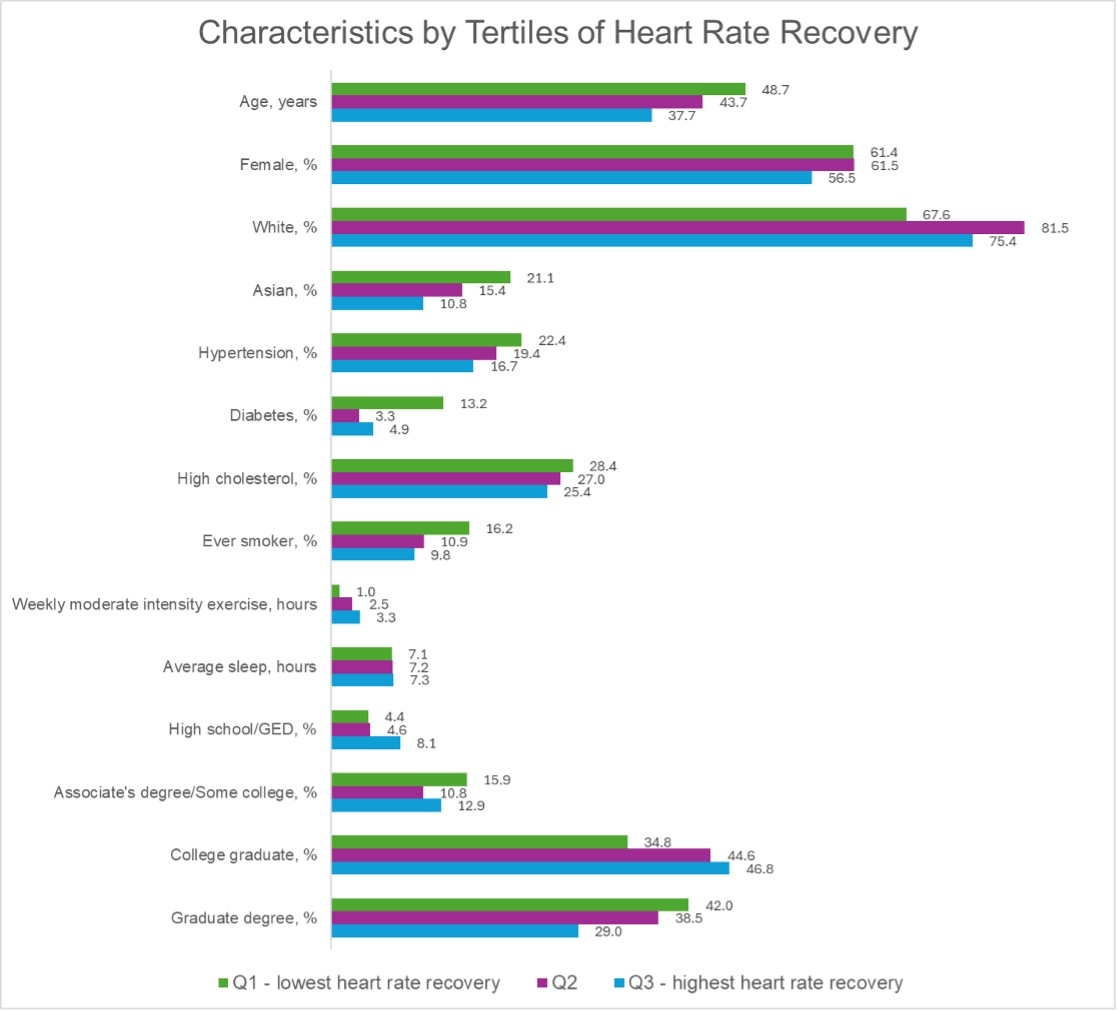
Abstract Body: Introduction: Change in heart rate in one minute following maximum exercise, or heart rate recovery (HRR), is a strong predictor of cardiovascular (CV) health and mortality. HRR assessment is appealing as it does not require expensive equipment or a clinic setting to be measured. The objective of this study was to assess CV fitness at a large public event using HRR and to evaluate the association of demographic characteristics, CV risk factors, and health behaviors with HRR. Methods: We conducted this study at the 2025 Minnesota State Fair, enrolling healthy, asymptomatic adults. Heart rate was obtained using a chest band monitor during 2 minutes of vigorous exercise and 1 minute of recovery. Demographic and CV health history were obtained via a post-test survey, including self-reported CV risk factors, exercise, and sleep. Participants were grouped by tertiles of increasing HRR and an age adjusted fitness score (poor, fair, good, excellent) was assigned. Results: A total of 263 participants were enrolled; 62 were excluded, 21 for technical failure related to the chest band or app, and 41 for inability to reach adequate heart rate for HRR calculation. Of the 201 participants with HRR data, mean age (SD) was 43.6 (17.5) years, 60% were female, 75% White, and 16% Asian. CVD risk factors were common including hypertension (18%) and high cholesterol (25%). When divided into tertiles, those with the highest (best) HRR tended to be younger, spend more time exercising, have a college or master’s degree, and were never smokers (Figure). In regression models, there was no significant association with demographic or CV risk factors and “excellent” HRR. Self-reported 7-9 hours of sleep compared to <7 hours was associated with excellent HRR (OR 2.45, 1.45-4.16) in the unadjusted model, but when adjusted for demographics and CV risk factors the association was no longer significant (OR 1.47, 0.77-2.84). Higher self-reported physical activity was significantly associated with excellent HRR in the adjusted model – tertile 2 vs 1 (OR 2.56, 1.19-5.52) and tertile 3 vs 3 (OR 4.13, 2.01-8.50). Conclusions: Measuring HRR and corresponding heart fitness grade in a brief exercise test may be a useful screening tool for CV health in otherwise healthy adults. Longitudinal studies are needed to determine the association of CV fitness measured by this method and CV outcomes.
Hessian, Madelyn
(
University of Minnesota Medical School
, Minneapolis , Minnesota , United States )
Christensen, Gabriela
(
University of Minnesota Medical School
, Minneapolis , Minnesota , United States )
Metzger, Joseph
(
UNIV MINNESOTA
, Minneapolis , Minnesota , United States )
Chiu, Tobyn
(
Lillehei Heart Institute
, Minneapolis , Minnesota , United States )
Van't Hof, Jeremy
(
University of Minnesota
, Minneapolis , Minnesota , United States )