EPI-Lifestyle Scientific Sessions 2026
/
Poster Session 3
/
Culturally Tailored Positive Psychological Intervention in a Cluster-Randomized Trial of Blood Pressure Reduction in Spanish-Speaking Hispanics/Latinos with Uncontrolled Hypertension
American Heart Association
74
0
Final ID: TH808
Culturally Tailored Positive Psychological Intervention in a Cluster-Randomized Trial of Blood Pressure Reduction in Spanish-Speaking Hispanics/Latinos with Uncontrolled Hypertension
Abstract Body: Introduction Positive psychological interventions (PPIs) have demonstrated benefits for mental health and health behaviors, but their effects on physiologic cardiovascular outcomes remain underexamined. We tested whether ¡Alégrate!, a culturally adapted, church-based PPI, lowers blood pressure (BP) and promotes medication adherence in Spanish-speaking Hispanic/Latino adults with uncontrolled hypertension.
Hypothesis We hypothesized that ¡Alégrate! participants would show greater BP reductions and better adherence than controls, with stronger effects among those attending more sessions.
Methods In a cluster-randomized controlled design (six urban-area churches), 96 adults (51 intervention, 45 control) with uncontrolled hypertension (2017–2019) were enrolled. Medication adherence was assessed using the 8-item Morisky Medication Adherence Scale, and seated blood pressure (mm Hg) was measured objectively following a standardized protocol. The 8-week, group-based curriculum was delivered in Spanish and embedded cultural values (familism, religiosity). Core modules included mindfulness, gratitude, positive reappraisal, and goal setting to promote psychological well-being. Assessments occurred at baseline, 8 weeks, and 12 weeks. We used linear mixed models with random intercepts to estimate fixed effects of group, time, and their interaction, and conducted exploratory dose–response analyses by attendance.
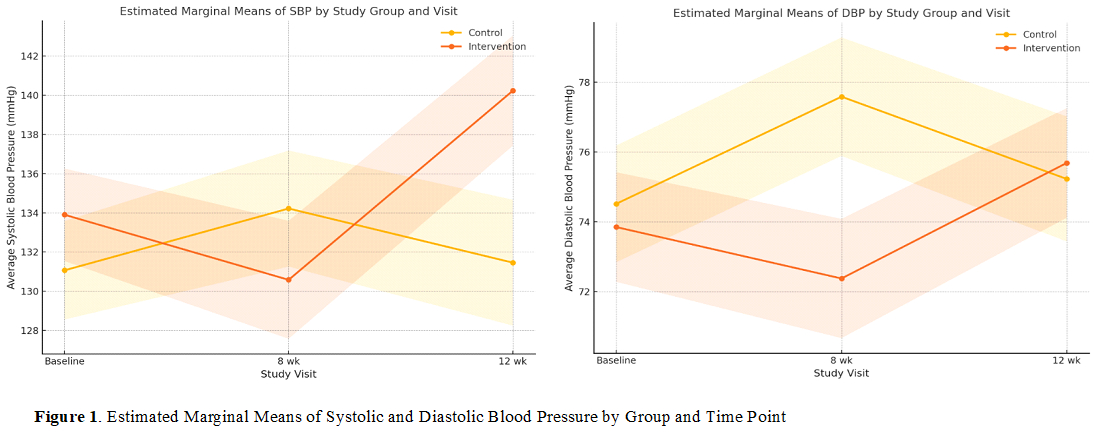
Results Group × time interactions for systolic and diastolic BP did not reach statistical significance (p = 0.09 and 0.07), though both trended toward improvement in the intervention arm. At 8 weeks, mean systolic BP decreased by –5.8 mm Hg (p = 0.045) and diastolic BP by –4.0 mm Hg (p = 0.065) versus control; effects attenuated by 12 weeks. In exploratory analyses, participants attending ≥ 6 sessions maintained more stable BP trajectories. No between-group differences were observed in medication adherence.
Conclusions In this pilot community-based trial, a culturally tailored PPI produced short-term systolic BP reductions in Spanish-speaking Hispanic/Latino adults with uncontrolled hypertension. These findings support the potential of positive psychological approaches to reduce hypertension disparities. Larger, longer trials are needed to confirm and extend these effects.
Hernandez, Rose
(
University of Illinois at Urbana Champaign
, Urbana , Illinois , United States )