
Logo

American Heart Association

  1
  0


Final ID: WE486

Cost-Effective Analysis of a Louisiana Community Program Addressing Food Insecurity

Abstract Body: The Geaux Get Healthy Clinical Program (GGH) is a program addressing food insecurity through nutritional education and access to resources. Prior studies have shown that GGH is effective in improving food insecurity in an underserved population. The purpose of this research is to conduct an analysis of GGH to determine if it is a cost-effective means for improving food insecurity.
Data was collected over 3 years on a subset of GGH participants to screen for food insecurity. 431 participants were enrolled in GGH, 141 were enrolled in the research study, and 79 completed the study. Participants completed USDA long form to determine food insecurity status at enrollment and at 12 weeks upon completion of the program. Success was defined as any individual moving from above 2 to 2 or less. Total GGH program costs were $79,333 annually. A cost-effectiveness model was created to estimate the costs and savings associated with addressing food insecurity via medically tailored meal programs using prior research on food insecurity and its associated monetary impacts on healthcare costs.
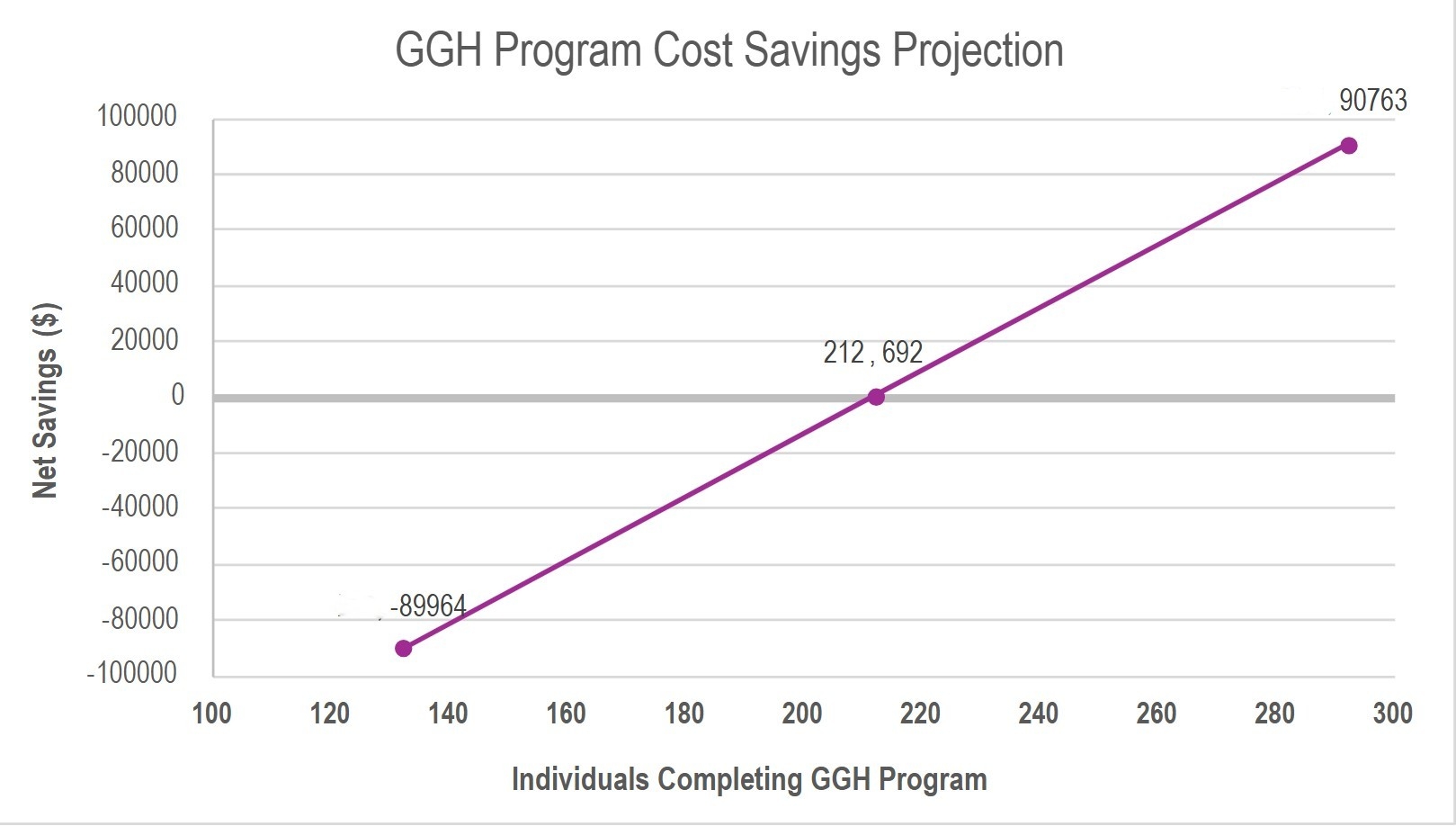
Over the course of 3 years, the GGH program incurred a total cost of $237,999. Analysis of participant data revealed that 54% of individuals demonstrated success with food insecurity improvement. Over the 3-year study period, 132 completed the program, indicating that 71 of these participants successfully transitioned to a food secure status with a predicted cost of $89,964 or $0.38 per dollar invested. Given the predictive model parameters, it can be calculated that an increase in program participation to 212 participants completing GGH over a 3-year period would allow the program to break even. This means that there is healthcare savings if greater than 70.7 participants complete the program annually. Further, increasing to 292 participants completing GGH over a 3-year period (97.3 participants per year) would engender a net gain in healthcare savings of $90,763. (Figure 1)
This data shows that if 71 participants complete the program annually, GGH is a cost-effective means of improving food insecurity. Based on the nominal cost per GGH participant in comparison to cost savings, increasing overall program participation may have a large impact on financial return. Addressing the various barriers that limit program participation (transportation/scheduling issues, healthcare skepticism, low health literacy, etc.) may lead to increased healthcare savings and thus financial success.
  • Lambert, Hunter  ( LSU Health Sciences Center , Baton Rouge , Louisiana , United States )
  • Bernet, Patrick  ( Seton Hall University , South Orange Village , New Jersey , United States )
  • Ardoin, Tiffany  ( LSU Health Sciences Center , Baton Rouge , Louisiana , United States )
  • Author Disclosures:
Meeting Info:

EPI-Lifestyle Scientific Sessions 2026

2026

Boston, Massachusetts

Session Info:

Poster Session 2

Wednesday, 03/18/2026 , 05:00PM - 07:00PM

Poster Session

More abstracts on this topic:
A Comparison of English and Spanish AI Chatbot Responses to Online Cardiovascular Questions: Differences in Response Length, Readability, and Guidance

Benarroch Yoel, Gusdorf Jason, Isaza Nicolas, Rodman Adam

Commercial Pricing of Percutaneous Coronary Intervention in The United States

Wei Chen, Paranjpe Ishan, Sharma Pranav, Song Nancy, Lan Roy, Sahu Maitreyi, Dieleman Joseph, Schulman Kevin, Sandhu Alexander

More abstracts from these authors:
Lipid Medication Adherence and Clinician Hesitation in Patients with ASCVD

Ardoin Tiffany, Chandra Rachel, Gianos Eugenia, Soe Kyaw, Yuan Neal

You have to be authorized to contact abstract author. Please, Login
Not Available