Resistance Training Lowers Blood Pressure in Older Adults with Low Muscle Strength: Findings from the INERTIA Study
Abstract Body: Background: Hypertension and chronic low muscle strength—the primary indicator of sarcopenia—commonly co-occur in older adults and significantly contribute to CVD risk. While resistance training lowers blood pressure (BP) in younger hypertensive populations, its efficacy in older adults with low muscle strength remains unclear. In the INERTIA study, we evaluated the feasibility and preliminary effects of a 12-week progressive resistance training (PRT) intervention on changes in BP in older adults with low muscle strength.
Methods: Older adults (≥60 years) without diagnosed CVD or conditions precluding PRT exercise were enrolled. Low muscle strength was defined using standardized criteria for grip strength (<30 kg men; <20 kg women). Participants were randomized (2:1 block allocation) to 12 weeks of biweekly supervised moderate-intensity PRT (60 to 80% 1RM, n=51) or an attention-control group (n=21) receiving home exercise mailings every 3 weeks. Paired t-tests assessed within-group BP changes from baseline to 12 weeks, and linear regression evaluated between-group differences in BP change. Linear mixed effect models estimated BP changes over time within the PRT group at baseline, 6 weeks, and 12 weeks (primary endpoint).
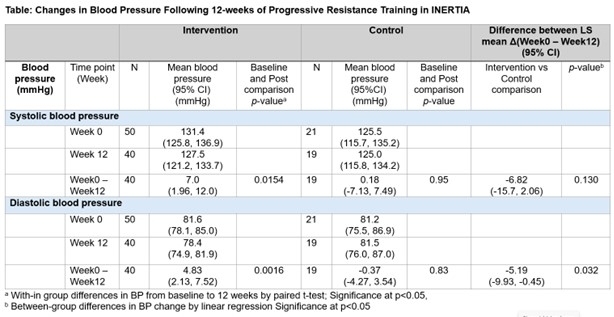
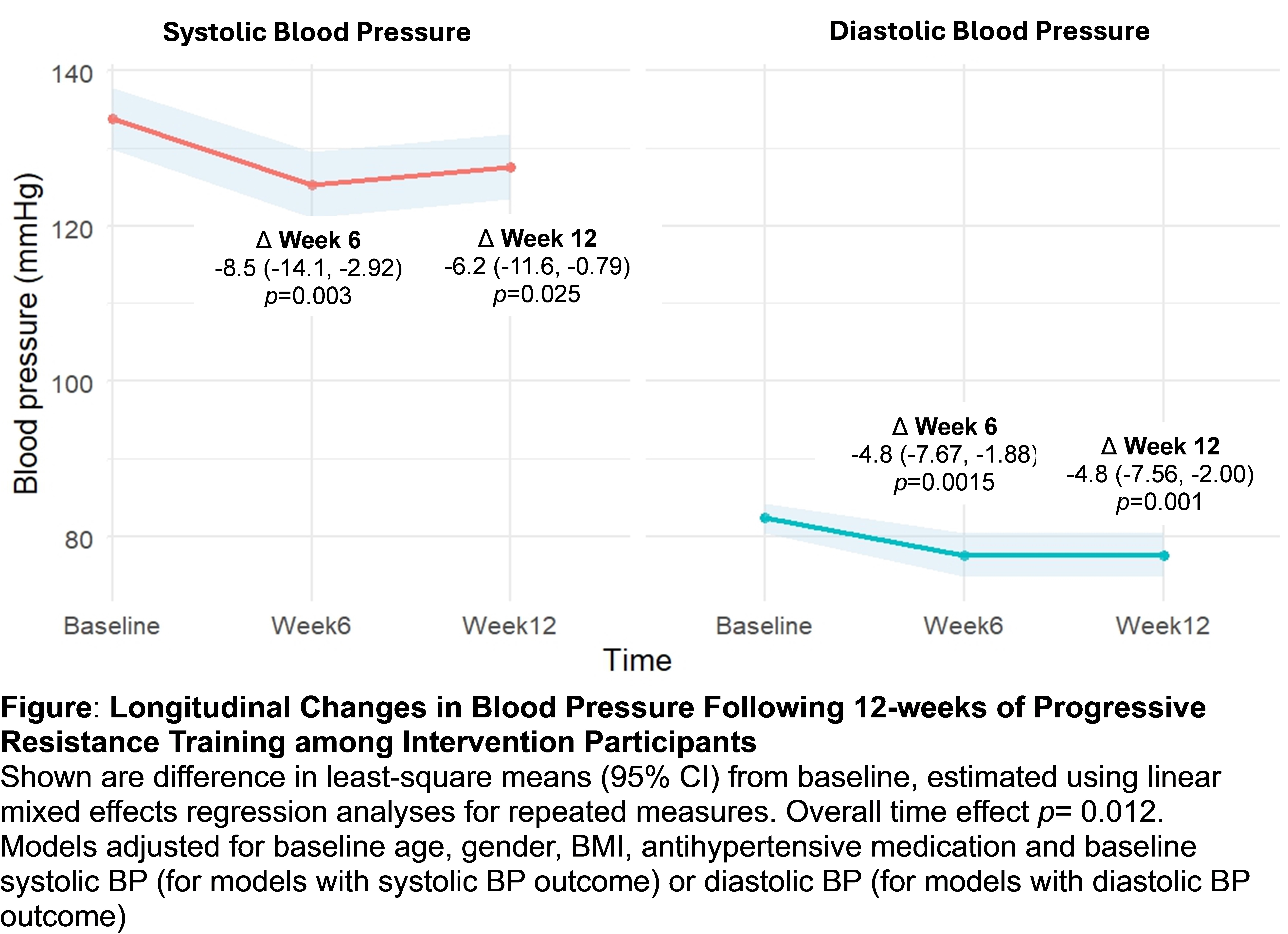
Results: Seventy-one participants were randomized (average age 70.1±6.3 years) with 76% female, 44% non-white; and 42% on antihypertensive therapy. At baseline, resting BP was higher in the PRT group versus controls (131/82 mmHg vs 126/81mmHg, p=0.11). Within the PRT group, there was significant reduction in systolic (-7.0 mmHg, 95% CI 1.96, 12.0, p=0.0154) and diastolic BP (-4.8 mmHg, 95% CI 2.13, 7.52, p=0.0016) from baseline to week 12, while negligible changes were observed in controls (Table). Between-group differences in BP change were significant for diastolic BP only. Within the PRT group, significant BP reductions were evident by 6 weeks and remained significant at week 12 weeks for systolic (-6.2 mmHg; 95% CI –11.6, –0.79; p=0.025) and diastolic BP (–4.8 mmHg; 95% CI -7.56, -2.00; p=0.001; Figure).
Conclusion: PRT meaningfully reduced BP in older adults with hypertension and low muscle strength. Larger trials are warranted to confirm these findings and examine integrated strategies targeting both muscle health and BP to reduce CVD risk in aging populations.
Laddu, Deepika
(
Northwestern University
, Chicago , Illinois , United States )
Cai, Xuan
(
Northwestern University
, Chicago , Illinois , United States )
Gepner, Adam
(
University of Wisconsin School of Medicine and Public Health
, Madison , Wisconsin , United States )
Allen, Norrina
(
NORTHWESTERN UNIVERSITY
, Chicago , Illinois , United States )
Ma, Jun
(
UNIVERSITY OF ILLINOIS AT CHICAGO
, Chicago , Illinois , United States )
Phillips, Shane
(
UNIVERSITY OF ILLINOIS AT CHICAGO
, Chicago , Illinois , United States )