Metabolomics-Based Reclassification of Ultra-Processed Foods and Risk of Cardiometabolic Outcomes
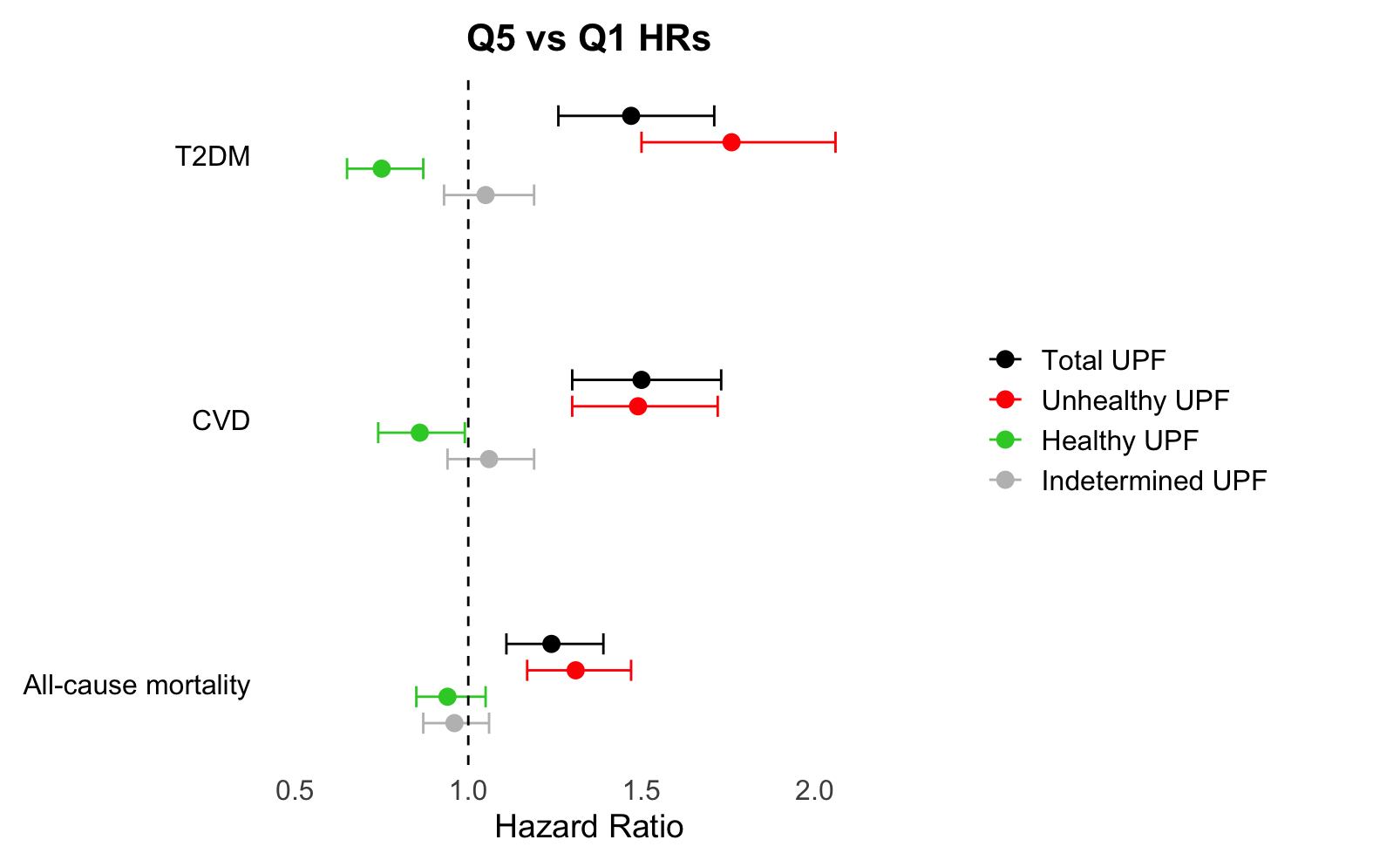
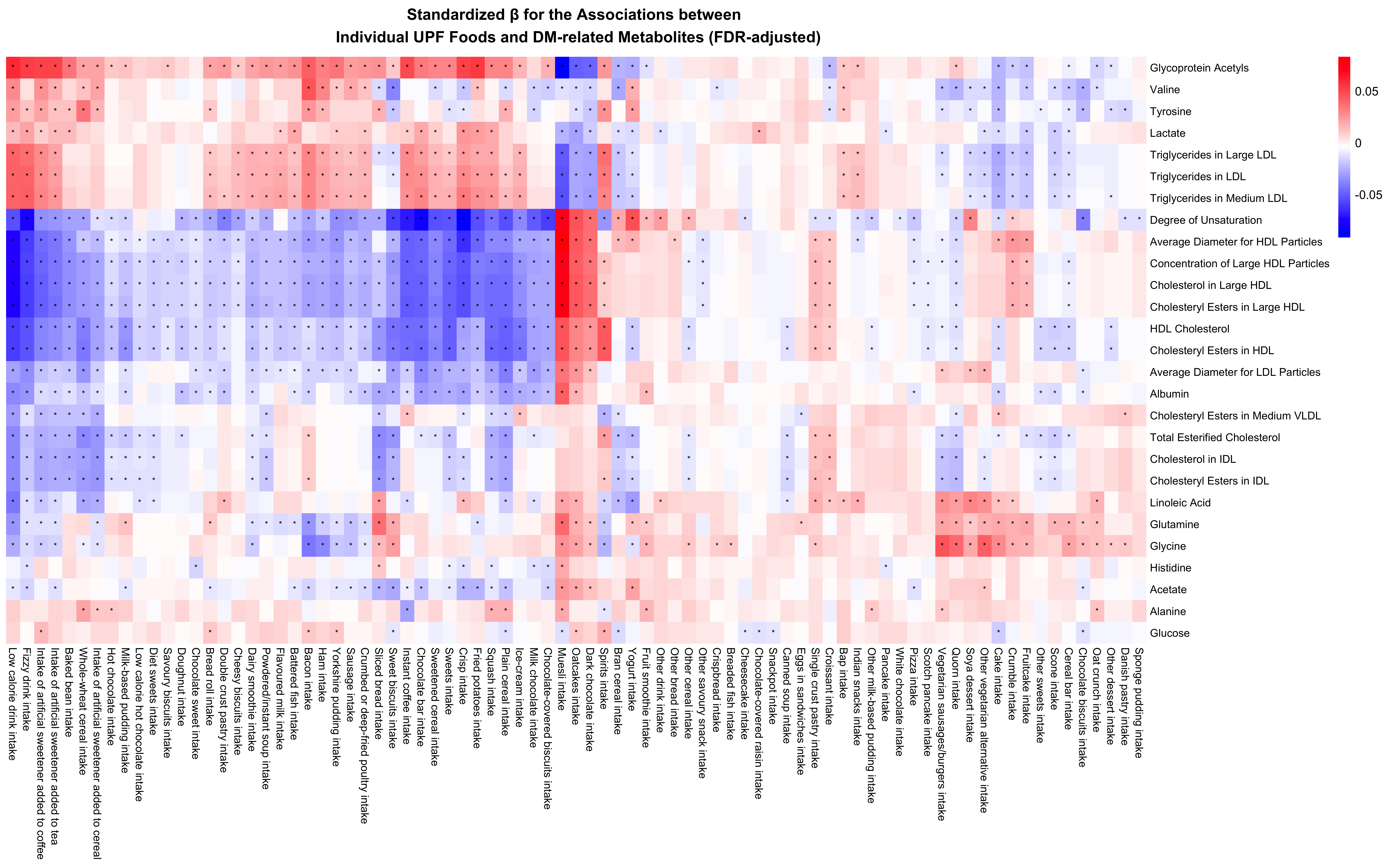
Abstract Body: Introduction: Ultra-processed foods (UPFs) are commonly treated as a single category, yet they encompass nutritionally heterogeneous products with potentially differential health effects. Existing classifications, such as Nova, primarily focus on food processing without accounting for biological heterogeneity, limiting precision in risk estimation. Hypothesis: We hypothesized that plasma metabolites could help to define UPF subclasses with divergent associations with type 2 diabetes mellitus (T2DM), cardiovascular disease (CVD), and all-cause mortality. Methods: We analyzed 248,092 UK Biobank participants with NMR-based plasma metabolomics (168 metabolites with absolute quantification) and a subset of 59,898 participants with at least 2 repeated 24-hour dietary recalls. Using elastic-net regression, we derived a metabolomic profile score predictive of incident T2DM from 23 metabolites and classified 81 UPF items as Healthy (β<0; false discovery rate (FDR)<0.05), Unhealthy (β>0; FDR<0.05), or Indeterminate (FDR>0.05) based on their associations with the T2DM metabolomic score. The metabolomic score and intakes of UPF subgroups were then related to incident T2DM, CVD, and death using multivariable Cox models. Results: During follow-up of approximately 0.9 million person-years, 2,113 T2DM, 2,465 CVD, and 3,767 all-cause death events were documented. A higher T2DM metabolomic score was associated with an higher risk of T2DM (Q5 vs Q1 HR [95% CI]: 12.66 [9.41–17.03]), CVD (1.63 [1.35–1.98]), and all-cause death (1.28 [1.11–1.49]). The Unhealthy UPF category included 40 foods, while the Healthy UPF category included 19 foods. Total UPF intake was significantly associated with a higher risk across endpoints (1.47 [1.26–1.71], 1.50 [1.30–1.73], and 1.24 [1.11–1.39] for T2DM, CVD, and death, respectively), but an increased risk was only found for the intakes of Unhealthy UPF (1.76 [1.50, 2.06], 1.49 [1.30, 1.72], 1.31 [1.17, 1.47], respectively). The Healthy UPF score showed inverse associations with T2DM and CVD (0.75 [0.65, 0.87] and 0.86 [0.73, 0.99], respectively), but no significant association with mortality. Conclusions: Metabolomics-enabled subclassification revealed heterogeneity within UPFs, with excess cardiometabolic risk driven by a subset of Unhealthy UPFs and inverse associations observed for Healthy UPFs. These findings underscore the need for biologically informed dietary guidance and reformulation beyond a single “total UPF” metric.
Chen, Szu-han
(
Harvard T.H. Chan School of Public Health
, Boston , Massachusetts , United States )
Du, Mengxi
(
Harvard T.H. Chan School of Public Health
, Boston , Massachusetts , United States )
Liu, Binkai
(
Harvard T.H. Chan School of Public Health
, Boston , Massachusetts , United States )
Haslam, Danielle
(
Harvard T.H. Chan School of Public Health
, Boston , Massachusetts , United States )
Liang, Liming
(
Harvard T.H. Chan School of Public Health
, Boston , Massachusetts , United States )
Hu, Frank
(
Harvard T.H. Chan School of Public Health
, Boston , Massachusetts , United States )