
Logo

American Heart Association

  3
  0


Final ID: TU143

Indoor Radon Concentrations Are Associated With Incident Heart Failure Among Postmenopausal Women in the United States

Abstract Body: Introduction: Emerging evidence links radon to prevalent risk factors for heart failure (HF), but little is known about the radon-HF association, itself.
Hypothesis: Indoor radon is associated with incident HF.
Methods: We conducted a prospective cohort study in the Women’s Health Initiative among black, Hispanic/Latina or clinical trial participants without HF at baseline (1993-1998), but with HF follow-up through 2/17/24. We used U.S. Environmental Protection Agency (EPA) data to estimate and categorize radon concentrations at geocoded participant addresses as <2, 2–4 and ≥4 pCi/L. We ascertained incident hospitalization for acute, decompensated HF via physician-review of medical records, classification and adjudication. We estimated hazard ratios and 95% confidence intervals (HR, 95%CI) using multi-variable adjusted Cox proportional hazards models on an attained age time scale. We examined sensitivity of the fully adjusted associations and expressed them in terms of equivalent increases in systolic blood pressure and body mass index to facilitate interpretation. We used Levin’s formula and a nonparametric bootstrap to estimate population-attributable fractions (PAF) at concentrations ≥2 pCi/L.
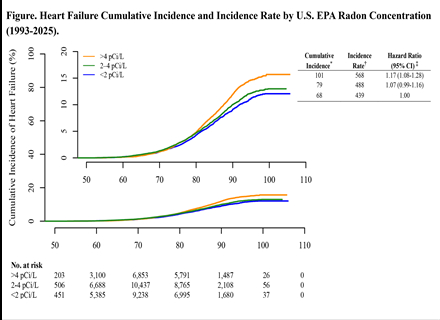
Results: Among 43,188 women (mean age 63 years; 59% white; 15% Hispanic/Latina; 75% in the clinical trial), approximately 36%, 41% and 23% had a radon concentration <2, 2–4 and ≥4 pCi/L. Over a mean of 16.2 years, we ascertained 3,446 incident HF events among them (Figure): 50%, 33%, 16% and <1% with preserved, reduced, unknown and recovered ejection fraction (EF). The unadjusted HRs (95%CIs) were 1.07 (0.99–1.16) and 1.17 (1.08–1.28) times higher at 2–4 and ≥4 than <2 pCi/L, changing little with cumulative adjustment for covariates. Associations were robust in most sensitivity analyses, but lower for HF with preserved EF: 1.06 (0.94–1.20) and 1.10 (0.94–1.28), higher for HF with reduced EF: 1.14 (0.98–1.34) and 1.29 (1.07–1.55), and highest for HF mortality: 1.18 (0.99–1.42) and 1.37 (1.10–1.70). The HR at ≥4 pCi/L approximated that of 15 mmHg and 5 kg/m2 increases in systolic blood pressure and body mass index. The PAF (95%CI) for radon ≥2 pCi/L was 7.0% (1.7%–12.1%).
Conclusions: Radon may be a modifiable environmental determinant of incident HF among postmenopausal women in the U.S.
  • Chen, Shu  ( University of North Carolina at Chapel Hill , Chapel Hill , North Carolina , United States )
  • Collins, Jason  ( Gillings School of Global Public Health, University of North Carolina at Chapel Hill , Chapel Hill , North Carolina , United States )
  • Stewart, James  ( UNC-Chapel Hill , Chapel Hill , North Carolina , United States )
  • Ekanayaka, Ayesha  ( University of North Carolina at Chapel Hill , Chapel Hill , North Carolina , United States )
  • Venkatachalam, Hari  ( Gillings School of Global Public Health, University of North Carolina at Chapel Hill , Chapel Hill , North Carolina , United States )
  • Reiner, Alex  ( Univerisity of Washington , Seattle , Washington , United States )
  • Williamson, Mark  ( University of North Dakota , Grand Forks , North Dakota , United States )
  • Smith, Richard  ( University of North Carolina at Chapel Hill , Chapel Hill , North Carolina , United States )
  • Whitsel, Eric  ( Gillings School of Global Public Health, University of North Carolina at Chapel Hill , Chapel Hill , North Carolina , United States )
  • Author Disclosures:
Meeting Info:

EPI-Lifestyle Scientific Sessions 2026

2026

Boston, Massachusetts

Session Info:

Poster Session 1

Tuesday, 03/17/2026 , 05:00PM - 07:00PM

Poster Session

More abstracts on this topic:
Age-Related Differences in Aortic Valve Calcium Progression and the Risk for Aortic Stenosis: Multi-Ethnic Study of Atherosclerosis

Marrero Natalie, Thanassoulis George, Rotter Jerome, Blaha Michael, Whelton Seamus, Jha Kunal, Grant Jelani, Razavi Alexander, Budoff Matthew, Shah Sanjiv, Blumenthal Roger, Post Wendy, Shaw Leslee

A Bridge from Sweet to Sour: A Case of Recurrent Myocardial Stunning in Diabetic Ketoacidosis

Satish Vikyath, Pargaonkar Sumant, Slipczuk Leandro, Schenone Aldo, Maliha Maisha, Chi Kuan Yu, Sunil Kumar Sriram, Borkowski Pawel, Vyas Rhea, Rodriguez Szaszdi David Jose Javier, Kharawala Amrin, Seo Jiyoung

More abstracts from these authors:
Indoor Radon Concentrations Are Associated With Incident Myocardial Infarction in the Women’s Health Initiative

Buchheit Sophie, Schwartz Gary, Smith Richard, Whitsel Eric, Collins Jason, Stewart James, Williamson Mark, Bozeman Daslyn, Allison Matthew, Manson Joann, Meliker Jaymie, Vitolins Mara

Indoor Radon Concentrations Are Associated with Leukocyte and Platelet Counts

Shi Cuiran, Reiner Alex, Smith Richard, Whitsel Eric, Collins Jason, Stewart James, Vitolins Mara, Williamson Mark, Conneely Karen, Jung Su Yon, Manson Joann, Schwartz Gary

You have to be authorized to contact abstract author. Please, Login
Not Available