Ultra-Processed Food Intake, Lipidomics, and Incident Cardiovascular Disease in American Indians: A Longitudinal Study
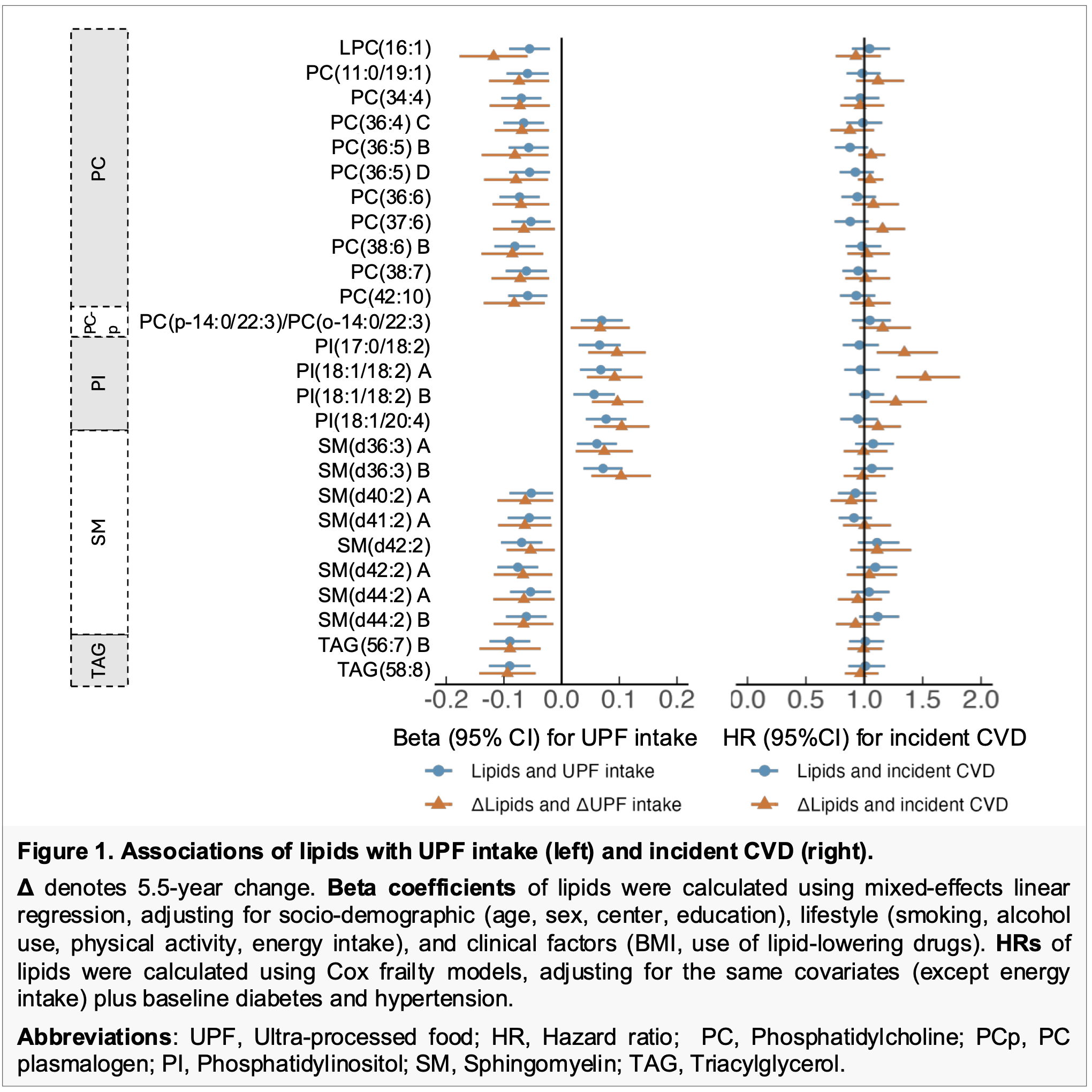
Abstract Body: Background: Ultra-processed food (UPF) consumption has been linked to cardiometabolic risk, but its molecular signatures remain unclear. Objective: To identify lipidomic markers of UPF intake and investigate their associations with the risk of CVD. Methods: Among 1,423 American Indian adults (64% women; mean age 41 years) in the Strong Heart Family Study, we repeatedly profiled 1,542 plasma lipids (518 named species) via LC–MS and assessed UPF intake at two visits (~5.5 years apart; 2001–2003 and 2006–2009) using the NOVA system with data from Block FFQ. CVD events (fatal or non-fatal coronary heart disease, myocardial infarction, stroke, and congestive heart failure) were tracked over a median follow-up of 18.5 years, through December 31, 2020. Mixed-effects linear models identified lipids associated with UPF intake, adjusting for sociodemographic (age, sex, center, education), lifestyle (smoking, alcohol consumption, physical activity, energy intake), and clinical factors (BMI, use of lipid-lowering drugs). Random effects accounted for family relatedness and repeated measures. We then examined whether lipid changes mirrored changes in UPF consumption and estimated hazard ratios (HRs) for CVD using Cox frailty models, adjusting for the same covariates (except energy intake) plus baseline diabetes and hypertension. Multiple testing was controlled at FDR < 0.05. Results: Each 10% increase in energy from UPF was associated with a 17% higher CVD risk [HR: 1.17 (95% CI: 1.01–1.36); 170 cases]. Seven lipids, mainly phosphatidylinositols (PIs), were positively associated with UPF intake and increased in parallel over time (Figure 1). In contrast, 19 lipids (mostly phosphatidylcholines and sphingomyelins) were inversely associated, with temporal increases linked to reduced UPF intake (FDR < 0.05). Notably, increases in three UPF-related PIs were also associated with incident CVD (HRs per 1-SD increase: 1.27–1.52). Conclusions: UPF-related lipidomic shifts, particularly in phosphatidylinositols, may serve as early biomarkers linking diet to long-term cardiovascular risk.
Wen, Xiaoxiao
(
University of South Florida
, Tampa , Florida , United States )
Miao, Guanhong
(
University of South Florida
, Tampa , Florida , United States )
Chen, Mingjing
(
University of South Florida
, Tampa , Florida , United States )
Zhang, Ying
(
University of Oklahoma Health Campus
, Oklahoma , Oklahoma , United States )
Kim, Hyunju
(
University of Washington
, Seattle , Washington , United States )
Fretts, Amanda
(
University of Washington
, Seattle , Washington , United States )
Zhao, Jinying
(
University of South Florida
, Tampa , Florida , United States )
Jiang Chao, Dong Jianzeng, Cai Jun, Anderson Craig, Du Xin, Tang Yangyang, Han Rong, Song Yanna, Wang Chi, Lin Xiaolei, Yi Yang, Rodgers Anthony, Ma Changsheng