Individual-level Social Determinants of Health and High-Risk Behavioral Engagement Among Puerto Rican Young Adults: PR-OUTLOOK Study
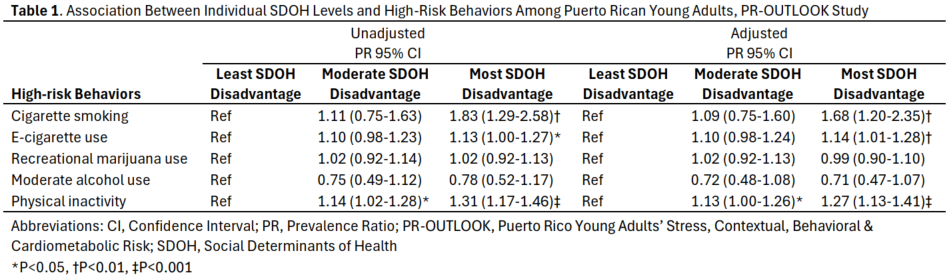
Abstract Body: Introduction: High-risk behaviors, such as tobacco use, physical inactivity, and excessive alcohol consumption contribute to chronic diseases, including cardiovascular disease and cancer. Social determinants of health (SDOH), including economic stability, housing, education, and healthcare access, shape these behaviors. In Puerto Rico (PR), longstanding economic instability, natural disasters, and COVID-19 have exacerbated social vulnerability. This study examines high-risk behaviors and their association with individual-level SDOH among PR adults aged 18-29 years, using baseline survey data from the PR-OUTLOOK cohort. We assessed the hypothesis that greater individual-level social disadvantage is associated with engagement in high-risk behaviors. Methods: The analytic sample included 2,484 participants from the baseline PR-OUTLOOK cohort (2020–2023), based on data available at the time of request and excluded those with missing data. Five binary high-risk behaviors were analyzed: cigarette smoking, e-cigarette use, recreational marijuana use, moderate alcohol use, and physical inactivity. Individual-level SDOH was derived using factor analysis of 10 indicators (e.g., “how difficult or easy is it currently for your household to make ends meet?”, educational attainment), with higher values indicating greater disadvantage and were categorized into tertiles (least, moderate, and most disadvantage). Adjusted prevalence ratios (aPR) comparing most vs. least disadvantaged SDOH groups were estimated using Poisson regression with robust standard errors, adjusting for sex, age, and marital status. Results: Participants were on average 22 years old (SD=3.2), and 61.3% were female. Overall, 34.1% reported one high-risk behavior, and 42.3% reported two or more behaviors. High-risk behaviors were most prevalent in the most disadvantaged SDOH group (p<0.01). Compared to the least disadvantaged, the most disadvantaged tertile had 68% higher prevalence of cigarette smoking (aPR: 1.68, 95% CI: 1.20-2.35), 14% higher prevalence of e-cigarette use (aPR: 1.14, 95% CI: 1.01-1.28), and 27% higher prevalence of physical inactivity (aPR: 1.27, 95% CI: 1.13-1.41) (Table 1). Conclusions. Individual-level social disadvantage was associated with multiple behaviors elevating cardiovascular risk among young adults in PR. Findings underscore the need for equity-focused strategies addressing upstream social conditions to reduce early behavioral risks for cardiovascular disease.
Lee, Mary
(
UMASS CHAN MEDICAL SCHOOL
, Worcester , Massachusetts , United States )
Perez, Cynthia
(
University of Puerto Rico
, San Juan , Puerto Rico )
Rosal, Milagros
(
UMASS CHAN MEDICAL SCHOOL
, Worcester , Massachusetts , United States )
Forrester, Sarah
(
UMASS CHAN MEDICAL SCHOOL
, Worcester , Massachusetts , United States )