Replacing Sedentary Behavior with Physical Activity or Sleep and Incidence of Atrial Fibrillation: Results From UK Biobank
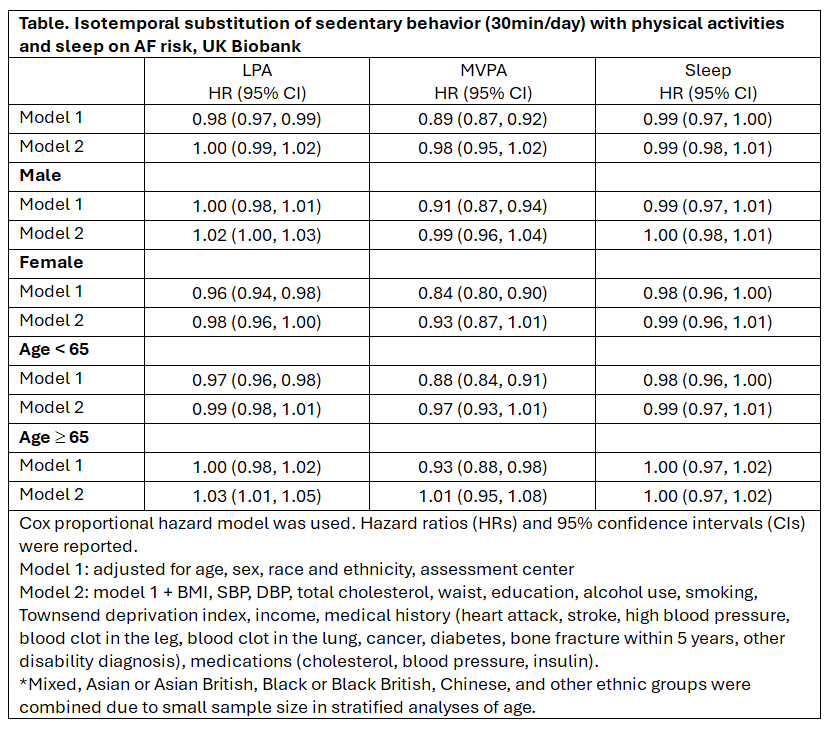
Abstract Body: Background Sedentary behavior (SB) has been associated with the risk of cardiovascular disease, independent of physical activity (PA) and sleep. However, the effect of replacing SB with PA or sleep on atrial fibrillation (AF) risk remains unclear. Methods This study included participants from the UK Biobank who wore wrist-worn accelerometers for seven days consecutively in 2013-2015. Those with prevalent AF, insufficient wearing time, and invalid or uncalibrated accelerometry data were excluded. Daily time spent in light PA (LPA), moderate to vigorous PA (MVPA), sedentary behavior (SB), and sleep were derived from accelerometer recordings, based on a previously trained and validated machine learning model in UK sample. Incident AF was classified by at least 1 ICD-10 code for the condition listed as either a primary diagnosis, secondary diagnosis, or cause of death through hospital and death registry data linkage (I48.x). Follow up began at accelerometer assessment and continued until the earliest of AF onset, loss to follow-up, death, or study censoring date. Using the proportional hazard model, isotemporal substitution was applied to examine the effect of replacing 30 minutes of SB with equivalent durations of each type of PA and sleep on AF risk, adjusting for demographic, socioeconomic, behavioral, and clinical covariates. Stratified analyses by sex and age (<65 vs. ≥65 years) were performed. Results Among 86,101 participants (57% female, mean age 56±7.8 years, 97% White race), 4,040 AF cases were identified during a median of 7.9 years of follow-up. On average, participants spent 9.0 ± 1.9 hours in SB, 4.8 ± 1.3 hours in LPA, 0.7 ± 0.6 hours in MVPA, and 8.5 ± 1.3 hours in sleep per day. Replacing 30 minutes of SB with PA was associated with a slightly lower risk of AF in the model adjusted for age, sex, race and ethnicity, and assessment centers [LPA: HR 0.98, 95% CI (0.97, 0.99); MVPA: HR 0.89, 95% CI (0.87, 0.92)]. The associations were attenuated after full adjustment [LPA: HR 1.00, 95% CI (0.99, 1.02); MVPA: HR 0.98, 95% CI (0.95, 1.02)]. Results were consistent across sex and age strata. No association with sleep was observed when substituting SB with sleep. Conclusion In a large population-based cohort in the UK, substituting SB with other daily activities or sleep did not reduce AF risk after accounting for confounding factors. Whether these findings are generalizable to more diverse populations warrant further investigation.
Li, Linzi
(
EMORY UNIVERSITY
, Atlanta , Georgia , United States )
Shah, Amit
(
EMORY UNIVERSITY
, Atlanta , Georgia , United States )
Ko, Yi-an
(
EMORY UNIVERSITY
, Atlanta , Georgia , United States )
Johnson, Dayna
(
EMORY UNIVERSITY
, Atlanta , Georgia , United States )
Sun, Yan
(
EMORY UNIVERSITY
, Atlanta , Georgia , United States )
Liu, Chang
(
EMORY UNIVERSITY
, Atlanta , Georgia , United States )
Levitan, Emily
(
UNIVERSITY ALABAMA AT BIRMINGHAM
, Birmingham , Alabama , United States )
Howard, Virginia
(
UNIVERSITY ALABAMA AT BIRMINGHAM
, Birmingham , Alabama , United States )
Judd, Suzanne
(
UNIVERSITY ALABAMA AT BIRMINGHAM
, Birmingham , Alabama , United States )
Soliman, Elsayed
(
WAKE FOREST SCHOOL OF MEDICINE
, Winston Salem , North Carolina , United States )
Alonso, Alvaro
(
EMORY UNIVERSITY
, Atlanta , Georgia , United States )