Logo

American Heart Association

  7
  0


Final ID: TU101

Hypothetical Reallocations of Sedentary Time with Light Intensity Physical Activity and Physical Function in the CARDIA Study

Abstract Body: Introduction: Current physical activity (PA) recommendations support replacing time spent sedentary with PA of any intensity. There is ample evidence that moderate/vigorous intensity PA is beneficially associated with physical function. Light intensity PA may provide an additional opportunity to improve physical function in inactive individuals. However, the longitudinal associations of replacing sedentary time with light intensity PA and physical function are not clear.
Hypothesis: We hypothesized that replacing sedentary time with light intensity PA is associated with better physical function.
Methods: Participants in the CARDIA study with accelerometer data at the Years 20 ([Y20] 2005-06) and 35 ([Y35] 2020-22) exams and physical performance at Y35 (n=996) were included. Measures of balance, endurance, gait speed, grip strength, and lower extremity strength Y35 were used to create a composite physical performance (CAPP) score; higher scores represent better physical function. We used compositional isotemporal substitution models to estimate predicted differences in CAPP resulting from hypothetical replacement of sedentary time with light intensity PA and whether associations varied by initial time spent sedentary, in moderate/vigorous intensity PA, or age. Secondary analyses evaluated associations with individual CAPP components. Multiple imputation was used to address missing data.
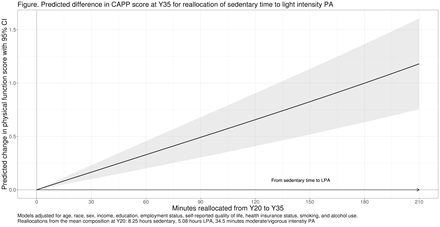
Results: Across midlife (mean 45±SD 3.5 [Y20] to 60± 3.6 [Y35] years old), 26% of participants increased daily time in light intensity PA. Mean CAPP score at Y35 was 13.1±SD 3.9. Hypothetical replacement of 3 hours of daily sedentary time with light intensity PA from Y20 to Y35 was associated with 1.0 unit greater CAPP score at Y35 (95% CI: 0.6,1.4) (Figure). This association was similar across initial time spent sedentary, in moderate/vigorous intensity PA, and age. By subcomponent, hypothetical replacement of 3 hours of daily sedentary time with light intensity PA was associated with better balance (6 seconds; 95% CI: 4,8), endurance (86 feet; 95% CI: 49,123), gait speed (0.04 m/s, 95% CI: 0.01,0.06), and lower extremity strength (0.7 sit-stands; 95% CI: 0.2,1.2), but not grip strength (0.6 kg/lbs of force; 95% CI: -0.3,1.4).
Conclusions: Replacement of sedentary time with light intensity PA across midlife was associated with better physical function. Interventions to increase light intensity PA may help improve physical function in midlife in active and inactive individuals.
  • Badon, Sylvia  ( Kaiser Permanente Northern Cal , Pleasanton , California , United States )
  • Asera, Alex  ( Kaiser Permanente Northern Cal , Pleasanton , California , United States )
  • Dooley, Erin  ( University of Alabama at Birmingham , Birmingham , Alabama , United States )
  • Whitaker, Kara  ( UNIVERSITY OF IOWA , Iowa City , Iowa , United States )
  • Hornikel, Bjoern  ( University of Alabama at Birmingham , Birmingham , Alabama , United States )
  • Bhatt, Ankeet  ( Kaiser Permanente Northern Cal , Pleasanton , California , United States )
  • Booker, Robert  ( Northwestern University , Chicago , Illinois , United States )
  • Sternfeld, Barbara  ( Kaiser Permanente Northern Cal , Pleasanton , California , United States )
  • Bowling, Barrett  ( Duke University , Durham , North Carolina , United States )
  • Gabriel, Kelley  ( University of Alabama at Birmingham , Birmingham , Alabama , United States )
  • Author Disclosures:
Meeting Info:

EPI-Lifestyle Scientific Sessions 2026

2026

Boston, Massachusetts

Session Info:

Poster Session 1

Tuesday, 03/17/2026 , 05:00PM - 07:00PM

Poster Session

More abstracts on this topic:
Achieving Guidelines within a 24-Hour Movement Paradigm and Risk of Cardiovascular Disease and All-Cause Mortality in United States Adults

Boudreaux Benjamin, Xu Chang, Dooley Erin, Hornikel Bjoern, Munson Alexandra, Shechter Ari, Palta Priya, Gabriel Kelley, Diaz Keith

A 60-fold increase in SCA risk in the last kilometer of endurance races : Final sprint, fatal outcome.

Chocron Richard, Levy Bernard, Beganton Franckie, Bougouin Wulfran, Empana Jean-philippe, Jouven Xavier, Laurenceau Thomas, Chabrol Marion, Mignot Soline, Meli Ugo, Langlois Camille, Cezard Pierre, Schwartz Peter, Kaab Stefan

More abstracts from these authors:
Model-based Replacement of Sedentary Time with Light Intensity Physical Activity is Associated with Improved Cardiometabolic Risk Score over 15 Years of Midlife in the CARDIA Study

Badon Sylvia, Asera Alex, Dooley Erin, Whitaker Kara, Hornikel Bjoern, Bhatt Ankeet, Booker Robert, Sternfeld Barbara, Gabriel Kelley

Longitudinal associations of accelerometer-determined sedentary and physical activity behaviors with heart failure biomarkers during the midlife transition: Coronary Artery Risk Development in Young Adults (CARDIA)

Gabriel Kelley, Lima Joao Ac, Reis Jared, Schreiner Pamela, Shikany James, Sidney Stephen, Whitaker Kara, Lewis Cora, Sternfeld Barbara, Hornikel Bjoern, Dooley Erin, Chen Baojiang, Badon Sylvia, Bhatt Ankeet, Carnethon Mercedes, Jacobs David, Khan Sadiya

You have to be authorized to contact abstract author. Please, Login
Not Available