
Higher Allostatic Load Is Associated With Lower Cardiorespiratory Fitness Among U.S. Adults: NHANES 1999–2004
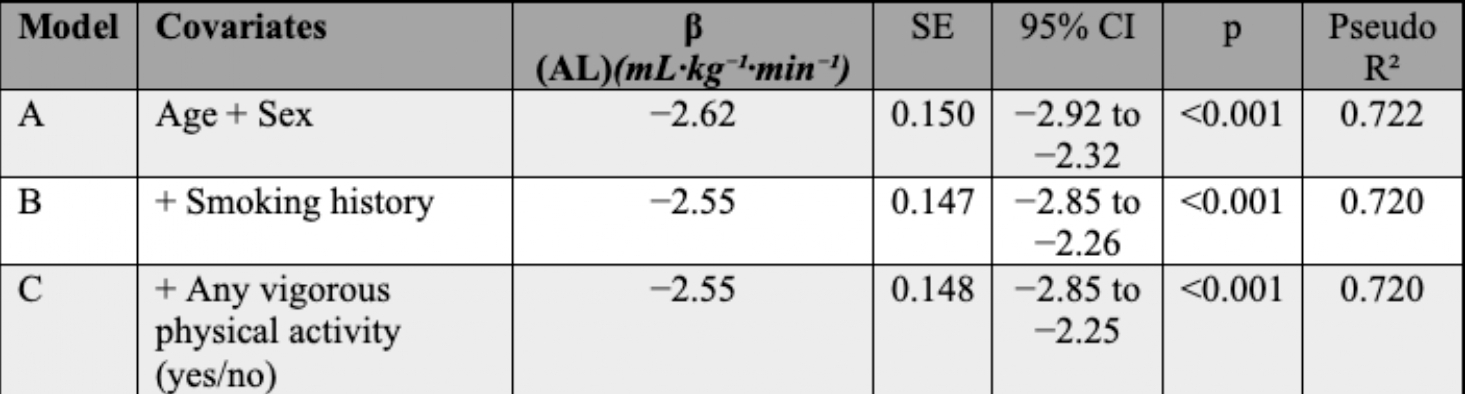
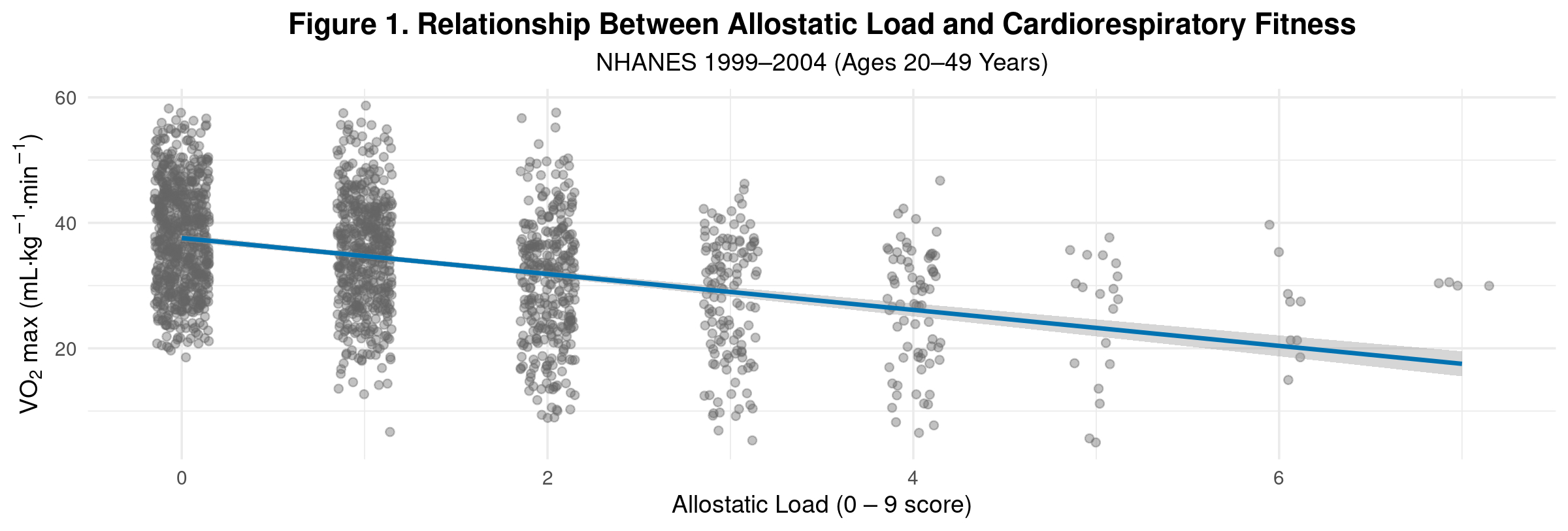
Abstract Body: Introduction: Allostatic load (AL) reflects cumulative physiological stress across multiple body systems and may influence cardiorespiratory fitness (CRF). Understanding this relationship may clarify how chronic stress contributes to early cardiovascular risk among U.S. adults aged 20–49 years (≈133 million individuals). Hypothesis: We hypothesized that higher AL would be associated with lower CRF, independent of smoking and physical activity. Methods: Data from NHANES 1999–2004 were analyzed among adults with complete AL components (nine biomarkers across cardiovascular, metabolic, inflammatory, lipid, obesity, and renal systems) and treadmill-derived VO2 max (N = 1,761). Six-year MEC weights and design variables (SDMVSTRA/SDMVPSU) were applied. The primary model used survey-weighted linear regression of VO2 max on AL adjusted for age and sex. Sensitivity analyses sequentially added smoking (≥100 lifetime cigarettes) and vigorous physical activity (VPA; PAD200 = Yes and PAQ560 ≥3/week; alternative “any vigorous” definition), tested nonlinearity (AL2), and evaluated AL×sex interaction. Results: Mean ± SD AL was 1.14 ± 1.32 and VO2 max 34.3 ± 9.0 mL/kg.min. AL correlated inversely with VO2 max (r = –0.37, p < 0.001). Each 1-unit higher AL was associated with a –2.62 mL/kg.min lower VO2 max (95% CI –2.92 to –2.32; p < 0.001; pseudo-R2 = 0.72). Results were consistent after additional adjustment for smoking (β = –2.62; SE 0.148; N = 1,759) and for any vigorous activity (β = –2.55; SE 0.147; N = 1,760), and unchanged in sensitivity models. The AL×sex interaction (p = 0.01) indicated a stronger inverse association in men. Conclusions: In conclusion, higher AL was consistently associated with ≈2.6 mL/kg. min lower VO2 max in U.S. adults aged 20–49 years, independent of smoking and physical activity. A ≈2.6 mL/kg .min reduction in CRF corresponds to a 10–15% higher mortality risk, highlighting AL as a modifiable target for stress reduction and a potential biomarker to enhance cardiovascular risk screening.
Daneii, Padideh
(
Lakeland Regional Health Medical Ce
, Lakeland , Florida , United States )
Sabina, Michael
(
Lakeland Regional Health
, Lakeland , Florida , United States )
Khan, Sana
(
Lakeland Regional Health
, Lakeland , Florida , United States )
Kadariya, Dinesh
(
Mary Washington health
, Stafford , Virginia , United States )