
Logo

American Heart Association

  1
  0


Final ID: WE503

Concordance Between Household and Area-Level Food Security Among People with Pre-Clinical Heart Failure

Abstract Body: Introduction: Diet is a key component of cardiovascular risk profiling in pre-clinical heart
failure. Food insecurity, defined as limited or uncertain access to nutritionally adequate food, is a
barrier to a healthy diet and warrants evaluation for intervention. However, self-reported food
security is rarely measured, with researchers/clinicians often relying on area-level measurements.
This study evaluates concordance between household and area-level food security to assess
whether county-level food security is an appropriate proxy for household-level food security.
Hypothesis: County-level food security is a poor proxy for household-level food security.
Methods: In September 2024, we enrolled 400 participants via the YouGov online survey
platform from the Southern Atlantic Region, with a design to include equal proportions of male
vs female, Black vs non-Black, and high vs low-income individuals. Household food insecurity
was assessed by the 6-item USDA questionnaire. County-level food security was measured by
Feeding America’s Mind the Meal Gap study and the CDC’s Social Vulnerability Index (SVI),
linking participants’ ZIP codes to county data. Concordance was assessed between household
food security categories (high/marginal vs low vs very low) and county food security tertiles (1 =
most secure; 3 = least secure), as well as county SVI tertiles.
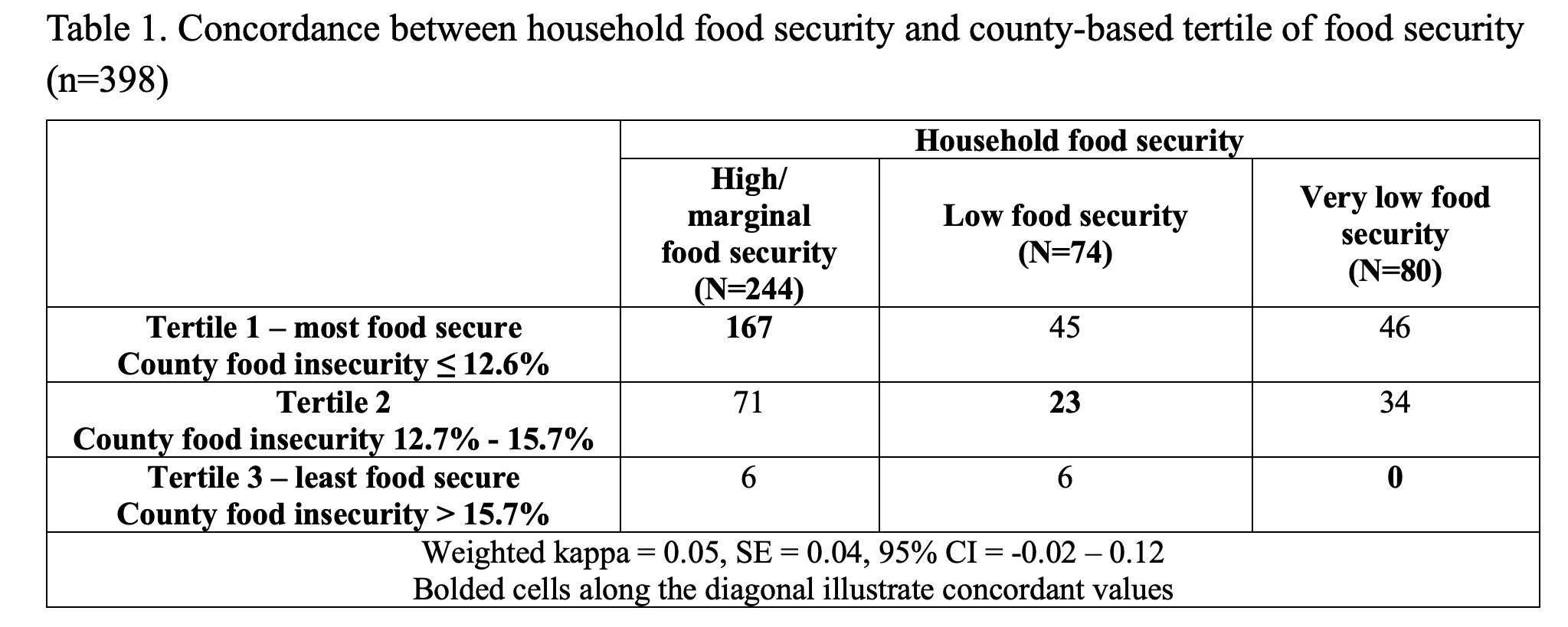
Results: The final sample included 398 participants from nine states (mean age 61.6 ± 11.6).
Half lived in counties in food insecurity tertile 1, while 7.5% lived in tertile 2 counties. There
was no concordance between county tertiles and household food insecurity categories (weighted
kappa = 0.05, 95% CI: -0.03 to 0.12). The concordance between ZIP code SVI tertiles and
household food insecurity was weak (weighted kappa = 0.05, 95% CI: 0.002 to 0.09). A weak
correlation existed between household food insecurity scores and ZIP code-level SVI
(Spearman’s rho=0.15), driven mainly by SVI sub-measures of socioeconomic status (rho=0.20)
and housing/transportation (rho=0.19).
Conclusion: In this study, county-level food security classifications were not valid proxies for
household-level food security. Using them interchangeably for risk stratification may lead to
misclassification. Clinicians and researchers should directly assess food security at the household
level when evaluating risk.
  • Hernandez-rubio, Sheila  ( National Institutes of Health , Bethesda , Maryland , United States )
  • Linton, Elizabeth  ( National Institutes of Health , Bethesda , Maryland , United States )
  • Joo, Jungnam  ( National Institutes of Health , Bethesda , Maryland , United States )
  • Henriquez-santos, Gretell  ( National Institutes of Health , Bethesda , Maryland , United States )
  • Shearer, Joe  ( National Institutes of Health , Bethesda , Maryland , United States )
  • Hashemian, Maryam  ( National Institutes of Health , Bethesda , Maryland , United States )
  • Roger, Veronique  ( National Institutes of Health , Bethesda , Maryland , United States )
  • Author Disclosures:
Meeting Info:

EPI-Lifestyle Scientific Sessions 2026

2026

Boston, Massachusetts

Session Info:

Poster Session 2

Wednesday, 03/18/2026 , 05:00PM - 07:00PM

Poster Session

More abstracts from these authors:
All-cause and Cause-specific Mortality Disparities in the District of Columbia: Temporal Trends from 2000 to 2020

Hashemian Maryam, Conners Katherine, Powell-wiley Tiffany, Rafi Rebeka, Henriquez Santos Gretell, Shearer Joe, Joo Jungnam, Shiels Meredith, Roger Veronique

A Scoping Review Exploring Cardiovascular Risk and Health Metrics and Cancer Prediction

Kim Ji-eun, Henriquez Santos Gretell, Kumar Sant, Livinski Alicia, Vo Jacqueline, Joo Jungnam, Shearer Joe, Hashemian Maryam, Roger Veronique

You have to be authorized to contact abstract author. Please, Login
Not Available