Life course maternal partnership and women’s health in the United States: a cohort comparison study of NLSY79 and NLSY97
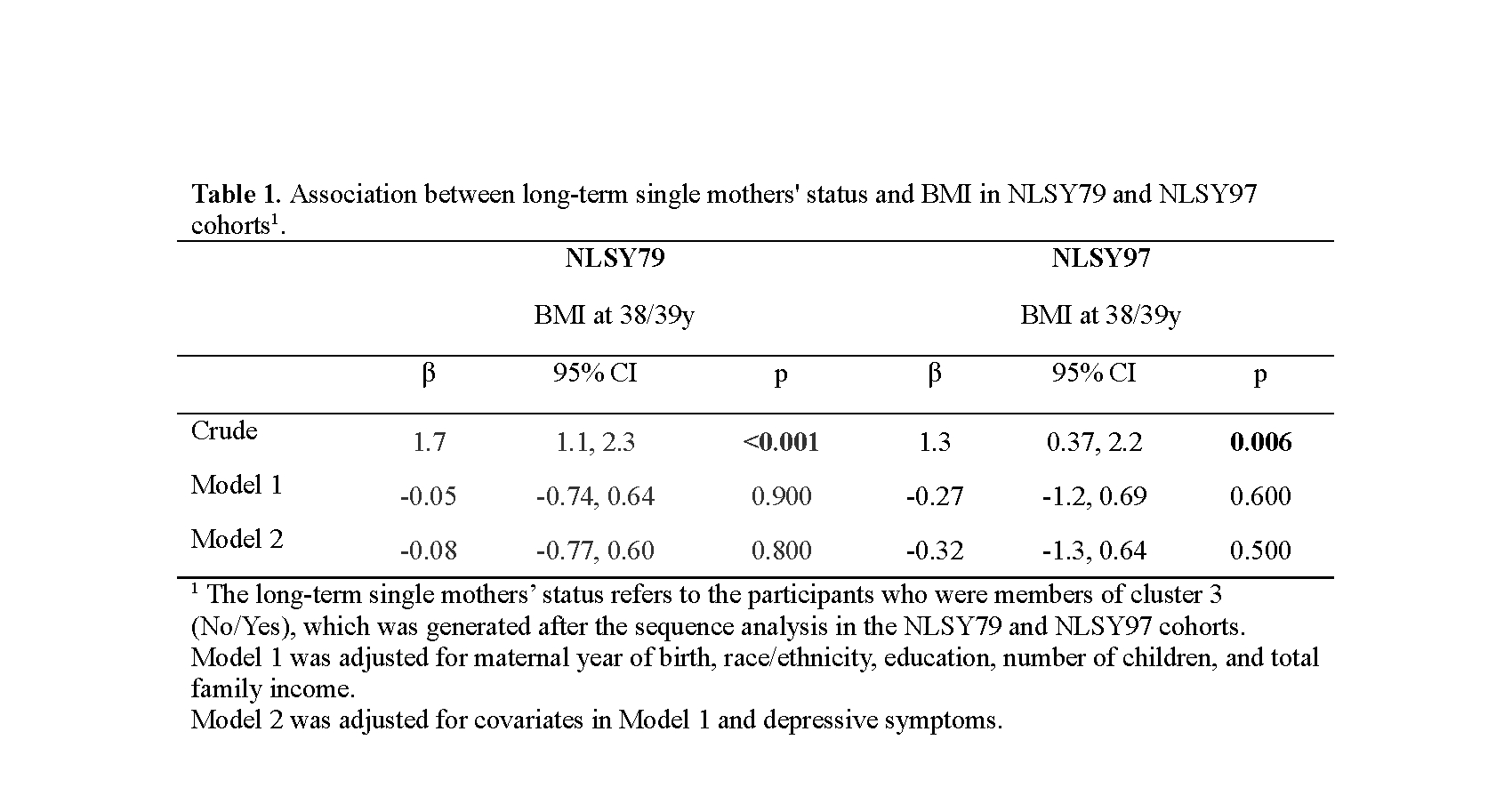
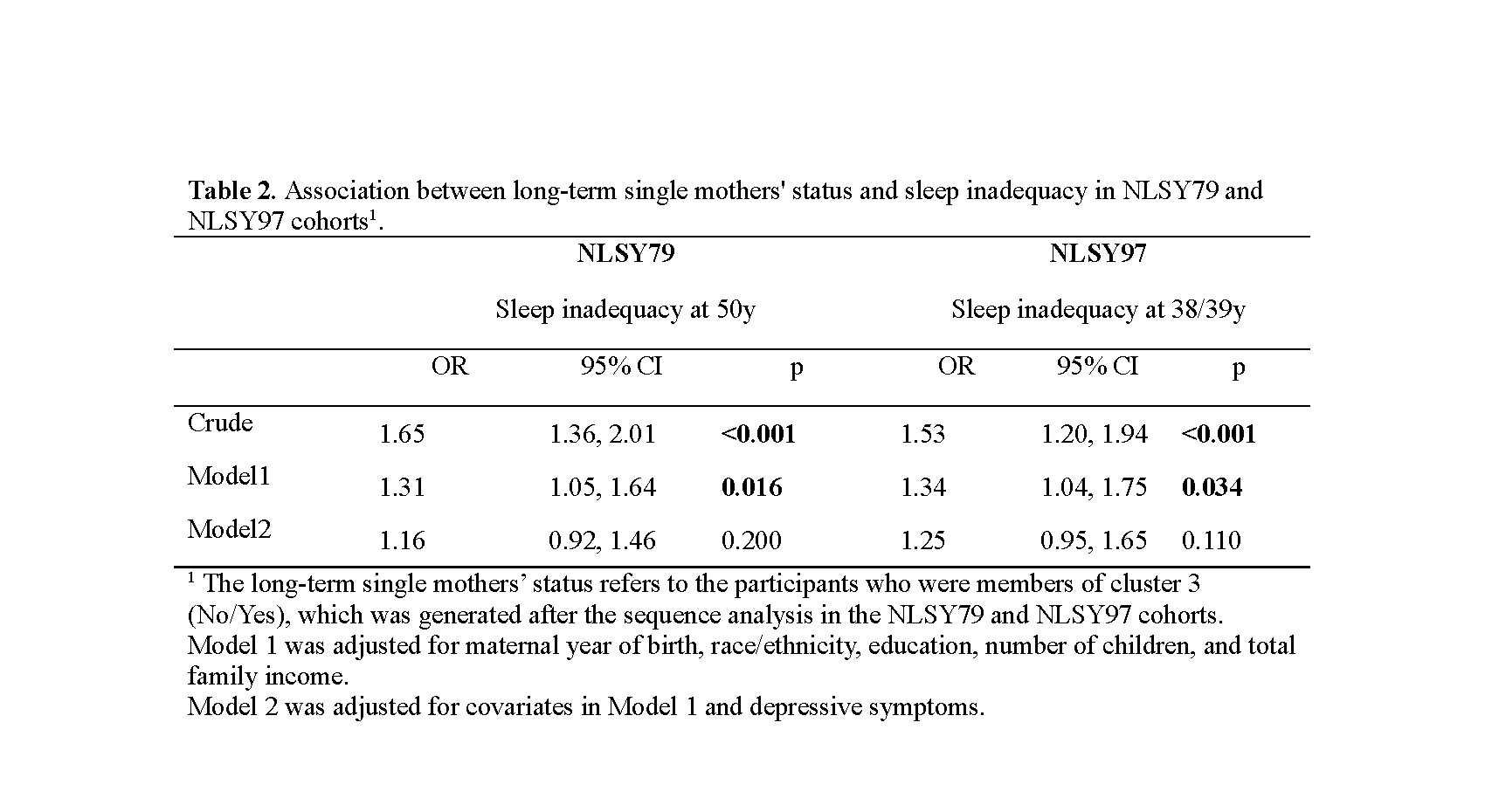
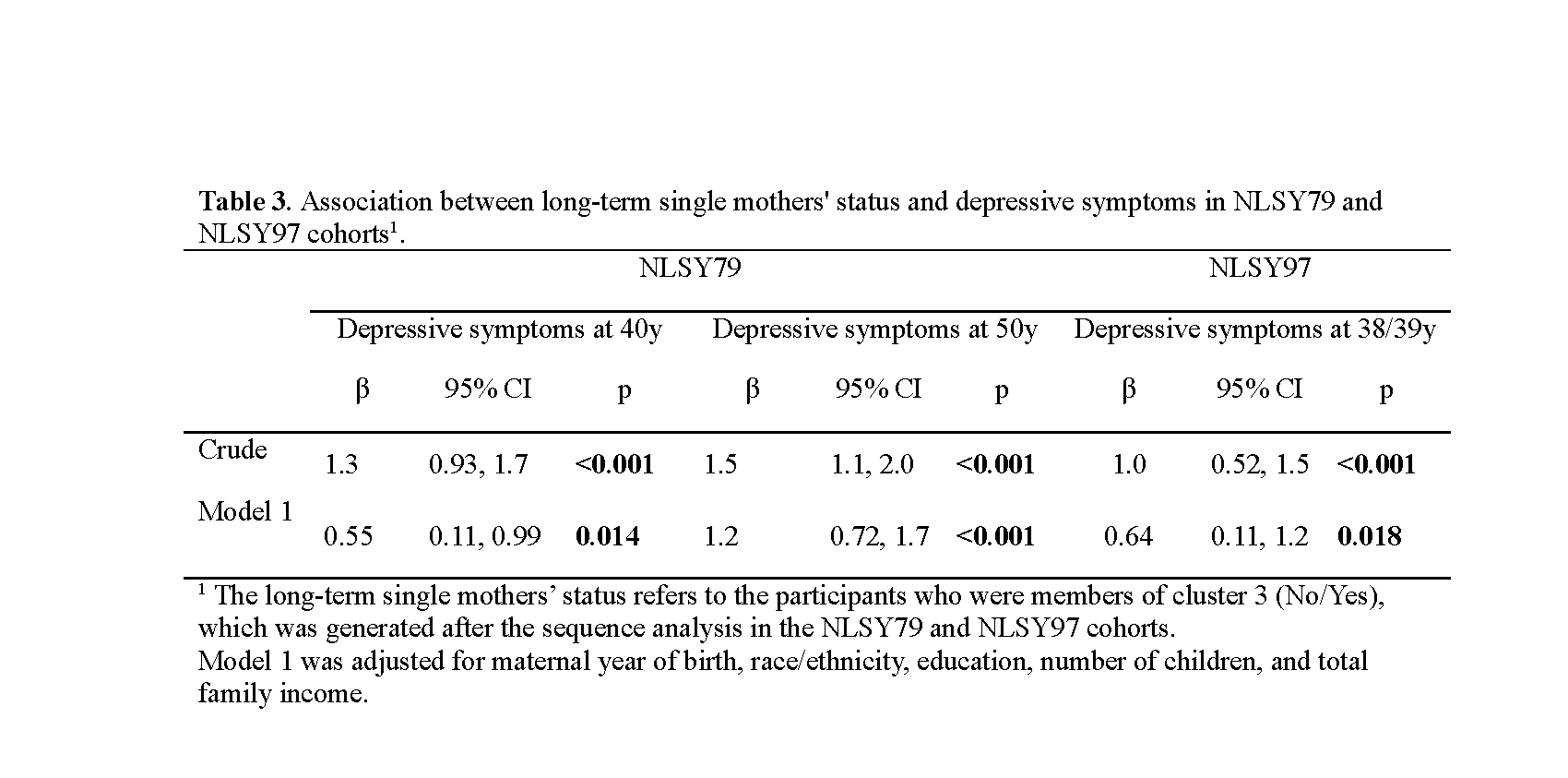
Abstract Body: Introduction: Single motherhood is the second main household arrangement in the United States (U.S.). However, little is known about the lasting effects of single motherhood on the cardiovascular health of midlife women. We hypothesized worse cardiovascular risk factors (body mass index- BMI, sleep duration, and depressive symptoms) for women who experienced long-term single motherhood, and that this association varies by U.S. cohorts due to different historical contexts. Methods: We used data from 2,320 and 1,386 mothers aged 15 to 37 from the National Longitudinal Survey of Youth (NLSY) 1979 and 1997 cohorts. Maternal partnership was defined as whether the woman was in a union or not, and had a child or not, at each follow-up year. BMI (continuous), depressive symptoms (continuous), and inadequate sleep duration (no/yes) were used as outcomes. Sleep duration inadequacy was defined as <7 or >9 hours. The Center for Epidemiological Studies Depression Scale was used to assess depressive symptoms. We used sequence analysis with a hierarchical cluster method to identify clusters of maternal partnership. We performed multivariate linear and logistic models to assess the association between long-term single motherhood and women’s health, adjusting for year of birth, race/ethnicity, education, number of children, and total family income. Results: The three clusters identified in both cohorts were long-term single mothers, long-term partnered mothers, and long-term single or partnered women without a child. Long-term single mothers represented 18.8% and 23.6% of the NLSY79 and NLSY97 cohorts, respectively. The association between long-term single motherhood and BMI was not independent of sociodemographic factors and depressive symptoms (Table 1). Long-term single motherhood was associated with sleep inadequacy independently of sociodemographic factors, but not of depressive symptoms (Table 2). Long-term single motherhood was associated with higher depressive symptoms (Table 3). The findings were similar for both cohorts. Conclusions: Independent of shifting historical context, single motherhood has long-term effects on women’s health, particularly on sleep duration and depressive symptoms. As single motherhood is rising as one of the main household arrangements in the U.S., these findings may have meaningful implications for public policies related to women’s health.
Batalha, Monica
(
Albert Einstein College of Medicine
, Bronx , New York , United States )
Huang, Wenxuan
(
Johns Hopkins University
, Baltimore , Maryland , United States )
Kelley, Jessica
(
Case Western Reserve University
, Cleveland , Ohio , United States )
Isasi, Carmen
(
ALBERT EINSTEIN COLLEGE MEDICINE
, Bronx , New York , United States )