Effect of a DASH-style diet and sodium reduction on kidney outcomes in people with type 2 diabetes: A randomized crossover feeding trial
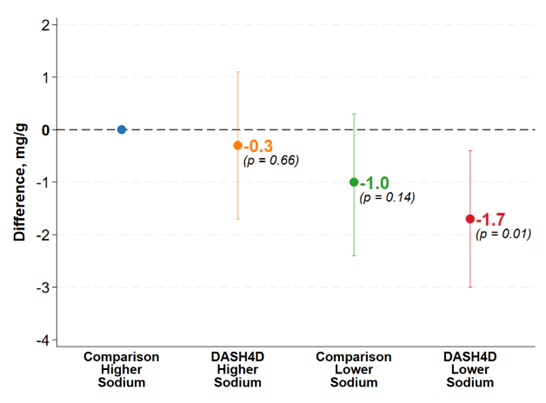
Abstract Body: Background: There is limited evidence from clinical trials on dietary strategies for kidney health in people with type 2 diabetes. Objective: We aimed to test the effect of a DASH-style diet and sodium reduction, alone and combined, on kidney outcomes in people with type 2 diabetes in a randomized 4-period crossover feeding trial. Methods: In the DASH4D trial, adults with type 2 diabetes were randomly assigned to a sequence of 4 interventions, each for a period of 5 weeks: 1) a DASH-style diet modified for diabetes with lower sodium (1500 mg/day at 2000 kcal, to align with American Heart Association recommendations), 2) a DASH-style diet with higher sodium (3700 mg/day at 2000 kcal), 3) a typical American diet with lower sodium, and 4) a typical American diet with higher sodium (reference). Participants were provided with all meals and snacks during the intervention periods and calories were adjusted for weight maintenance. We estimated the effect of diet on log-transformed urine albumin-to-creatinine ratio (UACR) and estimated glomerular filtration rate (eGFR, CKD-Epi equation) using linear mixed effects regression with a random intercept for participants and adjustment for order. Results: There were 101 participants with mean age 67 years, 65% female, 88% were Black adults, 92% with overweight or obesity, and mean systolic blood pressure 135 mmHg. Mean (standard deviation) eGFR was 80 (19) mL/min/1.73 m2 and median UACR (25th, 75th percentile) was 6.9 (4.0, 14.0) mg/g. Relative to the typical American diet with higher sodium, the DASH4D diet with lower sodium significantly reduced UACR (p=0.01) (Figure). eGFR was significantly reduced by the DASH4D diet with lower sodium (p<0.001) and the typical American diet with lower sodium (p=0.001) compared to the typical American diet with higher sodium. The mean difference between sodium interventions in UACR was -1.2 mg/g (95%CI -2.2, -0.3; p=0.01) and in eGFR was -2.3 mL/min/1.73 m2 (95%CI -3.5, -1.0; p<0.001). Conclusion: A DASH-style diet and sodium reduction decreased kidney damage (UACR) in people with type 2 diabetes, primarily by sodium reduction. The eGFR reduction was likely due to acute hemodynamic changes, which previously has been associated with favorable long-term effects on kidney function.
Rebholz, Casey
(
JOHNS HOPKINS UNIVERSITY
, Baltimore , Maryland , United States )
Wang, Dan
(
JOHNS HOPKINS UNIVERSITY
, Baltimore , Maryland , United States )
Farnsworth, Christopher
(
Washington University in St. Louis
, St. Louis , Missouri , United States )
Mitchell, Christine
(
Johns Hopkins University
, Baltimore , Maryland , United States )
Juraschek, Stephen
(
BIDMC-Harvard Medical School
, Boston , Massachusetts , United States )
Pilla, Scott
(
Johns Hopkins University
, Baltimore , Maryland , United States )
Appel, Lawrence
(
Johns Hopkins University
, Baltimore , Maryland , United States )
Selvin, Elizabeth
(
JOHNS HOPKINS UNIVERSITY
, Baltimore , Maryland , United States )