The Burden of Protein-Energy Malnutrition Mortality in Older Adults by County, Race, and Ethnicity in the USA,2000-19: A Systematic Analysis of Health Disparities
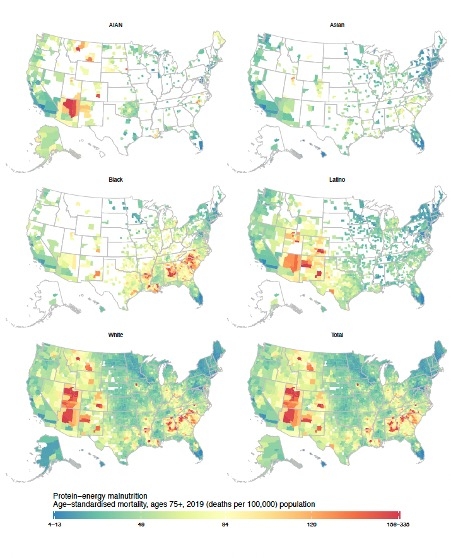
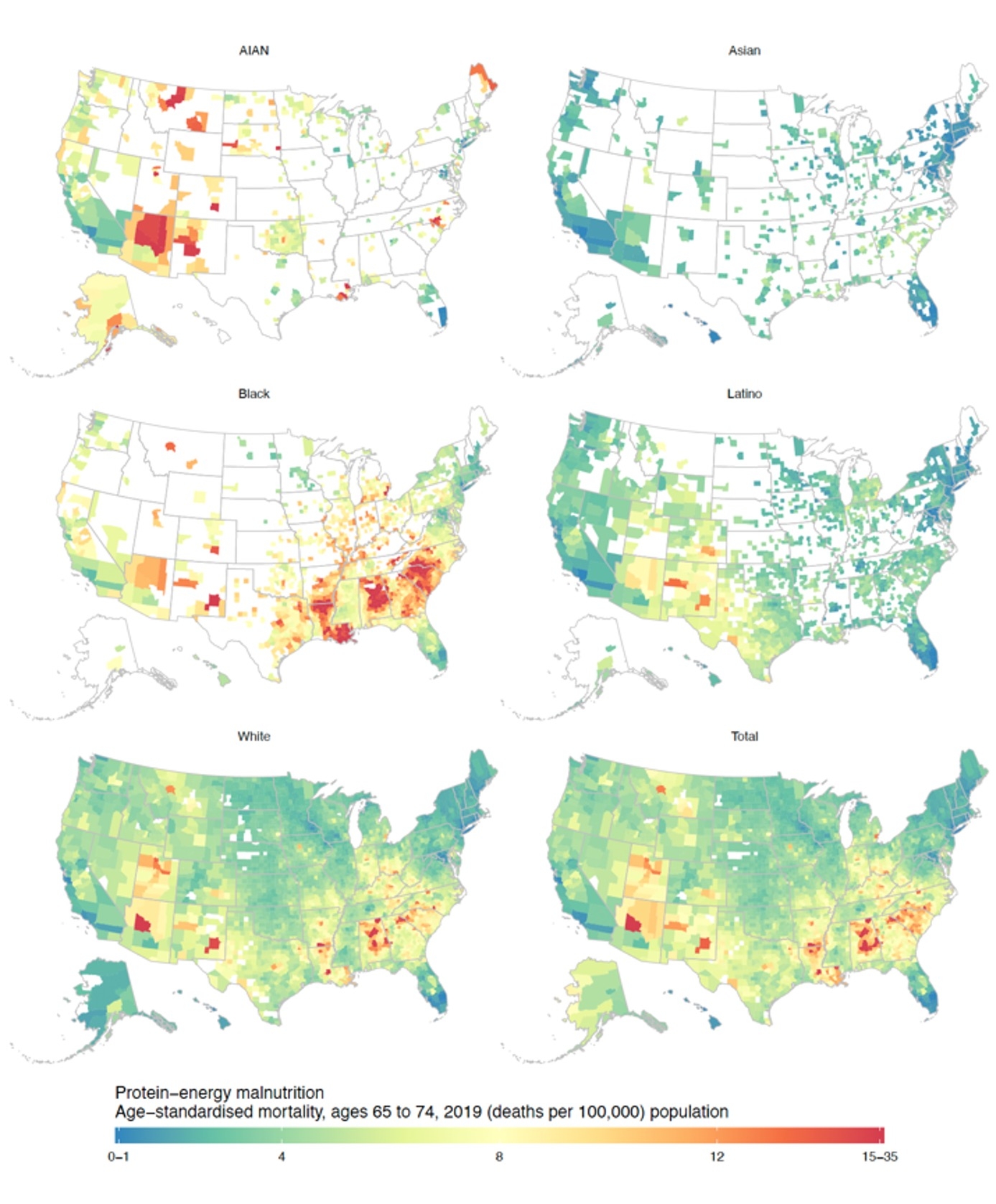
Abstract Body: Importance: Older adults have a higher malnutrition risk due to aging, chronic diseases, and social vulnerabilities. Understanding malnutrition mortality trends across racial/ethnic groups helps guide interventions to reduce health disparities and improve quality of life. Objectives: Estimate malnutrition mortality rates among older adults (ages 65-74 and ≥75) nationally and by county for racial/ethnic groups. Design/Setting: Analysis of National Vital Statistics System death registration (2000-2019), using small-area estimation to adjust for misclassification of race/ethnicity on death certificates. Exposure: Race/ethnicity (American Indian/Alaska Native (AIAN), Asian, Black, Latino, White) and county, mapped to temporally stable geographical units. Main Outcomes and Measures: Deaths due to malnutrition (ICD codes E40-E46.9, E64). Results: In 2019, adults aged ≥75 had the highest malnutrition mortality rate (49.2 per 100,000) compared to those aged 65-74 (4.6 per 100,000). Between 2000-2019, mortality increased for both ≥75 (19.5 to 49.2 per 100,000) and 65-74 (2.2 to 4.6 per 100,000). The Black population consistently had the highest malnutrition mortality rates (2019: ≥75: 60.8 per 100,000; 65-74: 7.7 per 100,000), followed by AIAN, White, Latino, and Asian populations. County-level analysis showed wide mortality variations for those ≥75 (4.9–308.9 per 100,000) and 65-74 (1.5–24.0 per 100,000). The South, particularly for Black individuals, was most affected, with rates of 0.6–27.9 per 100,000 (65-74) and 4.4–208.3 per 100,000 (≥75), with 66.2% of counties located in southern metro areas. For AIAN, mortality ranged from 0.6–34.9 per 100,000 (65-74) and 5.5–254.7 per 100,000 (≥75), with 75% in Rocky Mountains' metro areas. White individuals had rates of 0.4–25.0 per 100,000 (65-74) and 5.2–334.9 per 100,000 (≥75), mainly in nonmetro-Southern counties. Latino mortality ranged from 0.4–13.2 per 100,000 (65-74) and 4.2–173.1 per 100,000 (≥75), mostly in Rocky Mountains’ nonmetro areas, while Asian rates were 0.4–7.3 per 100,000 (65-74) and 4.4–141.5 per 100,000 (≥75), mainly in Rocky Mountains’ metro areas. Conclusions and Relevance Malnutrition mortality among older adults increased over the study period, particularly for those aged ≥75 in Southeastern counties. The variation across geography, age, race, and ethnicity indicates the need for targeted malnutrition screening, treatment, and nutritional interventions and policies for older adults.
Teruel Camargo, Juliana
(
, Bethesda , Maryland , United States )
Otero Machuca, Jessica
(
, Bethesda , Maryland , United States )
Hinerman, Amanda
(
, Bethesda , Maryland , United States )
Rodriquez, Erik
(
, Bethesda , Maryland , United States )
Alvarez Privado, Christian
(
NIMHD,NIH
, Bethesda , Maryland , United States )
Dwyer-lindgren, Laura
(
Institute for Health Metrics and Evaluation
, Seattle , Washington , United States )
Mokdad, Ali
(
Institute for Health Metrics and Evaluation
, Seattle , Washington , United States )
Mensah, George
(
NIH, NHLBI
, Bethesda , Maryland , United States )
Perez-stable, Eliseo
(
NIMHD,NIH
, Bethesda , Maryland , United States )
Author Disclosures:
Juliana Teruel Camargo:DO NOT have relevant financial relationships
| Jessica Otero Machuca:No Answer
| Amanda Hinerman:No Answer
| Erik Rodriquez:DO NOT have relevant financial relationships
| Christian Alvarez Privado:DO NOT have relevant financial relationships
| Laura Dwyer-Lindgren:No Answer
| Ali Mokdad:No Answer
| George Mensah:No Answer
| Eliseo Perez-Stable:DO NOT have relevant financial relationships