Engineering Microenvironmental Cues to Drive Functional Maturation of Human Induced Pluripotent Stem Cell-Derived Cardiomyocytes
Abstract Body: Cardiovascular disease remains the leading cause of mortality worldwide, driven by irreversible cardiomyocyte loss following myocardial infarction. A major barrier in cardiac tissue engineering is the inability of stem cell derived cardiomyocytes to achieve coordinated structural and electrophysiological maturation in vitro. Here, we introduce a mechanically defined, biomimetic three dimensional platform that integrates structural, biochemical, and electrical cues to systematically drive cardiomyocyte maturation toward a ventricular like phenotype.
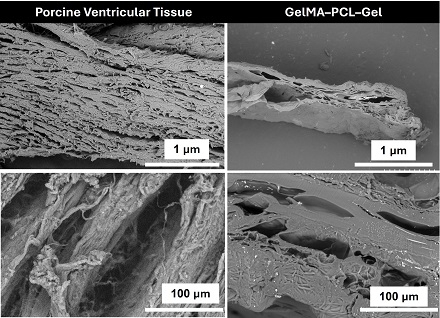
We engineer a tri component composite scaffold composed of gelatin methacrylate, cardiac derived extracellular matrix, and fragmented polycaprolactone gelatin nanofibers. This design uniquely enables simultaneous control of physiological stiffness, nanoscale architecture, and cardiac specific biochemical signaling within a single hydrogel system. The scaffold is tuned to match myocardial mechanics while preserving hydration and diffusion, and is combined with controlled electrical pacing delivered through a custom bioreactor to replicate developmental cardiac stimuli.
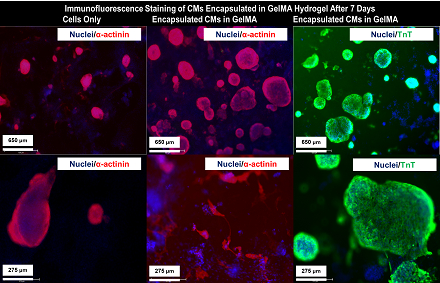
Methods include hydrogel fabrication and photo crosslinking, mechanical characterization to achieve physiological stiffness, and swelling and degradation analysis. Human induced pluripotent stem cell derived cardiomyocytes are encapsulated within the scaffold and assessed for viability, morphology, and maturation. Structural organization is evaluated using immunostaining of sarcomeric proteins and gap junction markers. Functional maturation is quantified through calcium imaging to measure contraction dynamics, amplitude, and decay kinetics. Gene expression analysis is performed to assess markers of contractility, electrical coupling, and calcium handling. Electrical stimulation parameters are systematically varied to determine dose dependent maturation responses.
We hypothesize that this integrated platform will produce coordinated improvements in sarcomeric organization, gap junction localization, and calcium handling, exceeding conventional two dimensional and hydrogel only systems. Electrical conditioning is expected to further enhance excitation contraction coupling and transcriptional maturation. By linking scaffold mechanics, matrix composition, and biophysical stimulation to functional outcomes, this study establishes a mechanistic framework for cardiomyocyte maturation in engineered tissues.
Khodadadi, Mahtab
(
North Carolina State University
, Raleigh , North Carolina , United States )
Gluck, Jessica
(
North Carolina State University
, Raleigh , North Carolina , United States )