
Logo

American Heart Association

  9
  0


Final ID: Mon056

H251N β-Cardiac Myosin Mutation Alters Cardiomyocyte Cell-Matrix Force Transmission via Focal Adhesion Remodeling In a Stiffness-Dependent Manner

Abstract Body: Introduction:
Hypertrophic cardiomyopathy (HCM)–associated mutations in MYH7 alter sarcomere mechanics, yet how these mutations influence mechanobiological signaling in cardiomyocytes (CMs) remains poorly understood. The early-onset H251N β-cardiac myosin mutation increases actin motility, intrinsic force, and ATPase activity, consistent with a hypercontractile molecular phenotype. Here, we investigate the transmission of these forces from the cell to the matrix.
Hypothesis:
We hypothesized that H251N-associated increases in molecular motor activity would enhance focal adhesion (FA) organization and mechanobiological responses.
Methods:
Human induced pluripotent stem cell-derived CMs (hiPSC-CMs) carrying the H251N mutation and isogenic controls were seeded onto deformable substrates to mimic phyhsiological and pathological stiffness. A Förster resonance energy transfer (FRET)- based molecular tension sensor was employed to assess intracellular FA organization and adhesion-associated tension.
Results:
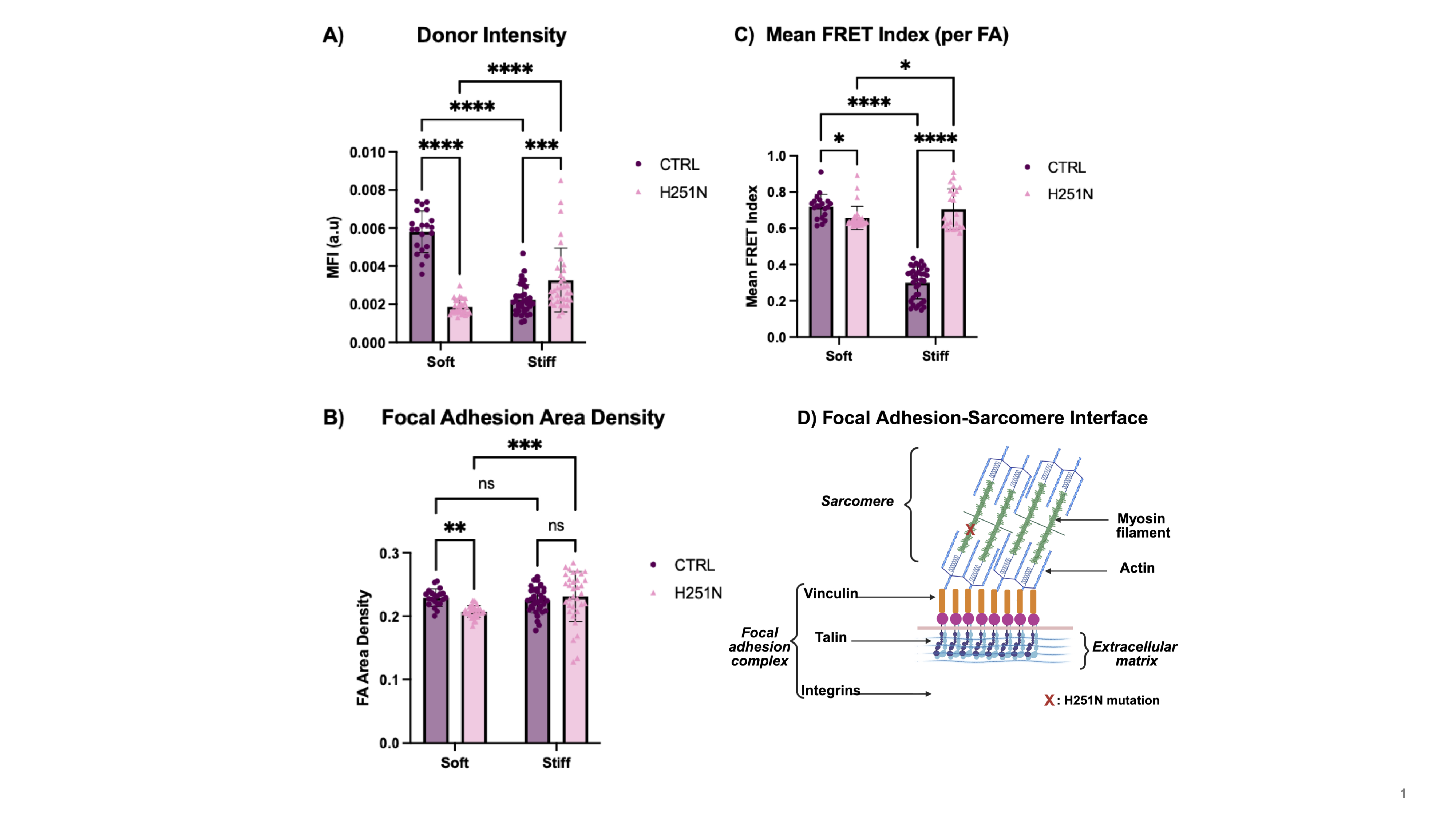
Two-way ANOVA revealed a significant interaction between genotype and substrate stiffness for FA area density (p < 0.0001), FRET index (p = 0.0121), and donor fluorescence intensity (p < 0.0001), indicating a stiffness-dependent effect of H251N (Figure 1). FA area density was lower in H251N relative to control on soft substrates but slightly higher on stiff substrates. Consistent with this pattern, FRET index was lower in H251N on soft substrates and higher on stiff substrates, while donor fluorescence intensity exhibited a similar but more pronounced stiffness-dependent shift.
Conclusion:
Our results show that H251N-associated increases in molecular motor activity are linked to stiffness-dependent alterations in FA remodeling and mechanotransductive coupling.
This finding supports our hypothesis that the H251N myosin mutation promotes mechanosensitive remodelling through cell substrate adhesion complexes.
  • Stephanie, Georgina  ( University of Michigan, Ann Arbor , Ann Arbor , Michigan , United States )
  • Park, Mari  ( University of Michigan , Ann Arbor , Michigan , United States )
  • French, Nathan  ( University of Michigan , Ann Arbor , Michigan , United States )
  • Josyabhatla, Mahadev  ( University of Michigan , Ann Arbor , Michigan , United States )
  • Vander Roest, Alison  ( University of Michigan , Ann Arbor , Michigan , United States )
  • Author Disclosures:
Meeting Info:

Basic Cardiovascular Sciences 2026

2026

Boston, Massachusetts

Session Info:

Poster Session 1

Monday, 07/13/2026 , 04:30PM - 07:00PM

Poster Session and Reception

More abstracts on this topic:
Arteriovenous fistula creation results in cardiac dysfunction and remodeling in a uremic pig model

Kane Jamie, Collins Jeremy, Lee Timmy, Misra Sanjay, Singh Prabh, Kilari Sreenivasulu, Baranwal Gaurav, Naskar Atanu, Montonye Dan, Lutgens Esther, Wang Ying, Negm Ahmed

Abnormal Calcium Regulation Leads to Pathological Cardiac Hypertrophy During Pregnancy in the GSNOR-Deficient Mouse Model of Preeclampsia

Dulce Raul, Balkan Wayne, Hare Joshua, Kulandavelu Shathiyah

More abstracts from these authors:
Clinically Variable Penetrant MYH7 G256E Mutation Shows Gene-Dose-Dependent HCM Disease Phenotype on a Transcriptomic, Proteomic, and Functional Level

Heinrich Paul, Lundby Alicia, Wu Sean, Lee Soah, Sailer Carolin, Achter Jonathan, Jung Raina, Lee Carissa, Vander Roest Alison, Roberts Brock, Bernstein Daniel

You have to be authorized to contact abstract author. Please, Login
Not Available