
Logo

American Heart Association

  8
  0


Final ID: Tue043

Ultrasound Responsive Smart Hydrogels for Vasculogenesis

Abstract Body: Background: Vascularization, a challenge in tissue engineering strategies rely on hydrogels, which mimic the extracellular matrix, to help coordinate cellular behaviors. However, conventional hydrogels do not afford dynamic control of critical cues that drive vascular assembly.
Hypothesis: Biochemical and biophysical cues triggered in smart hydrogels via ultrasound synergistically influence microvascular assembly.
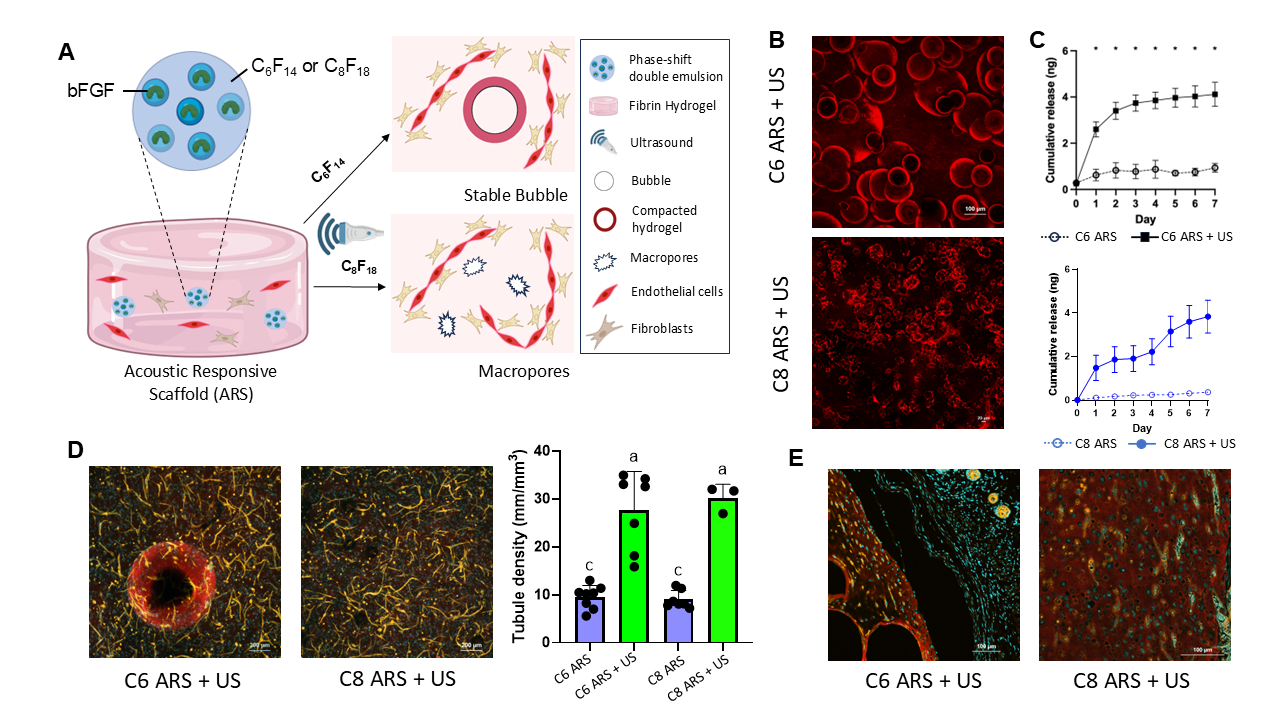
Goals: Develop smart hydrogels, termed acoustically responsive scaffolds (ARSs), that enable simultaneous release of bFGF and matrix reorganization using ultrasound.
Methods: ARSs were prepared by loading ultrasound-sensitive emulsions containing bFGF and perfluorohexane (C6) or perfluorooctane (C8) into 5 mg/mL fibrin hydrogels along with human endothelial cells and fibroblasts. ARSs were exposed to pulsed 2.5 MHz ultrasound at 4.4 MPa. Hydrogel architecture, mechanical properties, and bFGF release were characterized with confocal microscopy, rheometry, and ELISA, respectively. In vitro endothelial tubule formation was assessed after 7 days of culture with Ulex europaeus agglutinin I staining. Similar vasculogenic studies were performed with ARSs implanted subcutaneously in mice.
Results: Ultrasound generated stable bubbles in C6-ARSs, along with localized matrix compaction and an increased storage modulus. In C8-ARSs, ultrasound generated macropores, with no impact on modulus. For both ARSs, bFGF release increased significantly after ultrasound. In vitro tubule density increased 3-fold in C6-ARSs and 3.3-fold in C8-ARSs after ultrasound versus unexposed controls. In vivo, the endothelial area fraction increased 1.8-fold in C6-ARSs and 1.6-fold in C8-ARSs following ultrasound.
Conclusion: Using ultrasound, synergistic modulation of bFGF release and microarchitecture reorganization in fibrin-based ARSs enhanced microvascular assembly. Overall, this strategy could help improve vascularization of engineered constructs and ischemic tissues.
  • Maji, Somnath  ( University of Michigan , Ann Arbor , Michigan , United States )
  • Danish, Zubi  ( University of Michigan , Ann Arbor , Michigan , United States )
  • Varghese, Sam  ( University of Michigan , Ann Arbor , Michigan , United States )
  • Addla Hari, Dharshan  ( University of Michigan , Ann Arbor , Michigan , United States )
  • Pinch, Abigail  ( University of Michigan , Ann Arbor , Michigan , United States )
  • Quesada, Carole  ( University of Michigan , Ann Arbor , Michigan , United States )
  • Putnam, Andrew  ( University of Michigan , Ann Arbor , Michigan , United States )
  • Fabiilli, Mario  ( University of Michigan , Ann Arbor , Michigan , United States )
  • Author Disclosures:
Meeting Info:

Basic Cardiovascular Sciences 2026

2026

Boston, Massachusetts

Session Info:

Poster Session 2

Tuesday, 07/14/2026 , 04:30PM - 07:00PM

Poster Session and Reception

More abstracts on this topic:
Enhanced Vascularization in hPSC-derived Cardiac Organoids by Dynamic Culture

Huerta Gomez Angello, Kang Soo-yeon, El-mokahal Marcel, Lee Moo-yeal, Yang Huaxiao

Cardiac Fibrosis and Senescence in Engineered Human Myocardium

Dittrich Gesine, Xu Xingbo, Riester Daniel, Meyer Tim, Tiburcy Malte, Fischer Andre, Zimmermann Wolfram

You have to be authorized to contact abstract author. Please, Login
Not Available