Metabolic, Inflammatory, and Hypertensive Stressors Suppress Pulmonary Endothelial Klf2 Expression in Pulmonary Hypertension Due to Left Heart Disease
Abstract Body: Background:
Pulmonary hypertension due to left heart disease (PH-LHD) is the most common form of pulmonary hypertension worldwide, yet no therapies directly improve outcomes in this population. We previously found that natriuretic peptide signaling is altered in Group 2 PH, but the mechanisms that drive adverse pulmonary remodeling are not well known.
Hypothesis:
We hypothesized that known risk factors for PH-LHD drive adverse pulmonary vascular remodeling through suppression of Kruppel-like Factor 2 (Klf2) mediated suppression of C-type natriuretic peptide (CNP) release from endothelial cells.
Methods:
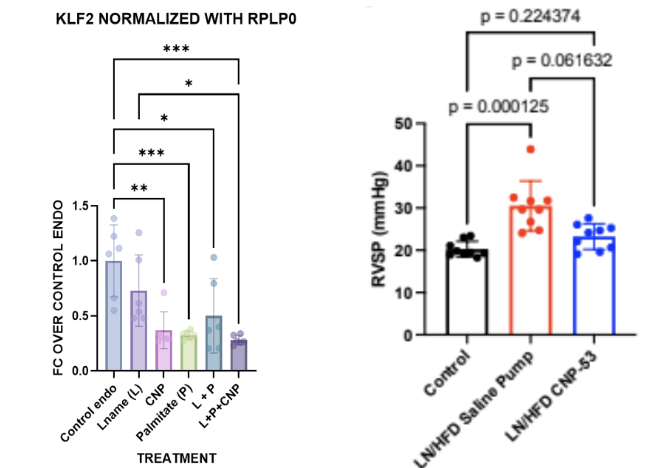
We analyzed plasma levels of natriuretic peptides across the lung vasculature of patients undergoing clinically indicated right heart catheterization by ELISA. PH-LHD was induced in wild type C57BL6/J mice with a combination of L-NAME (0.5 g/L) in water and high fat (60% lipid) diet for 5 weeks. Single cell sequencing, invasive catheterization, echocardiography, and histologic assessment were used to assess endothelial and pulmonary vascular changes. A modified CNP, CNP-53, was administered via osmotic pump in a subset of mice. Finally, murine pulmonary microvascular endothelial cells were treated for 24 hours with hypertensive (L-NAME, 1 µM), metabolic (palmitate, 100 µM), pro inflammatory (IL-1β and TNF-α, 10 ng/mL) stressors, and CNP-22 (100nm) with quantification of Klf2 and Nppc expression by qPCR.
Results:
In patients with LHD vs control, transpulmonary levels of CNP were lower with no changes in ANP or BNP levels, suggesting a decreased net production of CNP by the lung. In a mouse model of PH-LHD, Nppc expression also decreased in the lung. Single cell RNA sequencing identified gCap endothelial cells to have the greatest number of differentially expressed genes, with Klf2 as one of the most downregulated genes. In vitro, hypertensive, metabolic, and inflammatory stressors reduced both Klf2 and Nppc expression. Administration of a modified CNP (CNP-53) reversed pulmonary vascular remodeling in a PH-LHD mouse model.
Conclusion:
Our study identified a deficiency in CNP levels in the lungs of PH-LHD, which was recapitulated in a mouse model. Our studies suggest that known risk factors for PH in LHD (metabolic, inflammatory, and hypertensive stressors) drive endothelial dysfunction in part through a Klf2-mediated decrease in CNP expression. Finally, we demonstrate the therapeutic potential of CNP therapies in reversing pulmonary vascular remodeling in PH-LHD.
Abusharkh, Faris
(
Vanderbilt University
, Brookline , Massachusetts , United States )
Fatima, Anam
(
VUMC
, NASHVILLE , Tennessee , United States )
Kobeck, Elizabeth
(
VUMC
, NASHVILLE , Tennessee , United States )
Gardner, Sumner
(
Vanderbilt University
, Brookline , Massachusetts , United States )
Agrawal, Vineet
(
VUMC
, NASHVILLE , Tennessee , United States )