Ketone body β-Hydroxybutyrate Promotes MALAT1-Dependent Mitochondrial Bioenergetic Adaptation in Cardiomyocytes
Abstract Body: Heart failure is characterized by impaired metabolic flexibility and mitochondrial oxidative phosphorylation. Although β-hydroxybutyrate (BHB) improves cardiac bioenergetics, mechanisms linking ketone signaling to mitochondrial adaptation remain unclear. Our prior GEO dataset analysis (GSE206797) identified Malat1 among ketone-regulated long noncoding RNAs in neonatal mouse hearts lacking the ketone-producing enzyme HMGCS2. Consistently, six-month ketogenic diet–fed mice showed elevated blood ketones and increased cardiac Malat1 expression (n=13, P<0.01).
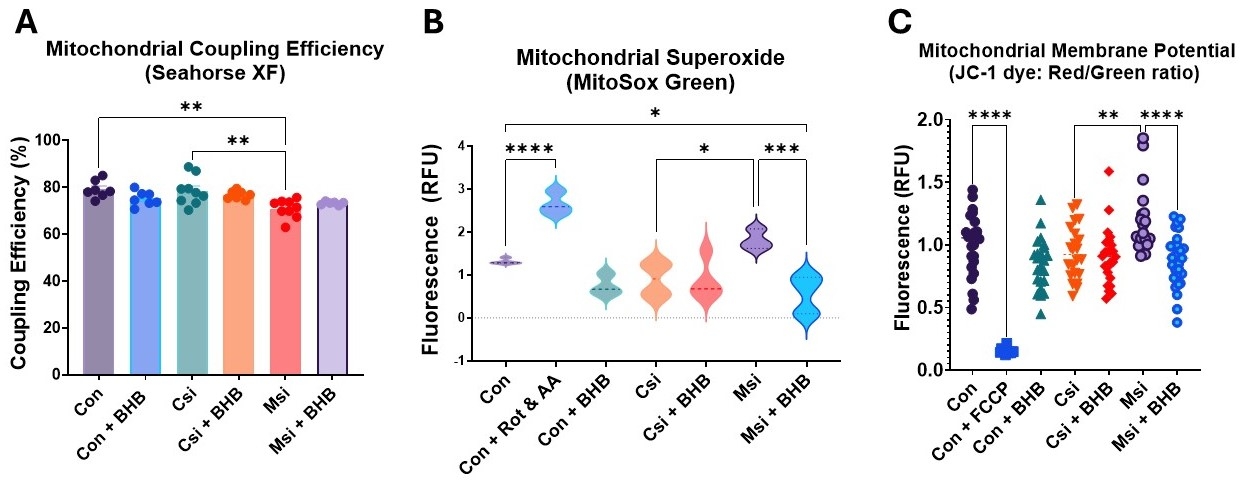
We hypothesized that BHB promotes cardiomyocyte mitochondrial protection through MALAT1. In AC16 human ventricular cardiomyocytes, BHB (0.5, 1, or 5 mM; for 24, 48, or 72 h) increased MALAT1 and induced genes involved in ketone metabolism, mitochondrial biogenesis, and antioxidant defense by qPCR (n=6). MALAT1 knockdown (10 nM siRNA for 72 h) reduced mitochondrial respiratory chain Complex I (P<0.05) and Complex IV (P<0.01) protein abundance vs control siRNA (Western blot; n=3) and increased NLRP3 inflammasome protein (P<0.01), whereas BHB (5 mM) reduced NLRP3 levels (P<0.01). Seahorse XF Mito Stress analysis (n=9) showed BHB enhanced basal respiration, maximal respiration, ATP-linked respiration, and spare respiratory capacity, whereas MALAT1 knockdown reduced respiratory capacity and coupling efficiency (P<0.01; Fig. 1A). MALAT1 deficiency increased cellular reactive oxygen species (H2DCFDA) and mitochondrial superoxide (MitoSOX) (n=12, P<0.05), which were reduced by BHB (P<0.001; Fig. 1B). JC-1 analysis showed that MALAT1 knockdown increased mitochondrial membrane potential (red/green ratio; n=24, P<0.01), indicating mitochondrial hyperpolarization associated with impaired electron transport and increased reactive oxygen species; BHB partially normalized this effect (P<0.0001; Fig. 1C).
In conclusion, BHB activates a MALAT1-dependent mitochondrial adaptation that enhances oxidative metabolism and limits inflammasome signaling. MALAT1 deficiency disrupts respiratory chain integrity and increases oxidative stress, revealing a novel BHB–MALAT1 pathway regulating cardiomyocyte bioenergetic adaptation.