Logo

American Heart Association

  8
  0


Final ID: Tue028

Optical Flow-based Software to Examine How Afterload Affects Excitation-Contraction Coupling in iPSC-Derived Micro-Heart Tissues

Abstract Body: Background: Micro-heart tissues (μHTs), generated by seeding iPSC-cardiomyocytes (iPSC-CMs) around elastomeric posts, allow for medium-throughput pharmacology analysis. Mimicking afterload by increasing post bending stiffness (resistance to systolic force) enhances functional maturation; we hypothesized this includes improved Excitation-Contraction Coupling (ECC).

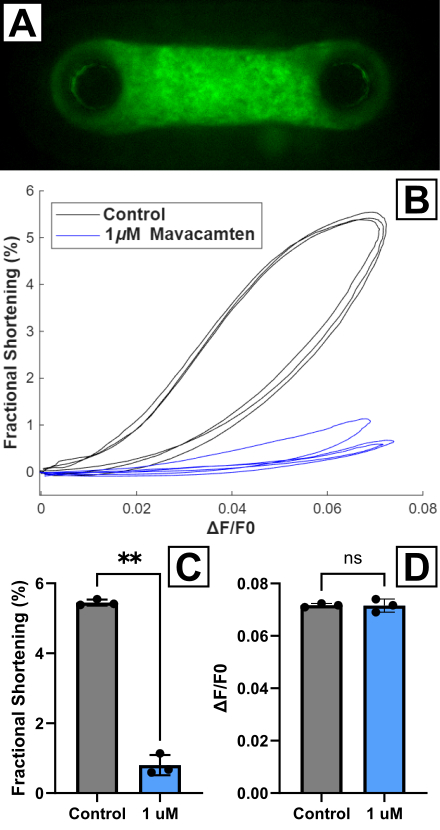
Methods: We differentiated iPSC-CMs from a GCaMP6f (Ca2+ indicator) knock-in WTC line and formed µHTs (Fig 1). To assess if afterload-induced maturation can improve ECC, we developed Python-based software tracking fluorescence intensity and post deflection (via dense Farneback optical flow). To track texture on changing intensity, we Gaussian-blurred frames and contrast gated low-signal regions. To validate ECC outputs, we treated µHTs with mavacamten. Tunable elastic modulus poly(dimethyl siloxane) yielded soft (bending stiffness: 0.42 N/m) or stiff (1.96 N/m) posts.

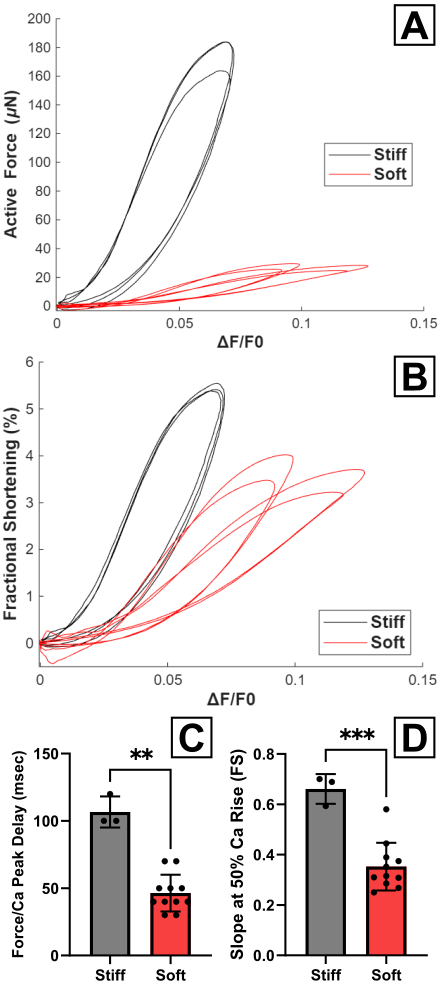
Results: Automated FS measurements were validated manually. Mavacamten treatment of µHTs showed a paired decrease in FS (P=.0018) and no change in ΔF/F0 (background-corrected peak Ca2+ amplitude) (P=.9165) (Fig 1). Consistent with our hypothesis, stiff post µHTs showed an increase in slope at 50% Ca rise for both Ca2+-force and Ca2+-FS loops compared to soft µHTs (P=.0009, .0008) (Fig 2). However, stiff µHTs also exhibited a longer delay between peak Ca2+ and peak force (P=.0021) (Fig 2), suggesting afterload adaptations involve improved ECC and longer force generation time, signifying a more mature phenotype.

Conclusion: Afterload drives physiological maturation of iPSC-CMs in engineered µHTs, reflected in improved ECC.
  • Kellogg, Austin  ( Washington University in St. Louis , Saint Louis , Missouri , United States )
  • Malayath, Ganesh  ( Washington University in St. Louis , Saint Louis , Missouri , United States )
  • Chou, Hsin-yi  ( Washington University in St. Louis , Saint Louis , Missouri , United States )
  • Huebsch, Nathaniel  ( Washington University in St. Louis , Saint Louis , Missouri , United States )
  • Author Disclosures:
Meeting Info:

Basic Cardiovascular Sciences 2026

2026

Boston, Massachusetts

Session Info:

Poster Session 2

Tuesday, 07/14/2026 , 04:30PM - 07:00PM

Poster Session and Reception

More abstracts on this topic:
Bismuth Nanoparticle-Infused Bioresorbable Graft Enables Multimodal Computed Tomography and Photoacoustic Imaging-Based Monitoring and Promotes Vascular Regeneration

Barcena Allan John, Fowlkes Natalie, Bouchard Richard, Huang Steven, Melancon Marites, Bernardino Marvin, Mishra Archana, Bolinas Dominic Karl, Marco Kitz Paul, Fernandez Kim Claudette, San Valentin Erin Marie, Court Karem, Godin Biana

Add-on Therapy with Dantrolene, a RyR2 Stabilizer, Terminates Ventricular Tachycardia Storm refractory to Intravenous Amiodarone in Heart Failure.

Nawata Junya, Omuro Ayumi, Fukuda Masakazu, Suetomi Takeshi, Miyazaki Yosuke, Fujimura Tatsuhiro, Mochizuki Mamoru, Sano Motoaki, Kobayashi Shigeki, Ishikawa Maho, Nakata Yuki, Murakawa Kaori, Nakashima Yusuke, Hisaoka Masahiro, Matsuyama Tetsuya, Nakamura Yoshihide

More abstracts from these authors:
Mechanistic Characterization of CRYAB-R120G Desmin-Related Cardiomyopathy in Human iPSC-Derived 3D Cardiac Micro-Tissues

Kargar Gaz Kooh Yasaman, Diwan Abhinav, Huebsch Nathaniel, Zhao Chen, Malayath Ganesh, Hayem Leah, Bahmani Bahareh, Ramahdita Ghiska, Jiang Huanzhu, Ma Xiucui, Rawnsley David

Low-dose JAK1 inhibitor partially rescues contractility in a human cardiac micro-tissue model of Desmin-related Cardiomyopathy caused by CRYAB mutation

Kargar Gaz Kooh Yasaman, Chou Hsin-yi, Ma Xiucui, Genin Guy, Rawnsley David, Diwan Abhinav, Huebsch Nathaniel, Bahmani Bahareh, Zhao Chen, Malayath Ganesh, Hayem Leah, Jin Hanxun, Ramahdita Ghiska, Jiang Huanzhu, Santiago Perez Javier

You have to be authorized to contact abstract author. Please, Login
Not Available