
Logo

American Heart Association

  7
  0


Final ID: Wed120

When ST Elevation Is Not Infarction: Diabetic Ketoacidosis–Induced Pseudoinfarction Pattern

Abstract Body: Background: Metabolic derangements such as diabetic ketoacidosis can produce electrocardiographic changes that mimic ST-elevation myocardial infarction. Recognition of non-ischemic causes of ST elevation is critical to avoid unnecessary invasive procedures.

Research question: Severe metabolic disturbances associated with diabetic ketoacidosis and hyperkalemia may produce electrocardiographic patterns that mimic acute myocardial infarction despite the absence of coronary occlusion.

Goals: The goal of this study is to highlight a case of diabetic ketoacidosis–associated hyperkalemia presenting with ST-segment elevation mimicking myocardial infarction and to emphasize clinical features that aid in distinguishing pseudoinfarction patterns from true coronary occlusion.

Methods: Clinical data were reviewed including presenting symptoms, laboratory findings, serial electrocardiograms, cardiac biomarkers, and transthoracic echocardiography to evaluate the cause of ST-segment elevation.

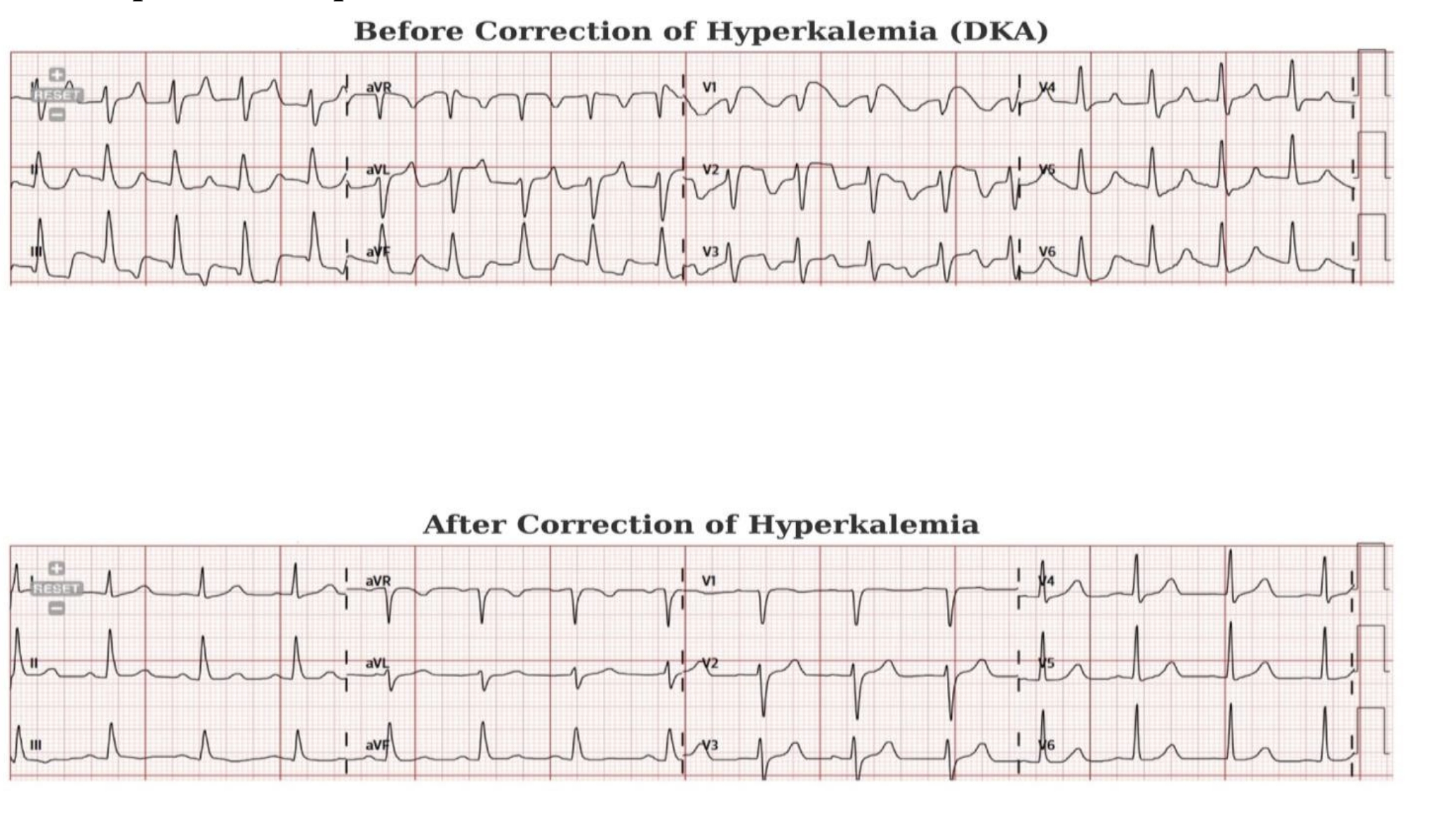
Results: A 56-year-old man with a history of type 2 diabetes mellitus and hypertension presented with several days of nausea and vomiting and was transferred for concern of ST-elevation myocardial infarction and diabetic ketoacidosis. Laboratory evaluation revealed severe metabolic acidosis, hyperkalemia with a potassium level of 7.0 mmol/L, and acute kidney injury. Electrocardiogram at the referring facility demonstrated ST-segment elevation in the precordial leads with reciprocal changes in the inferior leads. The patient denied chest pain. High-sensitivity troponin peaked at 453 ng/L. Transthoracic echocardiogram demonstrated preserved left ventricular systolic function without regional wall motion abnormalities. Serial electrocardiograms showed resolution of ST-segment changes with correction of hyperkalemia and metabolic acidosis.

Conclusion: Diabetic ketoacidosis–associated hyperkalemia can produce a pseudoinfarction electrocardiographic pattern. Recognition of this entity is essential to prevent unnecessary invasive procedures and to guide appropriate metabolic management.
  • Sandhu, Onkar  ( Saint Agnes Medical Center , Fresno , California , United States )
  • Palaniswamy, Chandrasekar  ( Saint Agnes Medical Center , Fresno , California , United States )
  • Author Disclosures:
Meeting Info:

Basic Cardiovascular Sciences 2026

2026

Boston, Massachusetts

Session Info:

Poster Session 3

Wednesday, 07/15/2026 , 04:30PM - 07:00PM

Poster Session and Reception

More abstracts on this topic:
A Metabolomic Study of Cardiac Dysfunction in Hyperglycemia

Yoshida Yilin, Qi Qibin, Cheng Susan, Kaplan Robert, Rodriguez Carlos, Shah Amil, Yu Bing, Nguyen Ngoc Quynh, Moon Eun Hye, Casey Rebholz, Skali Hicham, Arthur Victoria, Echouffo Justin, Ballantyne Christie, Selvin Elizabeth

The Utility of the Modified Shock Index (MSI) in Risk Stratification of Patients with STEMI

Jnani Jack, Alboucai Jack, Bulsara Kishen, Cheng Austin, Griffin Matthew, Alvarez Villela Miguel, Pierce Matthew, Weintraub Spencer, George Riya, Impastato Brandon, Kamel Maikel, Sood Aditya, Hsieh Ji-cheng, Srivastava Shreya, Tsai Andrew

You have to be authorized to contact abstract author. Please, Login
Not Available