
Elevated NPPB Identifies Myocardial Recovery Potential After LVAD in Pediatric Dilated Cardiomyopathy
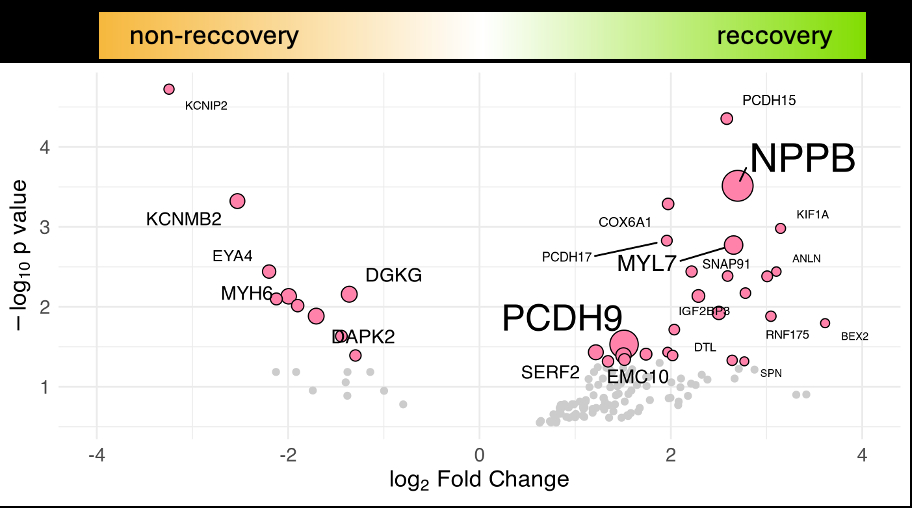
Abstract Body: ntroduction: A subset of children with dilated cardiomyopathy (DCM) recovers left ventricular (LV) function after LV assist device (LVAD) implantation, enabling device explantation. However, molecular determinants of successful bridge-to-recovery remain poorly understood. Hypothesis: We assessed the hypothesis that myocardial gene programs at the time of LVAD implantation differ between recovery and non-recovery pediatric DCM and that increased NPPB expression is associated with subsequent LV recovery. Methods: We studied 25 children with idiopathic DCM who underwent LVAD implantation between 2013 and 2023. Patients were classified as recovery (successful explantation with sustained stabilization, n=10) or non-recovery (transplantation or death, n=15). Single-nucleus RNA and ATAC sequencing were performed in 6 representative LV apical tissue samples obtained at implantation (3 recovery, 3 non-recovery). Candidate findings were validated in the full cohort using serum BNP measurement and histologic assessment of cardiomyocyte apoptosis. Results: Cardiomyocyte pseudobulk analysis showed higher expression of NPPB, MYL7, and PCDH9 in recovery cases, with NPPB demonstrating the highest expression among candidate genes (baseMean 16,305; log2FC 2.70; P<0.001, Image1) along with increased chromatin accessibility at its locus (log2FC 1.17; P<0.01). Gene ontology analysis demonstrated enrichment of apoptosis-related pathways. At LVAD implantation, serum BNP was significantly higher in the recovery group than in the non-recovery group (3048 [642–6032] vs. 732 [372–4179] pg/mL, P=0.04) and correlated with improvement in LV ejection fraction after LVAD support (r=0.5, P<0.05). The proportion of TUNEL-negative cardiomyocytes was higher in recovery cases (0.37 [0.19–0.48] vs. 0.21 [0.02–0.37], P<0.01). Conclusions: In conclusion, increased myocardial NPPB expression and elevated BNP at LVAD implantation are associated with subsequent LV recovery in pediatric DCM. These findings support a link between natriuretic peptide signaling and reduced cardiomyocyte apoptosis in successful bridge-to-recovery.
Kugo, Yosuke
(
The University of Osaka
, Suita , Japan )
Miki, Kenji
(
The University of Osaka
, Suita , Japan )
Kawamura, Takuji
(
The University of Osaka
, Suita , Japan )
Miyagawa, Shigeru
(
The University of Osaka
, Suita , Japan )