
Logo

American Heart Association

  12
  0


Final ID: Tue023

Developmentally Guided Human Cardiac Organoids Reproducibly Form Epicardial–Myocardial Organization and Myocardial Compaction–Like Remodeling

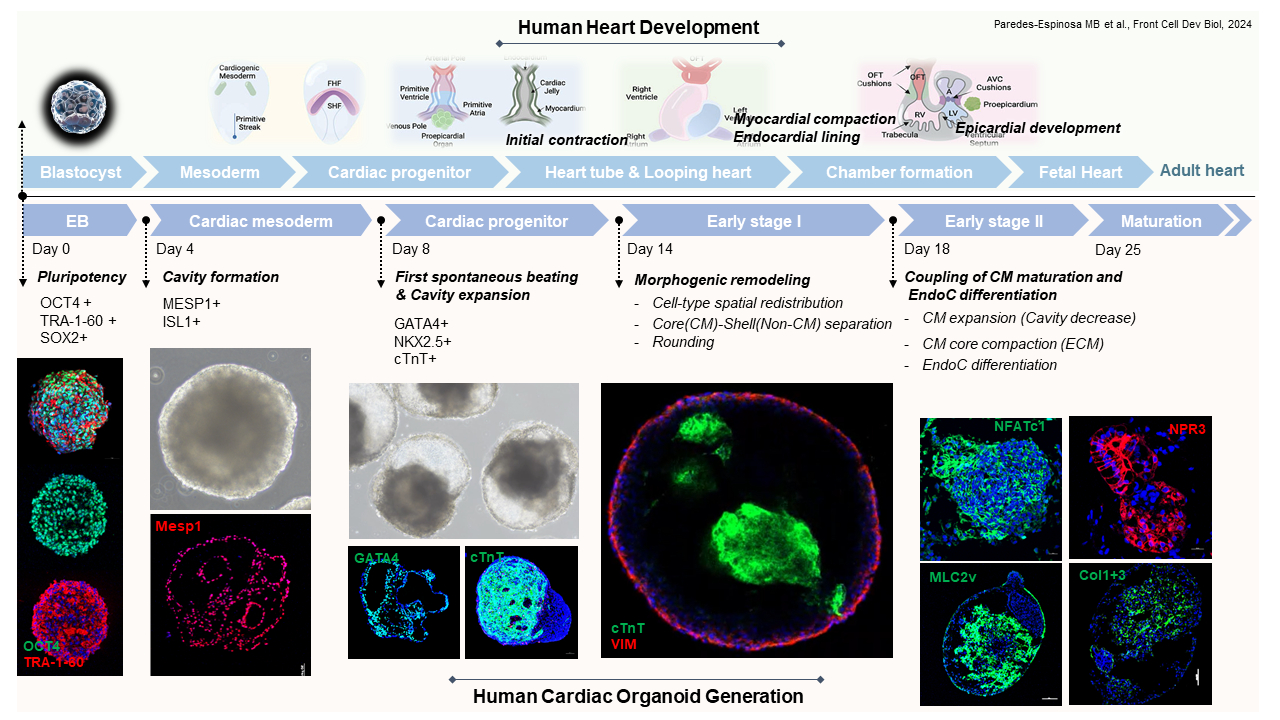
Abstract Body: Cell-type composition is commonly used to compare organoids with native tissues; however, developmental fidelity and structural reproducibility are also essential for robust human cardiac organoid models. We developed a developmentally guided protocol to generate structurally uniform, reproducible human cardiac organoids that recapitulate key morphogenetic features of fetal heart development.

Human induced pluripotent stem cells (hiPSCs) were aggregated into embryoid bodies (EBs) using EZ-passage and differentiated toward the cardiac lineage using Stemcell Technologies media with VEGF. At the cardiac progenitor cell (CPC) stage, organoids were co-cultured with hiPSC epicardial-derived cells (EPDCs) and treated with TGF-β. Functional responsiveness was assessed by Ca 2+ influx after pharmacological stimulation. Optical coherence tomography (OCT) was used to analyze beating activity and three-dimensional structure, and immunofluorescence to characterize cellular composition and lineage progression.

During the cardiac mesoderm stage, nascent cavities formed within EBs. As differentiation progressed to the CPC stage, cavities expanded and spontaneous contractile activity emerged. Cavities were surrounded by CD34+ and CD31+ endothelial-like cells. Lineage progression was confirmed by sequential upregulation of MESP1, ISL1, GATA4, and NKX2.5. EPDC co-culture with TGF-β induced coordinated morphogenetic changes, generating rounded organoids with improved structural uniformity and reproducibility. Cells reorganized into a CM core and a non-cardiomyocyte outer shell enriched with VIM+ and WT1+ epicardial-like cells, with extracellular matrix remodeling. Cardiomyocyte expansion progressively filled internal cavities, leading to cavity reduction and compaction of the CM core resembling myocardial compaction-like remodeling. Cardiomyocytes showed ventricular-oriented maturation with increased MYL2 (MLC2v) relative to MYL7 (MLC2a). NFATC1+ and NPR3+ endocardial-like cells formed a lining along residual luminal surfaces. Pharmacological stimulation modulated beating rates as measured by Ca 2+ influx. OCT enabled non-invasive visualization of internal cavity structures and beating dynamics, confirming functional contractile activity.

This protocol generates structurally uniform and reproducible human cardiac organoids that recapitulate key features of fetal cardiac morphogenesis, providing a robust platform for studying human cardiac development.
  • Yoo, Sooji  ( Cell Regeneration Research Institute, Chonnam National University , Gwangju , Korea (the Republic of) )
  • Cho, Meeyoung  ( Cell Regeneration Research Institute, Chonnam National University , Gwangju , Korea (the Republic of) )
  • Yoo, Jin  ( Cell Regeneration Research Institute, Chonnam National University , Gwangju , Korea (the Republic of) )
  • Cho, Dong-im  ( Cell Regeneration Research Institute, Chonnam National University , Gwangju , Korea (the Republic of) )
  • Kim, Yong Sook  ( Medical Research Center, Chonnam National University Medical School , Hwasun , Korea (the Republic of) )
  • Ahn, Youngkeun  ( Chonnam National University Hospital & Medical School , Gwangju , Korea (the Republic of) )
  • Author Disclosures:
Meeting Info:

Basic Cardiovascular Sciences 2026

2026

Boston, Massachusetts

Session Info:

Poster Session 2

Tuesday, 07/14/2026 , 04:30PM - 07:00PM

Poster Session and Reception

More abstracts on this topic:
3D spheroids composed by induced Skeletal Muscle Progenitor Cells and Mesenchymal Stem Cells derived from human Pluripotent Stem Cells can recapitulate embryonic niches in hindlimb ischemia model

Kim Jinju, Park Jae-hyun, Choi Yeon-jik, Park Hun

A Non-Pyroptotic Nuclear Role of Gasdermin D in Skeletal Muscle Regeneration

Xu Yanping, Zhu Hua, Wang Jethro, Zhang Zhentao, Chen Peng, Alizai Usman, Sathish Keerthika, Sollenberger William, Zhang Qingning, Pawlik Timothy

More abstracts from these authors:
ANGPTL4 Preserves Endothelial Identity and Suppresses EndMT: Extending Findings to Human iPSC-Derived Atheroid Models

Cho Dong-im, Ahn Youngkeun, Kim Yong Sook, Kang Bogyeong, Yoo Sooji, Yoo Jin, Cho Hyang, Cho Meeyoung

Development of a Reproducible Human Cardiac Organoid Model

Kim Yong Sook, Yoo Sooji, Cho Meeyoung, Cho Dong-im, Yoo Jin, Ahn Youngkeun

You have to be authorized to contact abstract author. Please, Login
Not Available