
Logo

American Heart Association

  5
  0


Final ID: Wed006

Resident Macrophages Promote Angiogenic Myocardial Preservation in the Regenerative Mammal Acomys

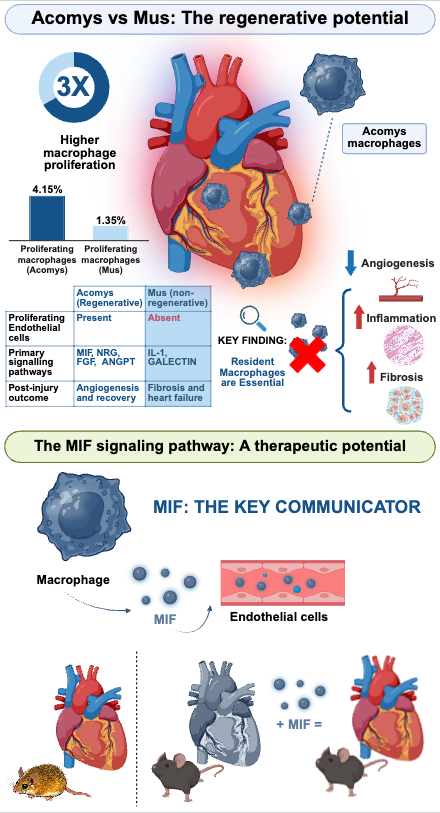
Abstract Body: The adult mammalian heart lacks regenerative capacity after injury, leading to heart failure. Unlike most adult mammals, Acomys preserves myocardial structure following ischemic injury. We tested the hypothesis that Acomys cardiac resident macrophages promote cardioprotection through a pro-angiogenic response. We depleted cardiac resident macrophages in Acomys using anti-CD115 antibody prior to myocardial infarction. Cardiac function was assessed by echocardiography (mixed-effects analysis; n=4-5/group; p<0.001 vs. control), and capillary density and fibrosis were quantified histologically (unpaired t-test; n=4-5/group; p<0.01 vs. control).
Macrophage depletion impaired cardiac function (EF 31±7%, FS 29±3%), worsened remodeling, and reduced angiogenesis in ischemic (85.7%) and peri-infarct (33.3%) regions. Bulk RNA-seq demonstrated increased pro-inflammatory and pro-fibrotic gene expression with reduced pro-angiogenic signaling following depletion. Comparative snRNA-seq in Acomys and Mus revealed enhanced macrophage-endothelial crosstalk and higher expression of angiogenic secretomes in Acomys after injury. CellChat analysis identified augmented MIF signaling with macrophages as dominant signal senders.
MIF overexpression in Mus improved cardiac function (EF 54±9%, FS 24±6%) and increased peri-infarct capillary density (76.2%), whereas MIF antagonism in Acomys had no significant functional effect, suggesting pathway redundancy in regenerative species.
These findings identify resident macrophages as central mediators of post-injury vascular preservation in Acomys. Gain-of-function insights highlight MIF potential as a target to modulate innate immunity post-injury. Targeting single pathways may be insufficient in Acomys species with inherent regenerative abilities. Current studies in our laboratory are exploring the underlying pathways that enhance angiogenesis in Acomys.
  • Alzamrooni, Afnan  ( University of Michigan , Ann Arbor , Michigan , United States )
  • Chaudhary, Rajesh  ( University of Michigan , Ann Arbor , Michigan , United States )
  • Shabani, Parisa  ( University of Michigan , Ann Arbor , Michigan , United States )
  • Singh, Anand  ( University of Michigan , Ann Arbor , Michigan , United States )
  • Lopez-schenk, Rachel  ( University of Michigan , Ann Arbor , Michigan , United States )
  • Suhan, Tahra  ( University of Michigan , Ann Arbor , Michigan , United States )
  • Patel, Komal  ( University of Michigan , Ann Arbor , Michigan , United States )
  • Abdel-latif, Ahmed  ( University of Michigan , Ann Arbor , Michigan , United States )
  • Author Disclosures:
Meeting Info:

Basic Cardiovascular Sciences 2026

2026

Boston, Massachusetts

Session Info:

Poster Session 3

Wednesday, 07/15/2026 , 04:30PM - 07:00PM

Poster Session and Reception

More abstracts on this topic:
A mechanism whereby SGLT2 inhibitor dapagliflozin reverses cardiac diastolic dysfunction in a model of HFpEF

Liu Man, Liu Hong, Kang Gyeoung-jin, Kim Eunji, Neumann Mitchell, Johnson Madeline, Murikinati Ruthvika, Dudley Samuel

Biophysical Conditioning of hiPSC Cardiomyocyte-Dense 3D Engineered “Bioelectric Threads” Improves Alignment and Conduction

Jamal Benjamin, Roser Stephanie, Zhang Xinai, Soepriatna Arvin, Matsunaga Madilyn, Choi Bum-rak, Coulombe Kareen

More abstracts from these authors:
PF8380-mediated Autotaxin Inhibition Ameliorates HFpEF Phenotype by Reducing LPA-mediated Systemic Inflammation and Cardiac Remodeling.

Chaudhary Rajesh, Robbins Andrew, Singh Anand, Shabani Parisa, Alzamrooni Afnan, Suhan Tahra, Lopez-schenk Rachel, Collins Nicholas, Abdel-latif Ahmed

Circulating suPAR Promotes Diastolic Dysfunction in Metabolic HFpEF

Singh Anand, Goonewardena Sascha, Hayek Salim, Abdel-latif Ahmed, Shabani Parisa, Chaudhary Rajesh, Ismail Anis, Luther Tahra, Alzamrooni Afnan, Nho Matthew, Lopez-schenk Rachel, Soni Chetna

You have to be authorized to contact abstract author. Please, Login
Not Available