Photobiomodulation Therapy (PBM) Attenuates Age-Associated Arterial Stiffness and Preserves Left Ventricular Performance in Aged Mice
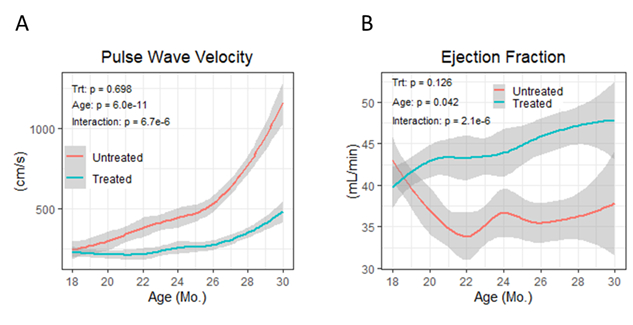
Abstract Body: Introduction: Arterial stiffening is a central driver of cardiovascular aging, increasing left ventricular (LV) afterload, promoting hypertrophy, and accelerating functional decline. Interventions that reduce age-associated vascular stiffening may prevent secondary cardiac remodeling and preserve performance. Photobiomodulation (PBM) has demonstrated remarkable therapeutic effects in various disease models, but its impact on arterial aging is unknown. Hypothesis: We assessed the hypothesis that chronic low-dose PBM initiated at midlife attenuates arterial stiffness and thereby preserves LV structure and function during advanced aging. Methods: 18-month-old, males and female C57 mice (n=132), were randomly selected to receive either near infrared light (NIR, 850nm) at 25 mW/cm2 (4.5 pJ/cm2 or 1 Einstein), for 2 min on weekdays (Treated group) or no NIR (Untreated group) for 12 months. Serial echocardiography and vascular sonography studies were performed every 2 months. Aortic pulse wave velocity (PWV), thoracic aortic fractional diameter change (TA-FC) and carotid artery fractional diameter change (CA-FC) were measured as indices of arterial stiffness. Interactions between treatment and age were analyzed using two-way mixed ANOVA. Results: In untreated mice, aging significantly increased aortic PWV and reduced TA-FC and CA-FC (p<0.05), indicating progressive arterial stiffening. These changes were accompanied by increased LV mass, wall thickness, and end-systolic volume, and reduced ejection fraction, cardiac output, and cardiac index (all p<0.05). PBM significantly blunted the age-associated rise in PWV and decrease in TA-FC and CA-FC (p<0.05) and preserved aortic compliance (Fig.A). Concomitantly, PBM attenuated LV hypertrophy and wall thickening and reduced end-systolic volume (p<0.05). Importantly, PBM prevented the decline in LV ejection fraction (Fig.B), cardiac output, and cardiac index observed in untreated mice (p<0.05). Histological analysis demonstrated increased elastic lamina thickness in treated mice aortas (p<0.05). Median survival was modestly extended by 0.9 months (log-rank p=0.18). Conclusions: Chronic PBM initiated at midlife attenuates age-associated arterial stiffening and preserves LV performance during advanced aging. These findings suggested that PBM could be a noninvasive strategy to mitigate cardiovascular aging in clinical practice.
Ahmet, Ismayil
(
NIH
, Baltimore , Maryland , United States )
Riordon, Daniel
(
NIH
, Baltimore , Maryland , United States )
Morrell, Christopher
(
NIA
, Parkville , Maryland , United States )
Lakatta, Edward
(
National Institute on Aging
, Baltimore , Maryland , United States )