
Logo

American Heart Association

  62
  0


Final ID: Wed072

Impact of myocardial infarction severity on biomechanical remodeling of the left ventricle

Abstract Body: Introduction: Myocardial infarction (MI) leads to functional and structural deterioration in the left ventricle (LV). Understanding the relationship between LV biomechanical remodeling and cardiac decompensation post-MI relies on models that can consistently produce a wide spectrum of LV remodeling, including both mild and severe levels. This study presents an MI animal model to investigate LV biomechanical remodeling at two levels of infarct severity, myocardial stress, and ejection fraction (EF) over time, which is critical for assessing LV biomechanics-function relationship post-MI.
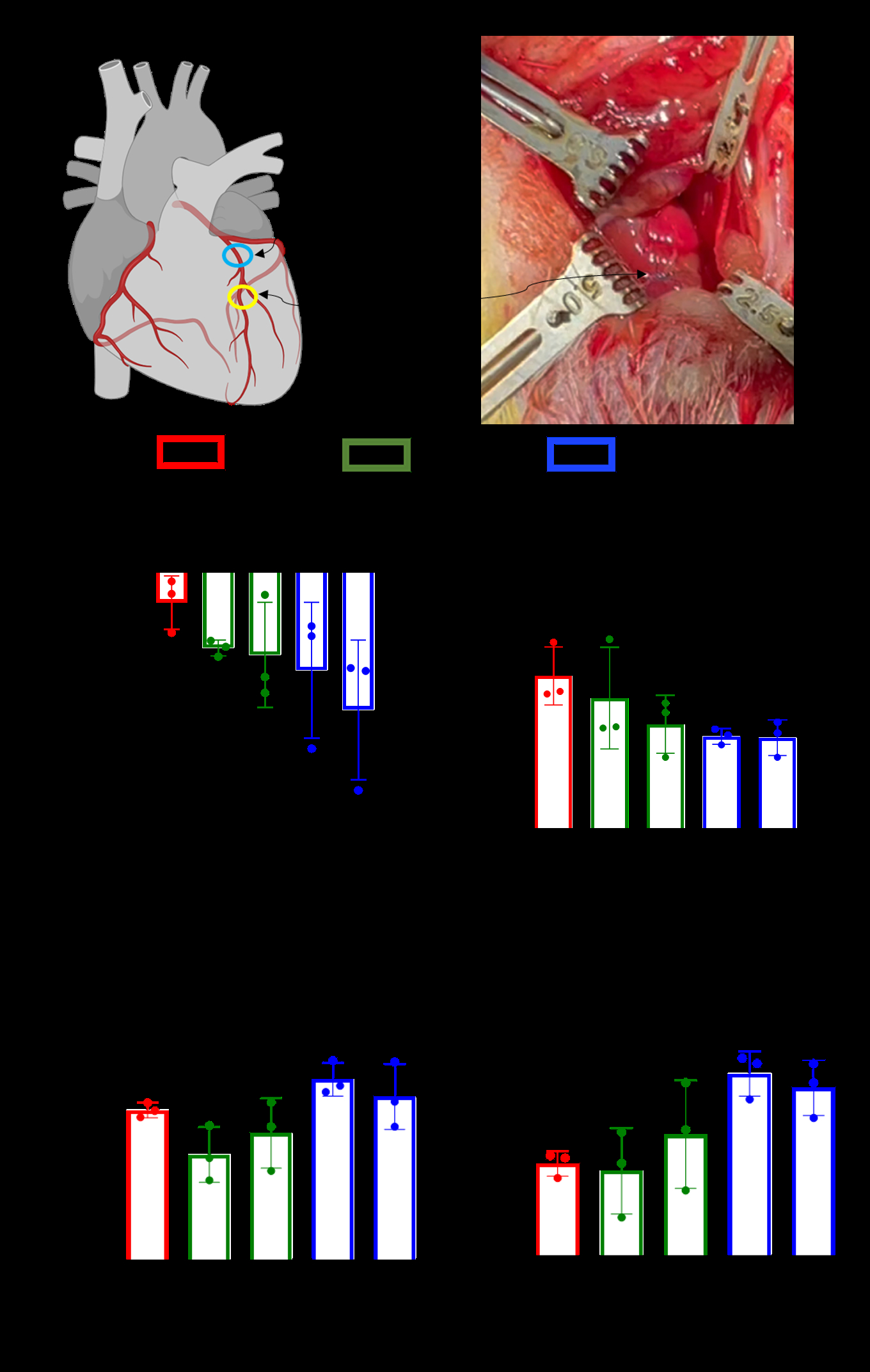
Method: MI was induced in male, 8-week-old WKY rats (n=6) by ligating the left anterior descending (LAD) artery at different locations. Severe MI was created by ligation within 2 mm below the left atrium (LA), while mild MI was induced 3–4 mm below the LA (Figs. 1A, B). EF was measured using echocardiography before and after MI. Biaxial mechanical testing assessed circumferential and longitudinal myocardial stresses, and anisotropy was calculated as the circumferential-to-longitudinal stress ratio. The impact of infarct severity was evaluated by comparing EF, myocardial stress, and anisotropy trends at 2- and 4-week post-MI relative to sham. Statistical analyses were performed to quantify these trends and assess the progression of biomechanical remodeling.
Results: EF for both mild and severe MI groups tended to show a progressive decline over time, with a greater reduction in severe MI (Fig. 1C). Myocardial anisotropy was the highest in sham and tended to decrease with infarct severity, with the lowest value observed in severe MI at 4-week post-MI (Fig. 1D). The loss of tissue anisotropy was driven by an increase in longitudinal stresses compared to sham. These increases were more pronounced in severe MI compared to mild MI (Fig. 1E).
Conclusion: Animal models with a controllable severity of MI are needed to determine the LV biomechanical mechanisms driving LV decompensation post-MI. Severe MI, with a greater EF reduction, exhibited a more pronounced loss of tissue anisotropy compared to mild MI. Future studies will examine the potential role of diminishing tissue anisotropy in triggering LV decompensation post-MI.
  • Mehdi, Rana  ( Texas AM University , Bryan , Texas , United States )
  • Neelakantan, Sunder  ( TAMU , College Station , Texas , United States )
  • Xiang, Qian  ( Texas Heart Institute , Houston , Texas , United States )
  • Zhang, Xiaoxiao  ( Texas Heart Institute , Houston , Texas , United States )
  • Vanderslice, Peter  ( Texas Heart Institute , Houston , Texas , United States )
  • Avazmohammadi, Reza  ( Texas AM University , College Station , Texas , United States )
  • Author Disclosures:
    Rana Mehdi: DO NOT have relevant financial relationships | Sunder Neelakantan: DO NOT have relevant financial relationships | Qian Xiang: DO NOT have relevant financial relationships | Xiaoxiao Zhang: No Answer | Peter Vanderslice: DO have relevant financial relationships ; Consultant:7 Hills Pharma, Inc.:Active (exists now) ; Advisor:7 Hills Pharma, Inc.:Active (exists now) ; Individual Stocks/Stock Options:7 Hills Pharma, Inc.:Active (exists now) ; Ownership Interest:7 Hills Pharma, Inc.:Active (exists now) | Reza Avazmohammadi: DO NOT have relevant financial relationships
Meeting Info:

Basic Cardiovascular Sciences 2025

2025

Baltimore, Maryland

Session Info:

Poster Session and Reception 1

Wednesday, 07/23/2025 , 04:30PM - 07:00PM

Poster Session and Reception

More abstracts from these authors:
Role of left ventricular anisotropy in the outcome of myocardial infarction: Insights from a rodent model

Neelakantan Sunder, Mendiola Emilio, Mehdi Rana Raza, Xiang Qian, Zhang Xiaoxiao, Myers Kyle, Vanderslice Peter, Avazmohammadi Reza

Viscoelastic remodeling of the left ventricular myocardium in myocardial infarction

Neelakantan Sunder, Mehdi Rana Raza, Xiang Qian, Zhang Xiaoxiao, Vanderslice Peter, Avazmohammadi Reza

You have to be authorized to contact abstract author. Please, Login
Not Available