Logo

American Heart Association

  59
  0


Final ID: Thu126

Cell-Type-Specific Role of PDE5A in Atherosclerosis and Its Therapeutic Potential

Abstract Body: Introduction: Atherosclerosis is a major contributor to cardiovascular diseases. Phosphodiesterase 5A (PDE5A) regulates cGMP levels and plays a critical role in cardiovascular health. PDE5A inhibitors, such as sildenafil, are widely used in clinical practice. Observational clinical studies and genetic evidence suggest that PDE5A inhibition may offer protective effects against ischemic heart disease; however, its precise role and underlying mechanisms in atherosclerosis remain poorly understood.

Aim: This study investigates the role of Pde5a in atherosclerosis using smooth muscle cell (SMC)- and endothelial cell (EC)-specific knockout mouse models, complementary in vitro models, and human carotid atherosclerotic plaque analyses.

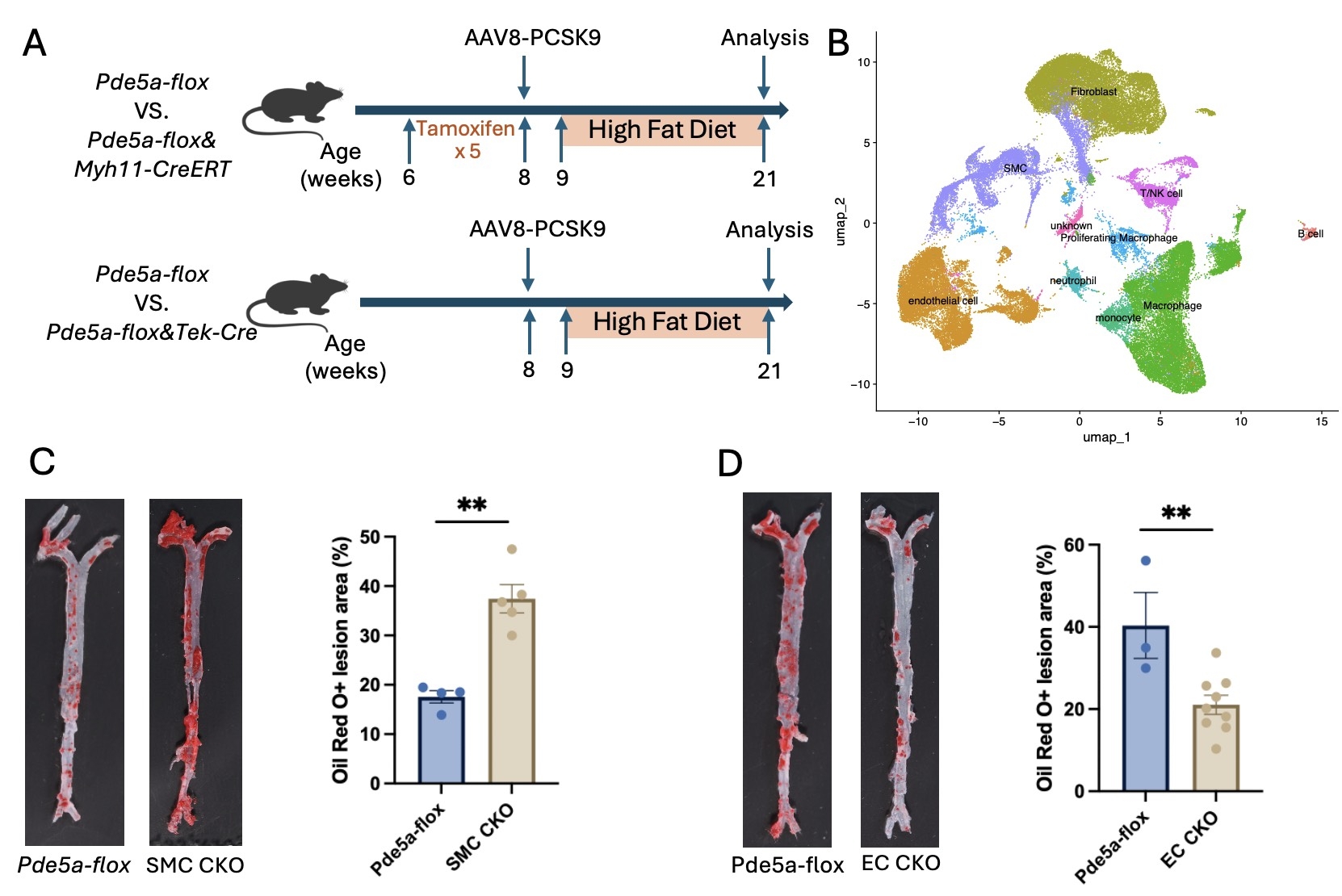
Methods: SMC-specific and EC-specific knockout mice were generated by crossing Pde5a-flox mice with Myh11-creERT and Tek-cre mice, respectively. Atherosclerosis was induced via AAV-PCSK9 injection and a 12-week high-fat diet, with Pde5a-flox mice serving as controls (Figure A). Single-cell RNA sequencing of atherosclerotic mouse aorta tissue was performed to explore the underlying mechanisms (Figure B). In parallel, siRNA-mediated knockdown of pde5a was performed in human ECs, followed by bulk RNA sequencing to identify affected molecular pathways. PDE5A expression in human carotid atherosclerotic plaques was analyzed using immunofluorescence staining.

Results: A 4-week treatment with sildenafil significantly reduced atherosclerotic lesions in mice. Immunostaining demonstrated that PDE5A is primarily expressed in SMCs and ECs within atherosclerotic plaques. SMC-specific Pde5a deletion led to a significant increase in lesion area (n=5, Figure C, p<0.01), whereas EC-specific deletion resulted in a significant reduction in lesion size (n=9, Figure D, p<0.01). These effects occurred independently of serum cholesterol and LDL levels. Moreover, PDE5A knockdown in human ECs significantly upregulated KLF2 and KLF4, two key atheroprotective transcription factors.

Conclusions: Our findings reveal a cell-type-specific role of Pde5a in atherosclerosis, with its deletion exacerbating lesion formation in smooth muscle cells but reducing it in endothelial cells, likely via KLF2 and KLF4 upregulation. These results highlight the cell-type-dependent effects of PDE5A and suggest that repurposing FDA-approved PDE5A inhibitors for atherosclerosis-related disorders warrants further investigation.
  • Feng, Yuyao  ( Peking Union Medical College Hospital, Peking Union Medical College, Chinese Academy of Medical Sciences , Beijing , China )
  • Lai, Zhichao  ( Peking Union Medical College Hospital, Peking Union Medical College, Chinese Academy of Medical Sciences , Beijing , China )
  • Zhao, Hongmei  ( Institute of Basic Medical Sciences, Chinese Academy of Medical Sciences, Peking Union Medical College , Beijing , China )
  • Liu, Bao  ( Peking Union Medical College Hospital, Peking Union Medical College, Chinese Academy of Medical Sciences , Beijing , China )
  • Chen, Junye  ( Institute of Basic Medical Sciences, Chinese Academy of Medical Sciences, Peking Union Medical College , Beijing , China )
  • Xiao, Xingqi  ( Institute of Basic Medical Sciences, Chinese Academy of Medical Sciences, Peking Union Medical College , Beijing , China )
  • Mao, Qilong  ( Institute of Basic Medical Sciences, Chinese Academy of Medical Sciences, Peking Union Medical College , Beijing , China )
  • Kong, Deqiang  ( Peking Union Medical College Hospital, Peking Union Medical College, Chinese Academy of Medical Sciences , Beijing , China )
  • Yang, Jie  ( Institute of Basic Medical Sciences, Chinese Academy of Medical Sciences, Peking Union Medical College , Beijing , China )
  • Xue, Yunfei  ( Institute of Basic Medical Sciences, Chinese Academy of Medical Sciences, Peking Union Medical College , Beijing , China )
  • Zhu, Zhan  ( Peking Union Medical College Hospital, Peking Union Medical College, Chinese Academy of Medical Sciences , Beijing , China )
  • Shu, Keqiang  ( Peking Union Medical College Hospital, Peking Union Medical College, Chinese Academy of Medical Sciences , Beijing , China )
  • Author Disclosures:
    Yuyao Feng: DO NOT have relevant financial relationships | Zhichao Lai: No Answer | Hongmei Zhao: No Answer | Bao Liu: No Answer | Junye Chen: No Answer | Xingqi Xiao: No Answer | Qilong Mao: No Answer | Deqiang Kong: No Answer | Jie Yang: No Answer | Yunfei Xue: No Answer | Zhan Zhu: No Answer | Keqiang Shu: No Answer
Meeting Info:

Basic Cardiovascular Sciences 2025

2025

Baltimore, Maryland

Session Info:

Poster Session and Reception 2

Thursday, 07/24/2025 , 04:30PM - 07:00PM

Poster Session and Reception

More abstracts on this topic:
Aging-Associated Lymphatic Dysfunction Drives Cardiac Injury During Chronic H1N1 Infection

Shi Yanxi, Xiao Chunyang, Roh Jason, Yu Paul, Griffith Jason, Roh Kangsan, Xia Peng, Lee Ahlim, Yang Zihui, Cottrell Victoria, Kim Meehyun, Xu Jia Han, Sangam Shreya, Gipson Gregory, Castro Claire

A hepatic steatosis-mediated metabolite reprograms macrophage lipid metabolism and aggravates atherosclerosis

Long Ting, Feng Ruijia, Feng Weiqi, Peng Guiyan, Yang Wenchao, Li Zilun, Huang Kan, Chang Guangqi

You have to be authorized to contact abstract author. Please, Login
Not Available